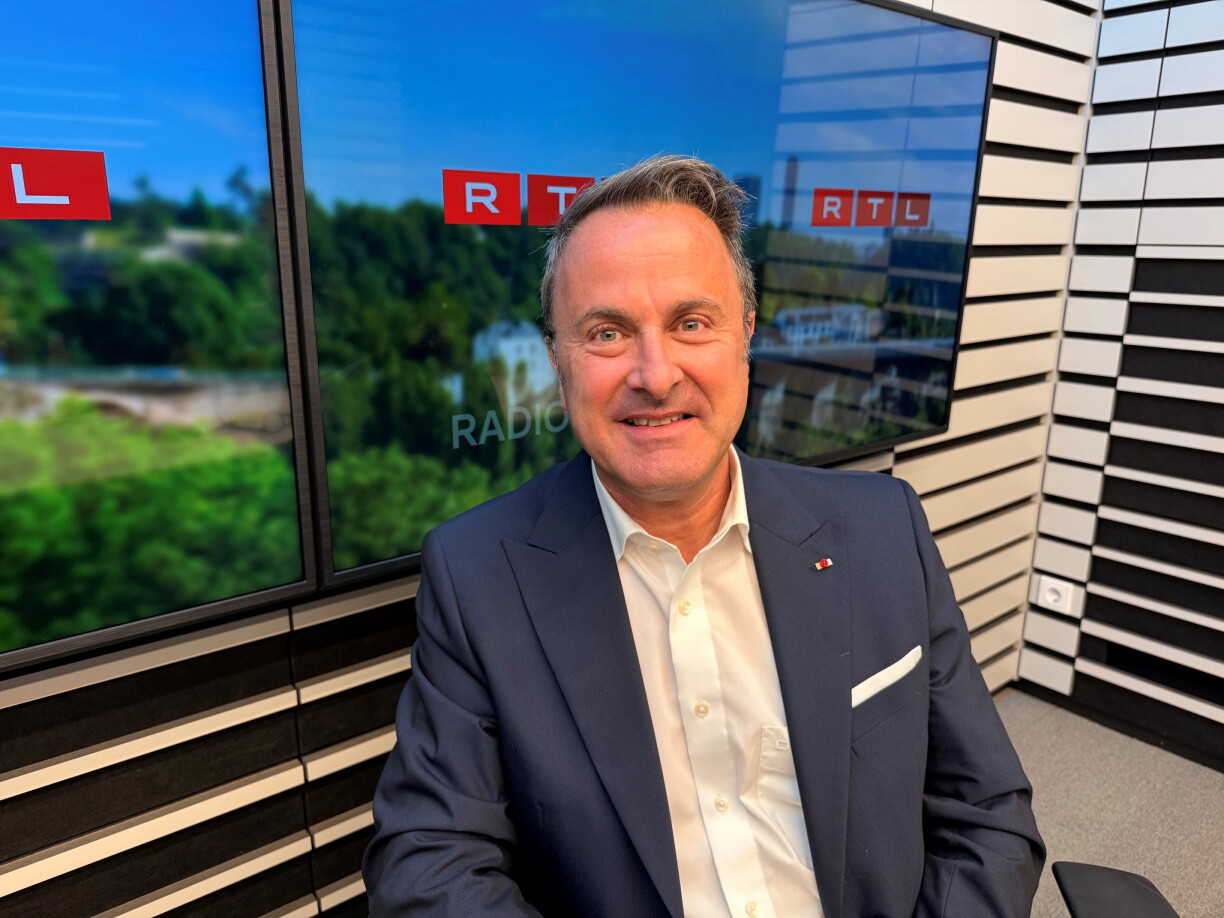
Foreign Minister Xavier Bettel spoke with RTL Radio on Tuesday morning, following Monday's meeting of EU foreign ministers in Luxembourg.
The agenda included further sanctions against Russia, but the EU continues to struggle to agree on sanctions against Israeli ministers. Asked why measures against Israel were proving more difficult than those targeting Russia, Bettel pointed to the unanimity rules that apply to a number of sanctions decisions.
He said several countries had wanted to force a vote on Monday, but that calculations showed there might not even have been a majority, let alone unanimity. In the end, EU foreign policy chief Kaja Kallas was tasked with preparing an analysis and putting forward proposals on possible measures.
Bettel said he was being transparent in admitting that there was also disagreement within the European Commission itself. According to him, some commissioners are prepared to go further, while others are not.
Luxembourg and a number of other countries pushed for at least some measures to be examined, including against Israeli National Security Minister Itamar Ben-Gvir, whom Bettel described as an extremist whose behaviour was unacceptable. He also referred to possible measures concerning products from settlements and settlers themselves.
Bettel stressed that settlers are often accompanied by Israeli soldiers, which, in his view, means that such policies are effectively being supported. He said the EU had now asked the Commission to do its homework and that proposals had been promised for July, although he noted that similar promises had already been heard in recent months.
The Foreign Minister said he could not guarantee that unanimity, or even a majority, would ultimately be reached on certain questions.
Asked what was holding other EU countries back, Bettel said he did not understand many of the arguments he heard. He stressed that he was not calling for all Israelis to be condemned, but said the behaviour and proposals of Ben-Gvir were unacceptable.
He referred in particular to Palestinian farmers losing access to land from one day to the next: "If we simply accept this, then we become complicit."
Bettel said Luxembourg had also examined, together with Belgian and other colleagues, whether products from such areas could be banned. However, he said they had been told that national measures would not be compatible with European law and that EU-level guidelines were needed.
He described the situation as a "political pandemonium", saying Europe's rules were designed for when everything is going well, but that their weaknesses become clear when problems arise.
The interview also returned to an exchange Bettel had last week at the Nexus conference with a Palestinian activist, who criticised the organisers for inviting Israeli start-ups. Bettel had responded by drawing an analogy with calls during the Second World War not to shop in Jewish-owned businesses.
The activist later criticised him, arguing that he did not distinguish between Judaism and Zionism, and that criticism of the Israeli government was not antisemitism.
Asked where legitimate political criticism of Israel ends and antisemitism begins, Bettel said the first thing to note was that the activist appeared to have come with people ready to film the exchange, which, in his view, suggested an intention to provoke a clash rather than contribute constructively.
He said he had been informed by his services that the companies invited by the organisers had been screened and that there was no suspicion they had been involved in any condemnable actions. Bettel argued that objecting to their presence simply because they were Israeli risked implying that no Israeli companies should be present at all.
He stressed that not everyone living or working in Israel supports the current Israeli government or its policies. He also warned against the frequent conflation of Israelis and Jews, saying this is one way in which antisemitism is currently spreading.
At the same time, Bettel said he also rejects being labelled antisemitic whenever he criticises the Israeli government. He said the two issues must not be thrown into the same pot: not every Israeli or Jewish person supports the Israeli government, and criticising that government does not automatically make someone antisemitic.
Turning to the war in Ukraine, Bettel said he was not on the ground, but observed that Russian forces were stalling. While attacks continue and people are dying every day, he said Russia no longer appeared to be making real progress in conquering the territory it wants.
However, he stressed that a solution is needed, with a ceasefire as the first step. Bettel said Ukraine must enter any negotiations from a position of strength and that such negotiations must include Ukrainians themselves. He noted that many discussions so far had taken place without Ukrainians or Europeans at the table, despite Ukrainian President Volodymyr Zelensky asking for Europe to be involved.
Bettel defended his earlier suggestion that Jean-Claude Juncker could play a role in seeking a ceasefire. He said Juncker had proved he was capable, was not seeking a Nobel Prize, and did not have the kind of ego that would make him want to outshine current prime ministers or heads of state.
The interviewer then played Juncker's response, in which the former Commission president had said the EU did not have a fully unified position and that those currently responsible should assume responsibility.
Bettel responded that he was talking about a ceasefire, not Ukraine's future EU membership. He maintained that Juncker had the charisma and personality to speak with the relevant protagonists and help bring about a ceasefire more quickly than many current office-holders.
On Ukraine's EU accession, Bettel said he remained cautious. He argued that criteria must apply and that Ukraine should not be given a fast-track route to membership simply because it is at war.
He noted that other candidate countries, including those in the Balkans, could otherwise feel they would need a war to join the EU more quickly. In his view, the rules should apply to all.
Bettel was also asked about his role as Minister for Foreign Trade and about the next World Expo, which falls within his portfolio. Paulette Lenert has been mentioned as the designated candidate to become commissioner for the Luxembourg pavilion.
Bettel confirmed that he would propose Lenert for the role to the Government Council. He said such posts had previously been held by figures such as Robert Goebbels, Maggy Nagel, and Marc Hansen in the last edition, and argued that it was important to appoint a woman given that the World Expo is held in Saudi Arabia.
He added that a former deputy prime minister carries weight in countries where such titles matter.
He said Lenert had expressed interest in the position and that he hoped the decision could be taken by the Government Council the following week. Bettel described her as the "right person in the right place", saying she had already proved what she was capable of during their time working together.
Bettel confirmed that she would begin in his Foreign Trade department on 1 July and said preparations were already under way for her office. "And I look forward to working with Ms Lenert", he emphasised.





