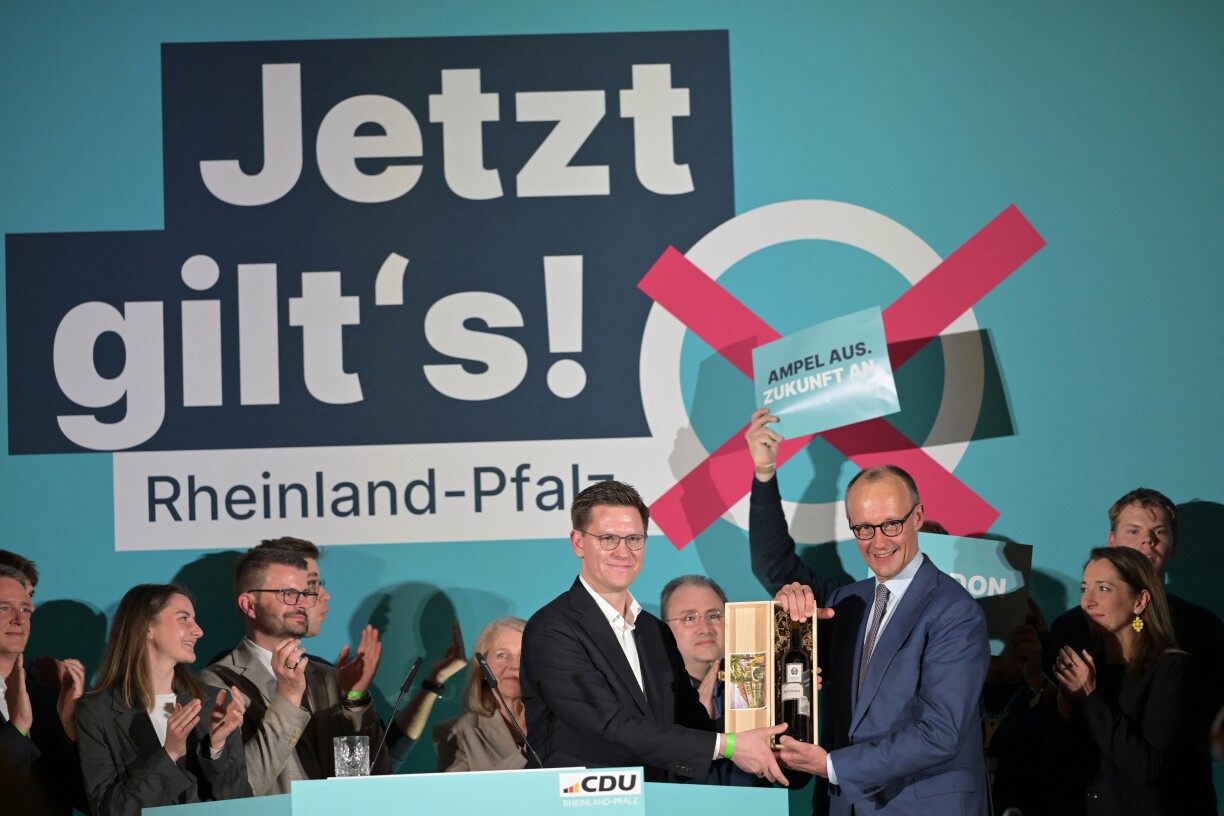
German Chancellor Friedrich Merz's conservatives look set to oust the centre-left Social Democratic Party on Sunday in a closely watched state election in which the far right also made big gains, according to exit polls.
Merz's Christian Democratic Union (CDU) took around 30 percent of the vote and looks poised to win the western state of Rhineland-Palatinate after 35 years under the SPD, which took 27 percent, according to two public TV networks' exit polls.
The far-right Alternative for Germany party (AfD) meanwhile looked set for a record score in western Germany, with around 20 percent, according to the polls from ARD and ZDF television.
AfD co-leader Alice Weidel hailed the result -- more than double the insurgent anti-immigration party's score in the state's last elections -- as a "great success", in a message on X.
The AfD looks set to pose a bigger threat to the two centrist parties in several state elections in September in the country's ex-communist east.
CDU candidate Gordon Schneider meanwhile claimed victory and vowed to bring change in the state's education, security, health and economic policy.
The CDU had enjoyed a narrow lead in opinion polls over the SPD, their coalition partners at the national level.
The state of Rhineland-Palatinate, bordering France, Belgium and Luxembourg and with a population of about four million, is known for its steep river valleys, many lined with vineyards and topped by castles.
It is also home to heavy industry, including steelmakers and chemicals giant BASF, and hosts several US military facilities, including the sprawling Ramstein Air Base.
Outgoing SPD premier Alexander Schweitzer, 52, had campaigned in hopes of holding together his coalition with the Greens and liberal Free Democrats.
But Schnieder, 50, now looks poised to bring his party back in power there for the first time since 1991.
If the final numbers confirm a CDU victory, it would be a shot in the arm for Merz, who has faced poor popularity ratings and struggled to meet his campaign pledge of rebooting Europe's biggest economy after years of stagnation.
Merz had campaigned with Schneider -- brother of his transport minister, Patrick Schnieder -- but stressed the state election should not distract the CDU and SPD from their government cooperation at the national level.
Losing the onetime SPD stronghold would be a setback for Germany's traditional labour party, whose fortunes have faded in recent years amid a string of bitter electoral defeats.
Nationally, the SPD hit a historic low point last year, when ex-chancellor Olaf Scholz led them to their worst result in more than a century -- 16.4 percent -- in a February 2025 election.
Nationally, the AfD is now polling neck-and-neck with the CDU, with both at around 25 percent.
Josephine, a 20-year-old student, said she voted to prevent "a slide to the right".
"We have to make sure we don't go in a direction that history has already shown us, and we must preserve what we have built in recent years," she said as she voted in Mainz, the region's capital.
In September, voters in eastern Germany will take part in several state elections, with the AfD expected to perform particularly well and potentially claim outright majorities.
Any alliance with the AfD remains taboo in the country, with all other parties refusing to cooperate with the far right.
The CDU faced a bitter defeat earlier this month in the larger state of Baden-Wuerttemberg, where missteps squandered a large lead in the polls to allow the Greens to claim victory.





