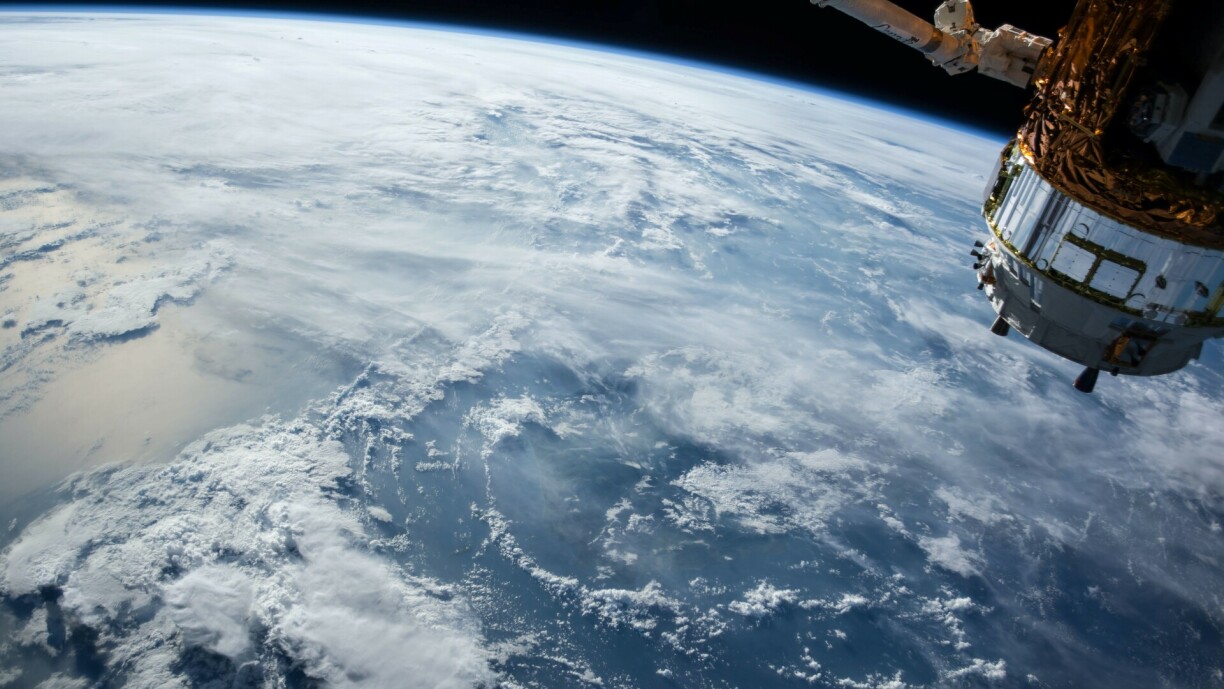
In light of the soon to be published US congressional report on UFOs, we also asked Mr Serres if they ever noticed unexplained events here in Luxembourg.
Mr Serres, could you briefly introduce yourself?
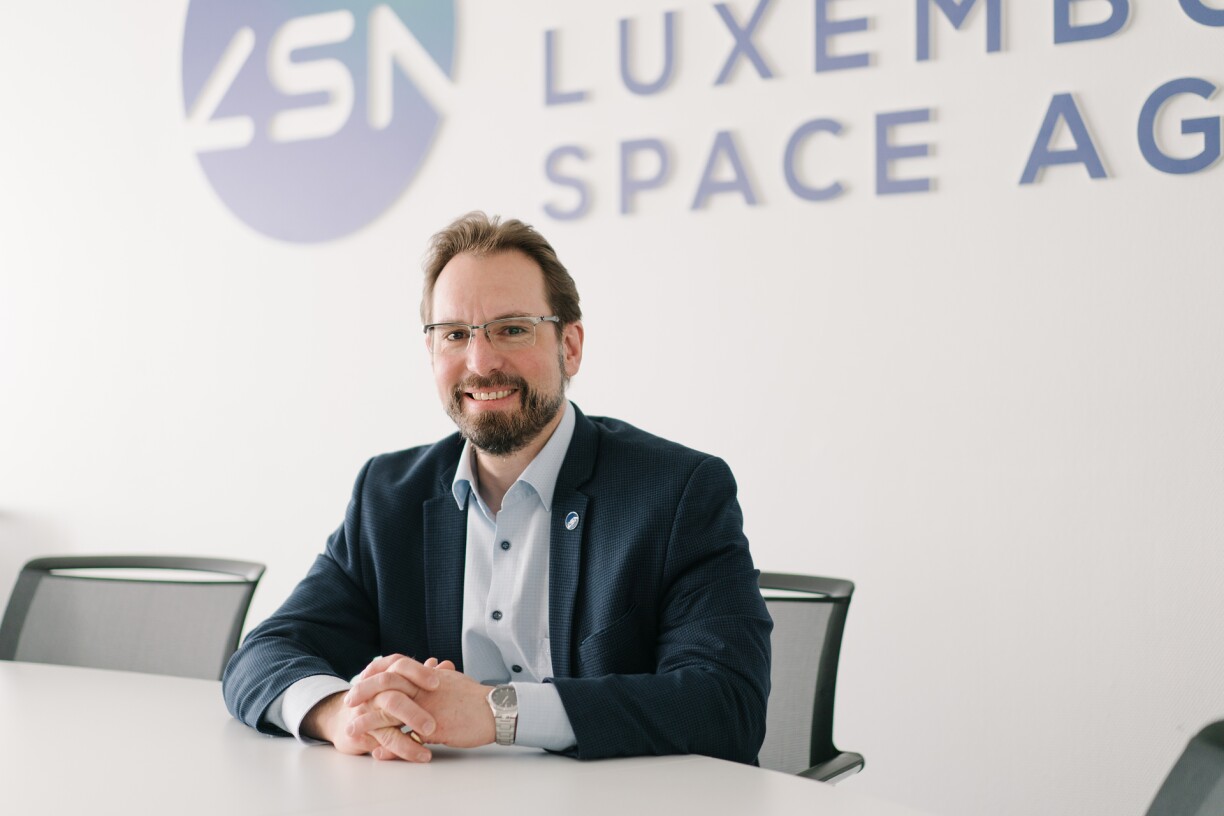
I am the CEO of LSA, which, I must admit, is something that when I started my career, I never thought of being. It is a very exciting job. I have a background in engineering and telecommunication but I never thought that I would start in the domain of space, especially not in Luxembourg.
People who are not familiar with Luxembourg's economic history might find it, let's say interesting, that the country invests in space. Could you explain how it came to that?
The driver for this development has been the diversification of the economy. Politicians have identified space as an opportunity to create something new in Luxembourg. Back when SES (editor’s note: provider of network solutions powered by satellites) was created in 1985, the government took a certain risk, because SES was a private satellite operator, which led to a big debate. At the beginning, SES had been the central point of the ecosystem. Now, having these types of private operators is totally normal and the public sector is not involved anymore in this type of services.
The fact that Luxembourg has then become a member of ESA (in 2005) was a door opener to further support innovation. Now, we have many companies and initiatives in Luxembourg that are not related to SES anymore. There are around 60 space-related start-ups in Luxembourg and almost 1000 people are employed in the space sector. In our last national action plan you can see that this sector now represents 1.5 % of Luxembourg’s GDP, which is a lot compared to any other European country.
It means that we are already successful but this is not enough for us, we will go beyond that.
What else does Luxembourg Space Agency do, could you briefly explain?
It may be a little bit surprising to have a space agency in a small country like Luxembourg, but one has to understand that our agency is atypical. Usually, space agencies are scientifically driven, for example NASA or ESA. The character of LSA is different, as we don’t have our own scientific missions. Our main mission is to support the diversification of Luxembourg’s economy, by developing the space ecosystem.
We stimulate our ecosystem to develop more commercial activities. The support of our national LuxIMPULSE programme, implemented by ESA, allows companies to develop their own products and services. Our space landscape consists of very diverse players with a large range of capabilities, products and services with which they enter the international market.
The field of application is multifaceted
Our actors here are very diversified. Some develop specific hardware that is used in space. For example, they build components or software for satellite manufacturing. There is one company that even builds entire satellites. Other companies are developing services using space data to provide information to their customers.
Nowadays, a number of applications are using data from space in combination with other sources.
Many of those are useful in daily life.
For example, the generated data can be used in the insurance sector, for disaster recovery, in the field of agriculture, in view of climate change or in the transport sector.
In agriculture for instance, it is possible to determine the level of maturity of plants from space. It means that it is possible to determine the ideal moment to harvest. You can also anticipate droughts and regulate water supplies accordingly.
Your agency is leading the spaceresources.lu initiative, could you tell us a bit more about this?
It is an initiative that started in 2016 and again, it came as a big surprise to the public as nobody ever thought that Luxembourg would position itself on a topic like this.
The initiative is an important long-term component of our strategy since at the moment, the activities that have been carried out were of a rather scientific nature.
We have identified that there will be a turning point regarding the origin of resources used in space.
We see that space brings more and more benefits to our earth ecosystem and more and more activities are taking place in space.
Several bigger nations want to travel to the surface of the Moon to carry out more sustainable and permanent activities. However, the future of space exploration very much depends on the capabilities we have to use the existing local resources. A sustainable human presence on Mars or the Moon for example, will only be possible if we are able to use in-situ resources.
Current missions are one-way robotic missions in a limited timeframe.
If at some point we were able to manage to use the space resources, then this could lead to think about other, less traditional activities like space mining for example.
The idea for Luxembourg is to be well positioned for the future: We don’t know exactly when it will happen, but when it does, we will be a part of it.
In 2020, Luxembourg signed the Artemis Accord, another milestone of their engagement in space. One of the accord’s goals is to return humans to the moon by 2024 and to set up a manned lunar base by 2030. With the US and it’s NASA leading, the accord was signed by Australia, Canada, Italy, Japan, United Arab Emirates, the UK and Luxembourg. Could you tell us why Luxembourg joined the accord?
The US is working towards a new space station, which at some point could make it possible to send astronauts, also from other nations, to the surface of the moon. Together with an industrial partner based in Luxembourg we are in discussions with NASA now, to see which mission we could be joining, and we will know more about that after the summer.
The very first missions would be “demonstration missions”, during which we will test and validate existing technologies and which will mainly focus on identifying the available resources on the Moon.
What types of resources do you hope to find?
On the Moon, you can find all the resources that we have on Earth as well. Some scientists say that the (geological) conditions on Earth exist because of asteroids that at some point crashed onto the Earth. To name a few, there are resources such as metal, water and other volatiles. The sand that you find on the surface of the Moon – named regolith- could for example be used as building material.
In a first study, which is available on our website we suggest that the water of the Moon could be used to refuel all sorts of spacecrafts. It would then be possible to use the Moon as an intermediate station to go to Mars.
Mr Serres, just recently, ESA closed their call for candidates to become one of their astronauts. Will we potentially see a Luxembourger on the Moon?
I know that there are candidates from Luxembourg, but we will have to see the results of the selection campaign for European astronauts. If someone from Luxembourg were to be selected, then she or he would participate under the ESA flag as part of an international mission with astronauts from other countries.
Since you work with both NASA and ESA, have you ever noticed conflicts of interests?
No, I haven’t.
Nonetheless, when you look globally, there are geopolitical aspects to take into consideration, for example when it comes to China, Russia. Presently, we manage to deal with these without any issues. As long as the projects are mainly of scientific interest, we will find ways to work together.
What is your perspective on the recent developments in the US – the upcoming US congressional report about “unidentified aerial phenomena”?
This would be a potential topic for bigger agencies but I have to say that we did not look into it as we are concentrating on the current mission of LSA.
Does LSA have a control room, from which it is possible to observe any types of events in space?
No, we don’t, but SES for example has a fantastic control centre, which is one of the largest ground stations in Europe. They might have a view on these phenomena.
Could you tell us about LSA's engagement with the youth here?
Through Esero (editor’s note: ESERO Luxembourg is co-funded nationally by the Luxembourg Space Agency and the Ministry of Education, Children and Youth.) we have a number of initiatives, some of them for primary and some for secondary schools.
In Luxembourg, the Luxembourg Science Center is hosting our ESERO office. The main objective is to provide educational material and resources for the teachers to use during their regular curriculum, like stem courses for instance.
Together with the University of Luxembourg, we also initiated an “Interdisciplinary space master”.
The Young Graduate Training Programme provides young graduates with traineeship opportunities within ESA.
Of course, our approach with the young graduates program is a little bit selfish, as we hope that the young people, after having gained experience during their internship at ESA, come back to Lux….which does not always work… (laughs).
What are the future goals of the agency?
We continue to work on new ideas and by the end of this year, we hope to introduce an exciting new one.





