Could you imagine being friends with someone who has completely different political views from you? Absolutely not. Probably not. Maybe. Probably. Absolutely.
This is a sample question that can be used in surveys to measure societal polarisation, i.e. how divided we are as a society.
The more responses are located at the extremes, the more polarised a society is. The more responses cluster towards the centre, the less polarised it is.
Judging by social media comment sections, you might think we're deeply polarised. Issues like identity, migration, climate change, and the Middle East often feature two opposing camps locked in conflict. There is little tolerance, consensus, or willingness to compromise and insults are used instead of arguments. There also seem to be more and more people voting for the far right or far left.
So should we be concerned? Is our consensus-based democracy coming to an end?
The good news is that science paints a far more nuanced picture. And polarisation also has positive effects. But we must make sure that it doesn't become too excessive, otherwise it becomes dangerous.
Which countries are very polarised? What trends are emerging? And what is the situation in Luxembourg?
These are the key points we have summarised in this episode of Ziel mir keng!. We based our analysis among others on the assessments of Dr Christophe Lesschaeve and Josip Glaurdić from the University of Luxembourg.
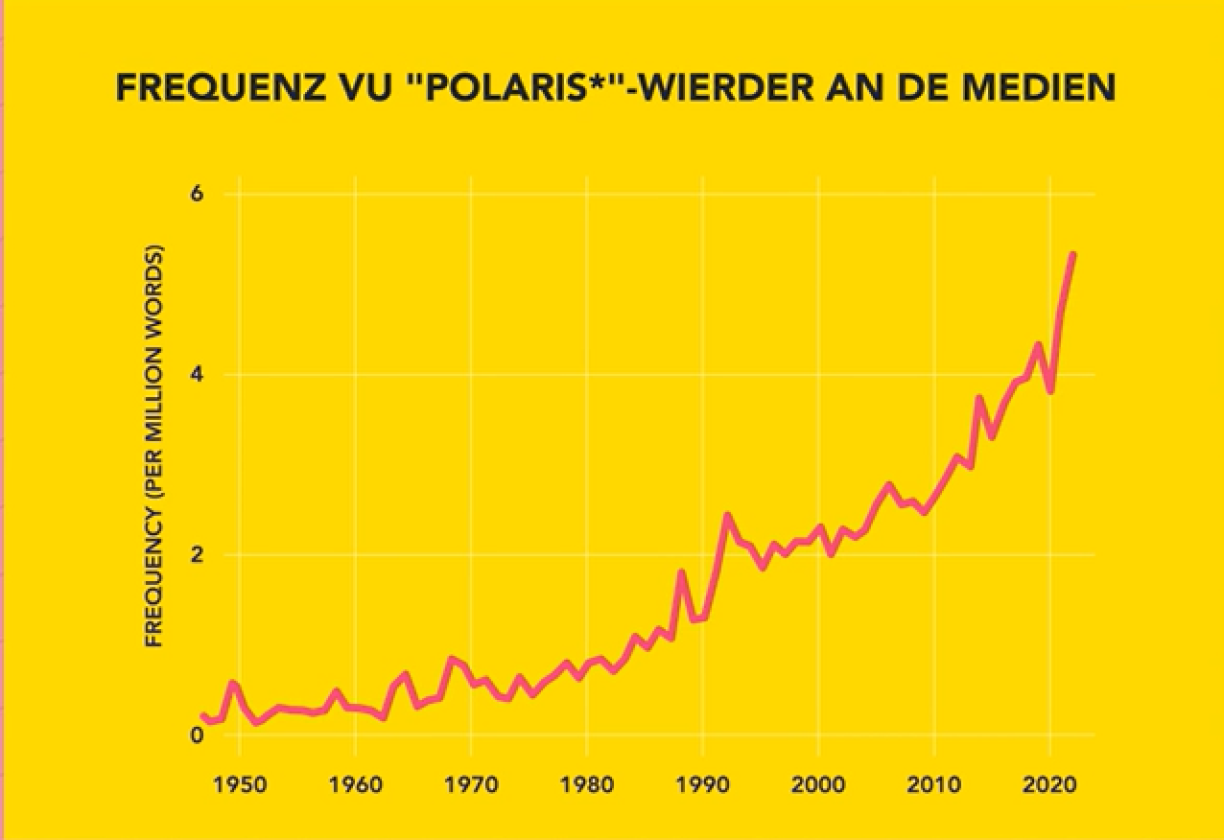
Research shows that terms like 'polarisation' or 'polarise' are appearing more frequently in the media.
This chart, for instance, shows how frequently these words appeared in the German press.
However, this data doesn't necessarily mean that society has become more polarised – just that polarisation is discussed more often.
In science, polarisation is an indicator of the degree of divergence between opinions and positions.
We can think of it like a thermometer.
Let's take a fictional example of how people position themselves between left and right on a political spectrum. When most people cluster in the centre with few at the extremes, polarisation is low. But when populations shift sharply to the far left and far right with hardly anyone in between, polarisation is high.


This example illustrates political or ideological polarisation – in other words, the political positions of policymakers or voters. Other examples include progressive versus conservative, or internationalism versus nationalism.
However, there is also social polarisation, in other words between various sections of society. For example young versus old, rich versus poor.
Then there's also emotional or affective polarisation, where people strongly favour members of their own group while hating others.
At extreme levels, yes! It can fuel aggression, erode trust between groups of voters or political leaders, paralyse institutions or weaken faith in the social system because debate becomes impossible while solutions and compromises become increasingly rare.
But polarisation also has its upsides, provided it isn't excessive: it sparks political debate and mobilises voters. What's more, a democracy must also be able to tolerate minority and dissenting opinions to some extent. Without differing opinions, a society would become stagnant and unable to progress.
The question is – and this hasn't been definitively answered yet – at what point polarisation becomes excessive, to the extent that the negative effects begin to outweigh the benefits.
That's why researchers are attempting to measure polarisation. This is done, for example, through surveys, psychological experiments, or analyses of elections, party manifestos, online comments, or media coverage.
So what's the situation now?
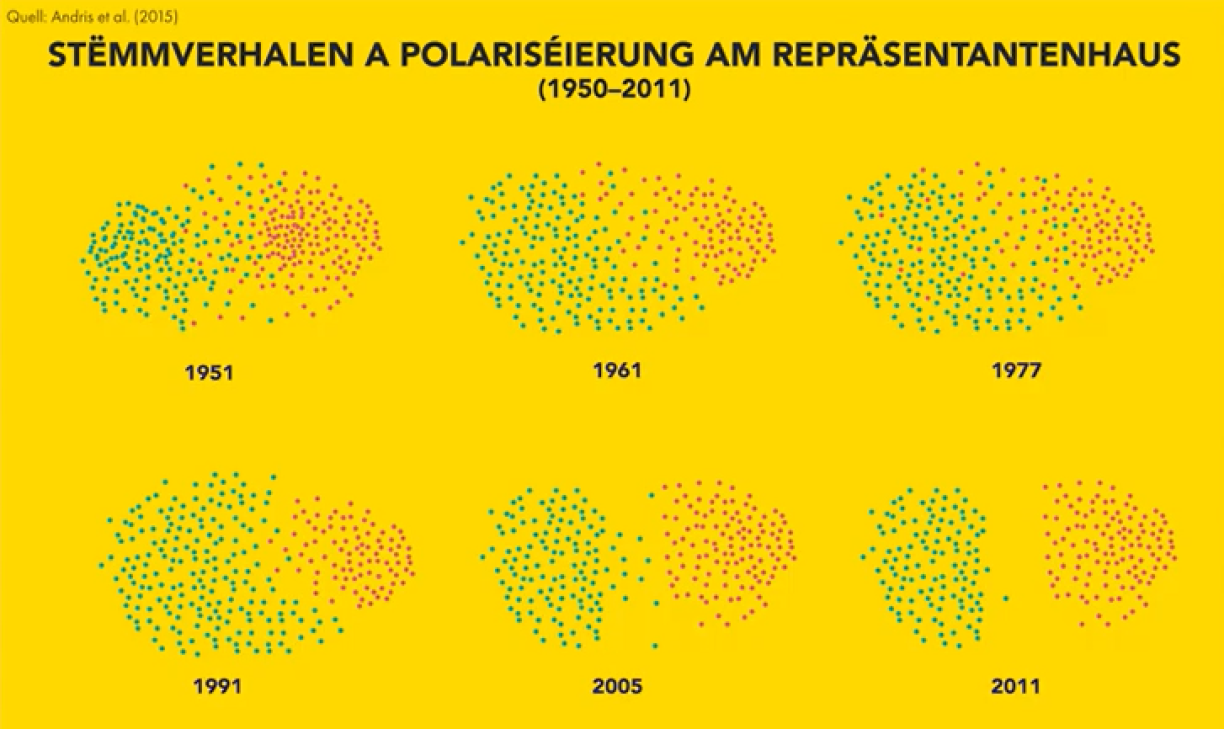
In the US, numerous studies confirm that polarisation is clearly increasing. This chart, for example, tracks voting patterns of Democrats and Republicans in the House of Representatives over the past decades. While the 1950s showed significant ideological overlap, two distinct political camps have since emerged with dwindling common ground.
While Europe, on the other hand, presents a more complicated picture.
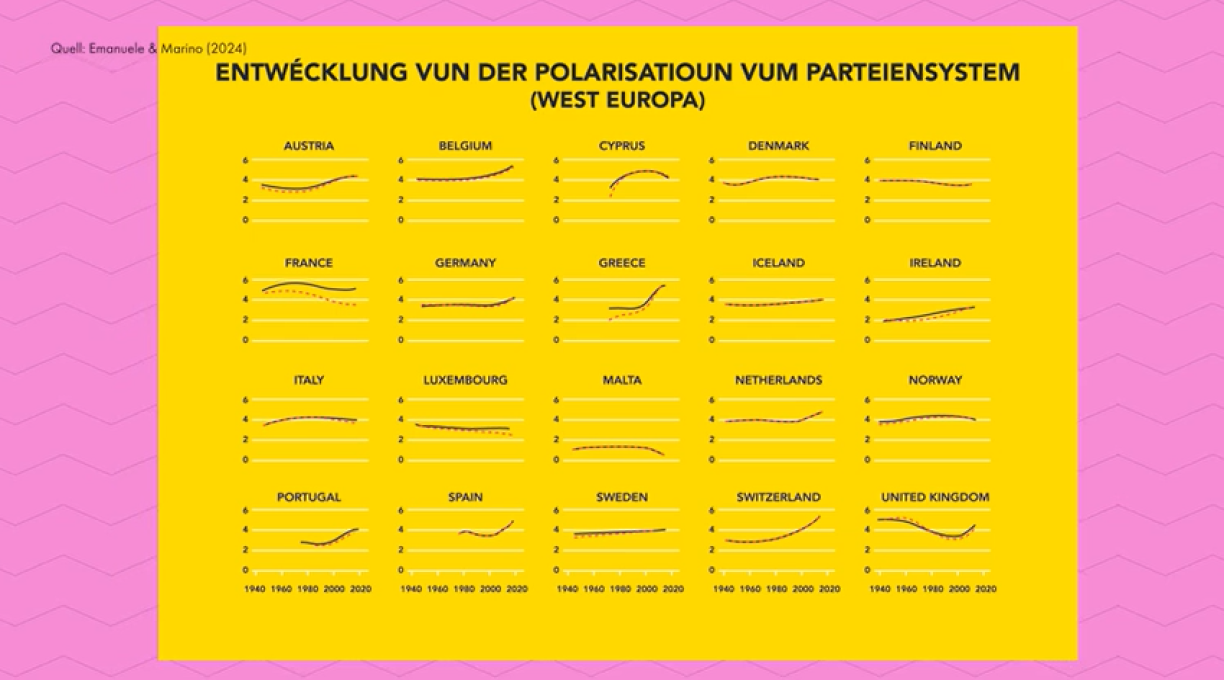
This graph tracks party system polarisation across countries over time, measured on a scale of 0 to 6. We can see high polarisation in France and the Netherlands, lower levels in countries such as Malta and Luxembourg, rising trends in Switzerland and Belgium, and a downward trend in Luxembourg. So there's a variety of different situations.
For affective polarisation – measuring emotional attitudes towards members of our group versus members of other groups – the situation is also very mixed.
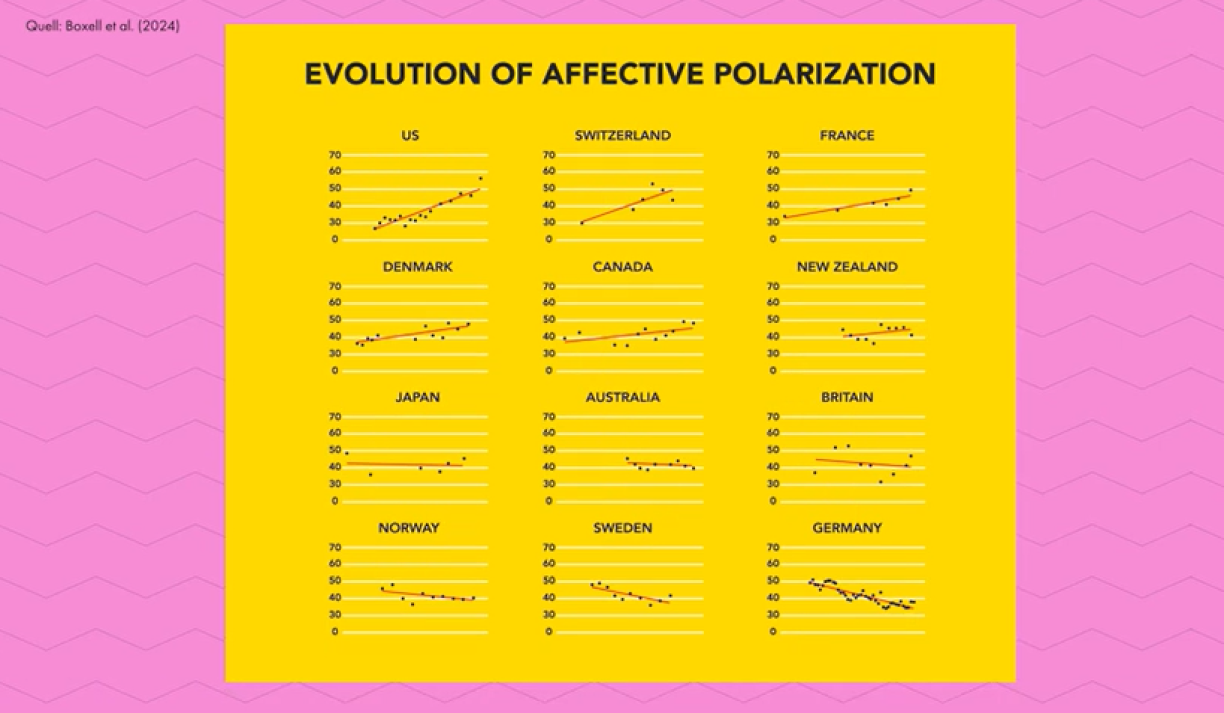
Clear increases appear in the US, Switzerland, and France, while Norway, Sweden and Germany show a downward trend.
So no, polarisation isn't rising constantly and uniformly across the entire Western world.
Moreover, even though the studies mentioned above were published recently, the data only covers the period up to 2019 or 2020. But a lot has happened since then, for example the COVID-19 pandemic, Russia's invasion of Ukraine, and various elections in Europe where extreme parties gained many votes.
More recent expert assessments up to 2024 suggest that political and societal polarisation in the EU has continued to rise since 2019.
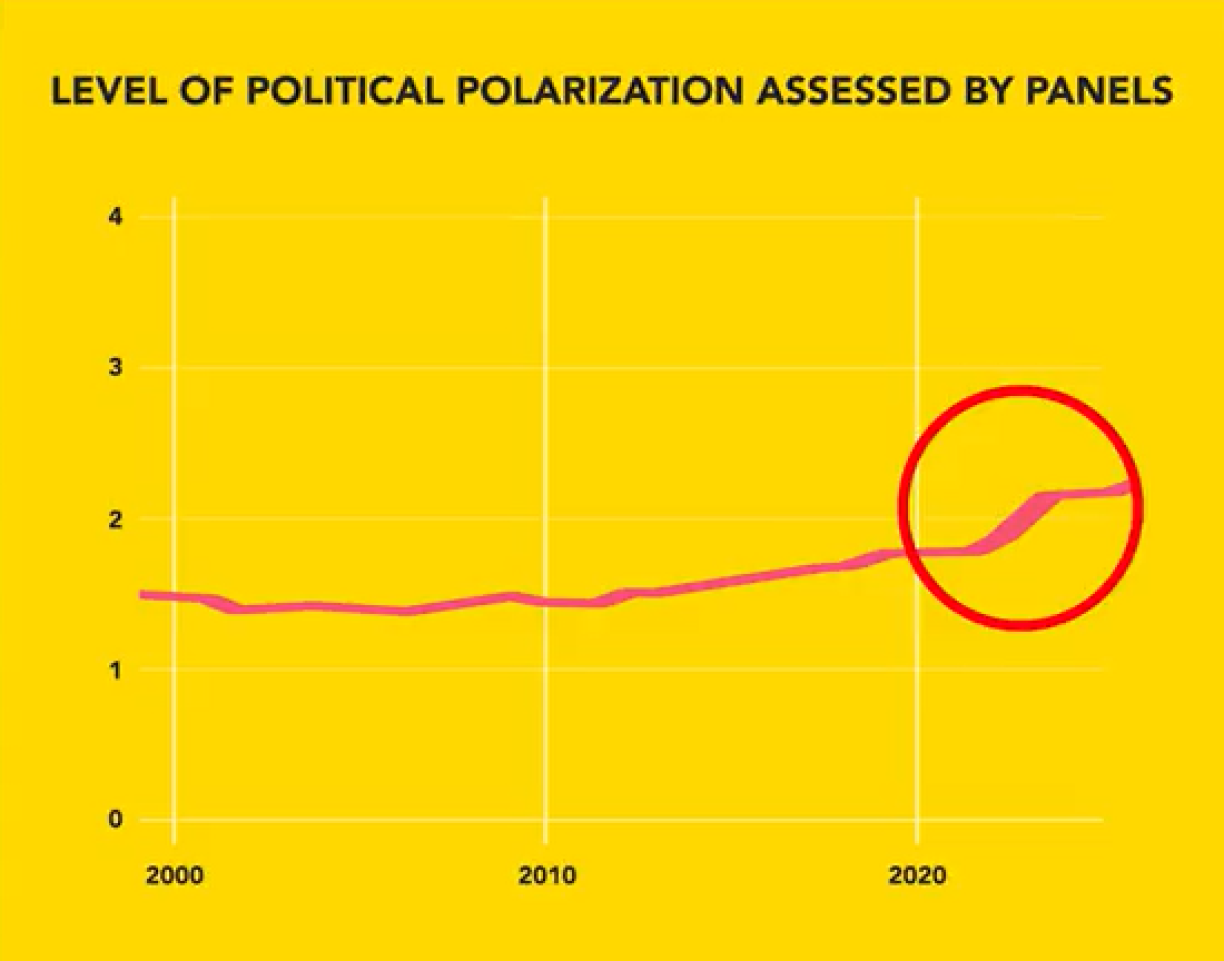
Current political polarisation in Europe is now approaching 1970s levels. It is higher than in the 1990s and 2000s, but below the level from the 1930s.
Other research further confirms this recent trend.
Incidentally, it's not that mainstream parties have become more extreme, but rather that voters have moved away from centrist parties, says researcher Dr Christophe Lesschaeve from the University of Luxembourg.
He warns that since 2010, polarisation has increasingly coincided with party fragmentation and voter volatility. This combination could become dangerous.
Additionally, since 2010, Western Europe has seen surging support for anti-establishment parties.
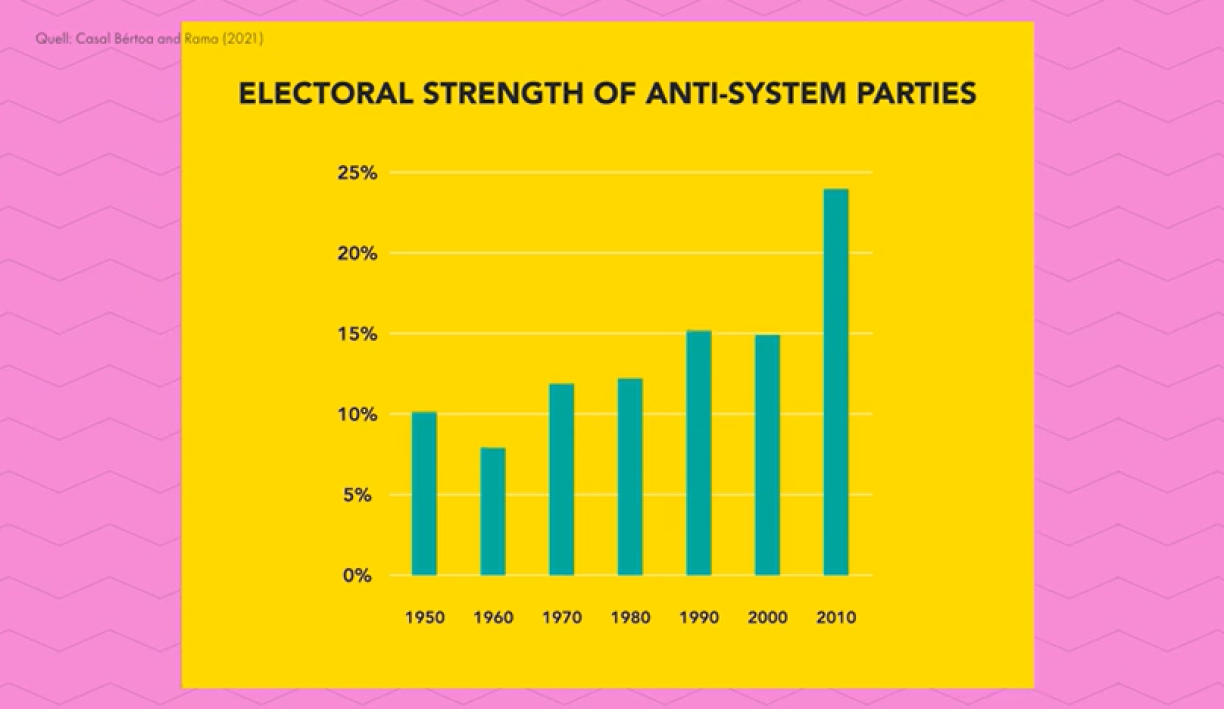
However, it should be noted that despite recent increases, the level of political polarisation in Europe remains substantially lower than in the US.
We've yet to talk about the reasons for high polarisation. One that comes up a lot is social media. However, research has not yet been able to establish a clear link. The fact that polarisation has not increased in every country since the introduction of social media doesn't really support this idea.
Researchers are also discussing a whole range of other potential causes, such as populism, fake news, and growing inequalities.
Studies and surveys suggest that Luxembourg is less polarised than many other European countries. And researcher Christoph Lesschaeve from the University of Luxembourg says that Luxembourg is bucking the trend of increasing polarisation. According to him, Luxembourg's party landscape is comparatively moderate from an ideological perspective, with inter-party divisions actually narrowing slightly.
Yet risks remain – such as economic inequality that could fuel the polarisation between rich and poor.
Polarisation isn't all bad. And contrary to common perception, it's not increasing universally or constantly worldwide. However, data from recent years does show growing polarisation trends, at least in the US and Europe. Luxembourg has largely resisted this trend – at least until now. And it's well known that beyond a certain point, polarisation has more negative than positive effects. It can even become quite dangerous!
If polarisation serves as our democracy's thermometer, then it's down to us to make sure the temperature doesn't get too high.
On that note: let's engage in a discussion and listen to one another, without shouting!

Ziel mir keng! is broadcast on Sunday evenings after the programme Wëssensmagazin Pisa on RTL Tëlee and is a collaboration between RTL and the Luxembourg National Research Fund. You can also watch the episodes on RTL Play.
Author: Jean-Paul Bertemes (FNR)
Peer review and advice: Josip Glaurdić, Christophe Lesschaeve (University of Luxembourg)
Background research: Daniel Saraga
Editing: Michèle Weber, Didier Goossens (FNR)
Video: SKIN
Translation: Nadia Taouil (www.t9n.lu)





