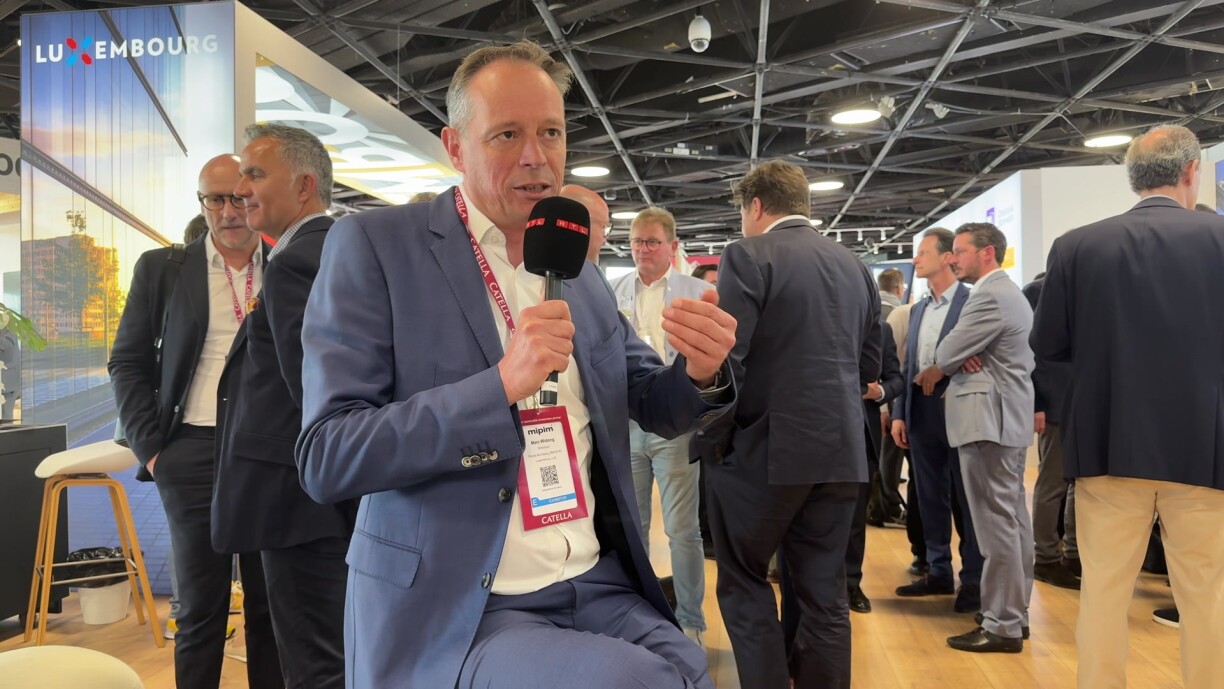
Marc Widong, director of the Fund for the Urbanisation and Development of Kirchberg (FUAK), discussed with RTL the future Midfield district, upcoming construction projects in Kirchberg, and the importance of strong Luxembourg representation at the International Market for Real Estate Professionals (MIPIM) in Cannes.
65 years after being tasked with urbanising and developing the Kirchberg plateau, the role of the fund has evolved, although its core mission remains largely unchanged. Recently, the FUAK was entrusted with the construction of the Midfield district, a project located between the municipalities of Hesperange and Luxembourg City.
Widong described the project as both a "great opportunity" and a "sign of confidence". The district is expected to accommodate nearly 5,000 residents, along with offices, a secondary school, and several public buildings.
The scale of the project is significant, although construction is not expected to begin for another four to five years, according to Widong. At this stage, Widong confirmed that the Lycée technique du Centre will be built in the northern part of the district, adding that it will become one of the largest secondary schools in the country.
Office space for the property branch of the national railway CFL is also planned. As for the future of the P+R South car park, Widong explained that it will remain in place but that it will be redesigned as an underground parking facility, allowing space above ground for a sports or cultural complex.
Widong stated that all possible solutions are being studied to ensure the Midfield district is as "pleasant and practical" as possible. The proximity of the A3 motorway Luxembourg had long raised concerns for the project, but Widong explained that part of the motorway will be covered to address the issue of noise.
These works will be carried out by the National Roads Administration, according to Widong. Housing will also be designed and positioned in a way that reduces exposure to traffic.
"Our expertise is now extending beyond Kirchberg", Widong noted, adding that this reflects growing trust in the FUAK's capabilities. However, the organisation still has much to accomplish within the district itself. Between projects at Kuebebierg and developments such as JFK South, Langfur, and Grünewald West, the FUAK has a full programme for at least the next 15 years.
"There is still a great deal to build in Kirchberg", Widong confirmed when asked about possible projects outside the district.
He also explained that housing built by the fund is sold under a 99-year leasehold system. These properties will therefore not return to the FUAK anytime soon, although the situation is different for office buildings, some of which have already reverted to the FUAK, according to Widong. When that happens, decisions must be made about the future use of both the land and the buildings.
Widong said that the question then becomes whether to continue using them in the same way or to redevelop them entirely. According to him, this is why a long-term vision and strategy are essential. "Work never really stops", he noted.
He added that the strategy of the FUAK has evolved considerably since its creation in 1961. Today, the focus is much more on housing, Widong said, which was not necessarily the priority when major infrastructure such as the Red Bridge, the European institutions, and major banking headquarters were first established in Kirchberg.
At the time, the land largely consisted of fields that had to be prepared for development before projects such as the European School Luxembourg I, the Coque, and the Philharmonie Luxembourg could be built.
Current global developments also play a role. The war in the Middle East, rising energy costs, and the possibility of higher interest rates all affect the sector. While Widong acknowledged that interest rates are beyond the fund's control, he noted that the organisation can take measures to offset rising construction costs, as it did after the pandemic.
"We cap our prices", he explained, adding that this approach gives buyers and banks greater security and visibility regarding the potential costs that could arise in the event of a wider crisis.
Finally, as the interview took place at the Luxembourg pavilion during the MIPIM fair in Cannes, Widong was asked about the presence of the FUAK there. The delegation was not looking for investors but rather for expertise. Architects, engineers, and other professionals had the opportunity to meet with the fund's representatives to discuss possible participation in future projects.
"For real estate professionals, it's the place to be. For us it's a little different, but our schedule is still very full", Widong said. He concluded that spontaneous meetings in an informal setting also offer valuable opportunities.





