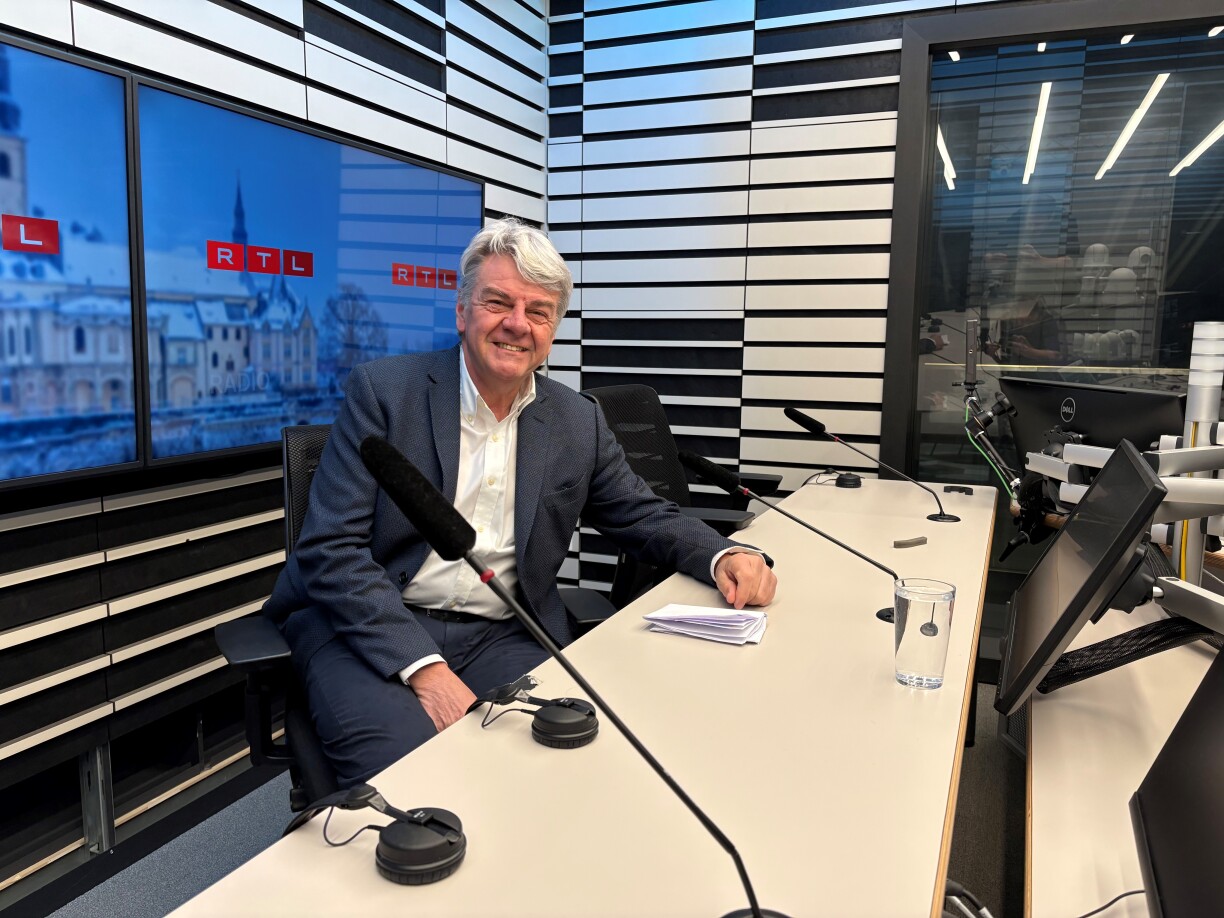
Wolff reacted to recent discussions involving union and employer representatives, including an RTL debate last week featuring Nora Back, president of the Independent Luxembourg Trade Union Confederation (OGBL) and Michel Reckinger, president of the Luxembourg Employers' Association (UEL). According to Wolff, the appointment of Marc Spautz as Labour Minister appears to signal a renewed effort to get social dialogue back on track.
He said Spautz had taken office with the stated aim of reactivating discussions between the social partners, adding that while concrete outcomes remain to be seen, there are reasons to believe progress is possible. The challenge, he noted, will be to balance competing interests fairly, as the Labour Minister must represent all sides rather than any single group.
The General Confederation of the Civil Service (CGFP) has made clear that it intends to remain fully involved in the Permanent Committee for Labour and Employment (CPTE). Wolff pushed back against suggestions that other unions should automatically take part in negotiations on public-sector wage agreements, arguing that the issue is governed by law and by representativeness.
He warned against attempts to create divisions between unions, saying such strategies benefit no one, neither private-sector workers nor civil servants. Wolff pointed to the most recent elections to the Chamber of Civil Servants and Public Employees, in which the CGFP won 24 of the 25 seats, as evidence of its clear national representativeness in the public service.
He stressed that the CGFP has consistently taken a pragmatic and responsible approach in negotiations, including during crisis periods such as the financial crisis and the Covid-19 pandemic, when the union refrained from making additional demands. In his view, this record undermines claims that civil servants' unions negotiate irresponsibly.
Wolff said the ongoing controversy could be resolved if the government, particularly the Minister for the Civil Service Serge Wilmes, were to publicly clarify their position on who should be involved in public-sector wage talks. He described this as a necessary step to bring the debate to an end.
On the issue of the minimum wage, Wolff said the CGFP shares the view that action is needed. He expressed surprise at proposals suggesting that public-sector wages should be excluded from reference calculations, noting that no such exclusion is foreseen by law.
According to Wolff, many people in Luxembourg depend on the minimum wage, making it essential to adjust it to current realities. He acknowledged the complexity of the debate, particularly given housing costs and pressure on labour-intensive sectors such as construction and hospitality, but insisted that improving pay for low-income workers remains a priority.
As a trade unionist, he said, his role is to stand up for workers, even if the discussion is difficult. From his perspective, inaction is no longer an option.
The conversation also touched on the widening pay gap between the public and private sectors. Wolff argued that higher average public-sector salaries reflect not only pay levels but also working conditions and responsibilities.
He rejected the idea that all public employees earn high wages, stressing that many civil servants are far below the often-cited median salary figures. In his view, if the state continues to recruit staff, it must offer conditions that reflect the importance of the roles involved.
Wolff also criticised the increasing use of private-law contracts in public institutions, particularly in newly created bodies. He cited the planned Luxembourg Agency for Medicines and Health Products as an example, questioning whether such a sensitive area should operate under private-law employment conditions.
He argued that many of the agency's future responsibilities are currently handled by the Directorate of Health, and said the CGFP had not been consulted on the employment framework. Wolff warned that if no progress is made during an upcoming "conciliation" meeting scheduled for Friday, the union would consider pursuing the matter further through formal procedures.
While no final decision has been taken, he said the CGFP is prepared to escalate the issue if necessary, stressing that meaningful social dialogue must start with consultation rather than unilateral decisions.
As of Monday morning, Wolff said no concrete signals had come from the government, suggesting a lack of willingness to reopen discussions. He expressed disappointment at what he described as a failure to engage with trade unions at an early stage.
For now, attention turns to Friday's meeting, which could prove decisive for this particular issue.





