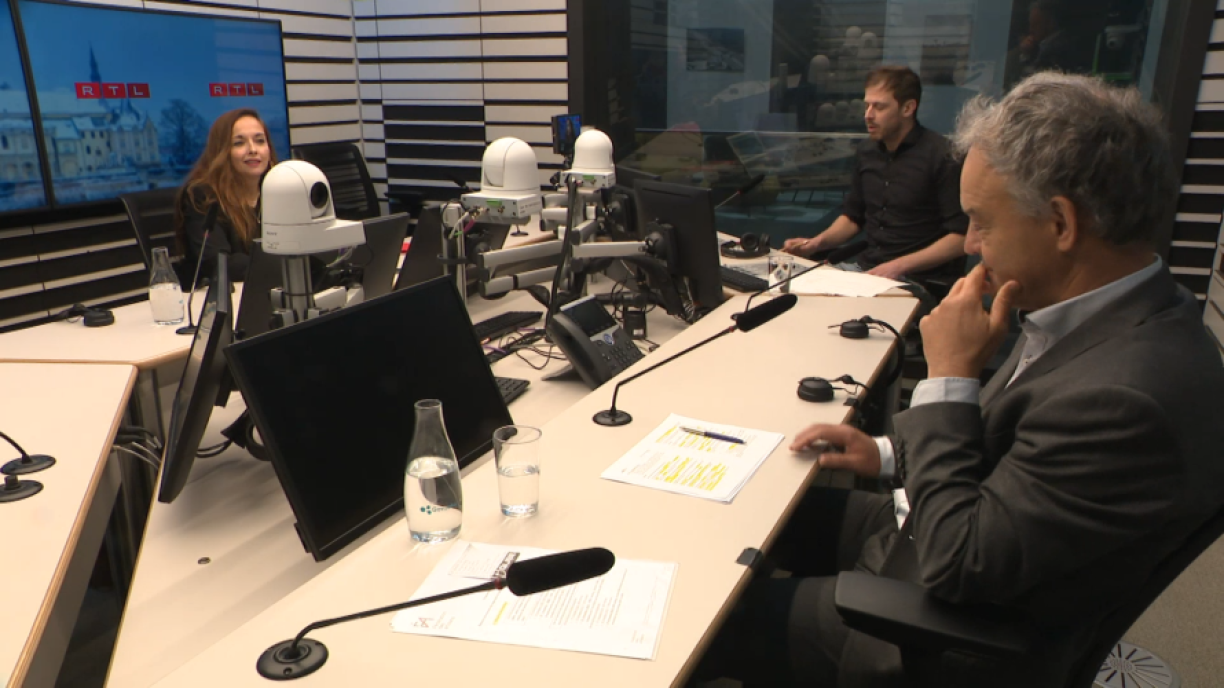
For the first time since the social talks held in July and September, trade union and employer representatives sat down together again, this time on RTL Radio.
Tensions have been high since October 2024, when the trade unions abruptly withdrew from a meeting of the Standing Committee of Labour and Employment (CPTE); this was followed by a withdrawal from the Committee in September 2025, in the wake of difficult social talks. Still, a number of issues stemming from the governing coalition agreement between the Christian Social People's Party (CSV) and the Democratic Party (DP) remain to be discussed, notably working-time organisation, the minimum wage, and the platform economy. All this is taking place against a backdrop of disruptive artificial intelligence, a changing international context, and a persistent housing crisis.
Both Nora Back and Michel Reckinger said on Saturday afternoon that the time had come to stop looking back and start looking ahead, as many challenges and difficult dossiers are still waiting to be addressed.
After months of tension, relations between union and employer representatives appeared more conciliatory on air, even though clear disagreements were still evident throughout the discussion. Asked whether the trade unions were ready to return to the table with employers in the CPTE, Back said they had always maintained their willingness to resume tripartite talks. She stressed that the Luxembourg social model depends on all three partners, but added that guarantees are needed to ensure that trade unions are genuinely taken seriously.
The sharpest differences remain over the minimum wage. According to Reckinger, it must not simply be increased automatically. He argued that economic growth is essential: a strong economy enables investment, job creation and, ultimately, the sustainability of the welfare state.
The two sides also disagreed on which reference incomes should be used to determine the minimum wage. Reckinger insisted that public-sector salaries should be excluded, arguing that their median level, around €9,000 per month, would push the reference too high. Back rejected this approach, saying such incomes could not simply be disregarded.
When asked whether he would personally like to take part in negotiations over public-sector pay agreements, Reckinger replied that this was not his role. However, he added that some restraint in public-sector pay would make sense, as the gap between private- and public-sector salaries continues to widen and is becoming increasingly difficult to bridge.
Reckinger also said he supported an increase in collective agreements, provided they resulted in a "win-win" situation for both employers and employees. However, he and Back disagreed on which aspects of working-time organisation should be defined by law. For Back, it is not possible to set one-size-fits-all legal rules, given the wide differences between sectors and companies.
Despite their differences, both sides agreed on one point: high housing costs are the main reason why many households struggle to make ends meet.
Reckinger argued that raising the minimum wage alone would not solve the problem. Back, meanwhile, insisted that good wages remain necessary, particularly in a context of labour shortages. For Reckinger, however, the priority must be to roll up one's sleeves and get the economy working properly again.
With relations between unions and employers appearing to improve, the question was raised as to whether the established united front between the OGBL and the Luxembourg Confederation of Christian Trade Unions (LCGB) is still needed. Back's answer was unequivocal: more than ever. Unity, she said, strengthens negotiating power and influence. As for the leadership of the UEL, no changes are currently planned.





