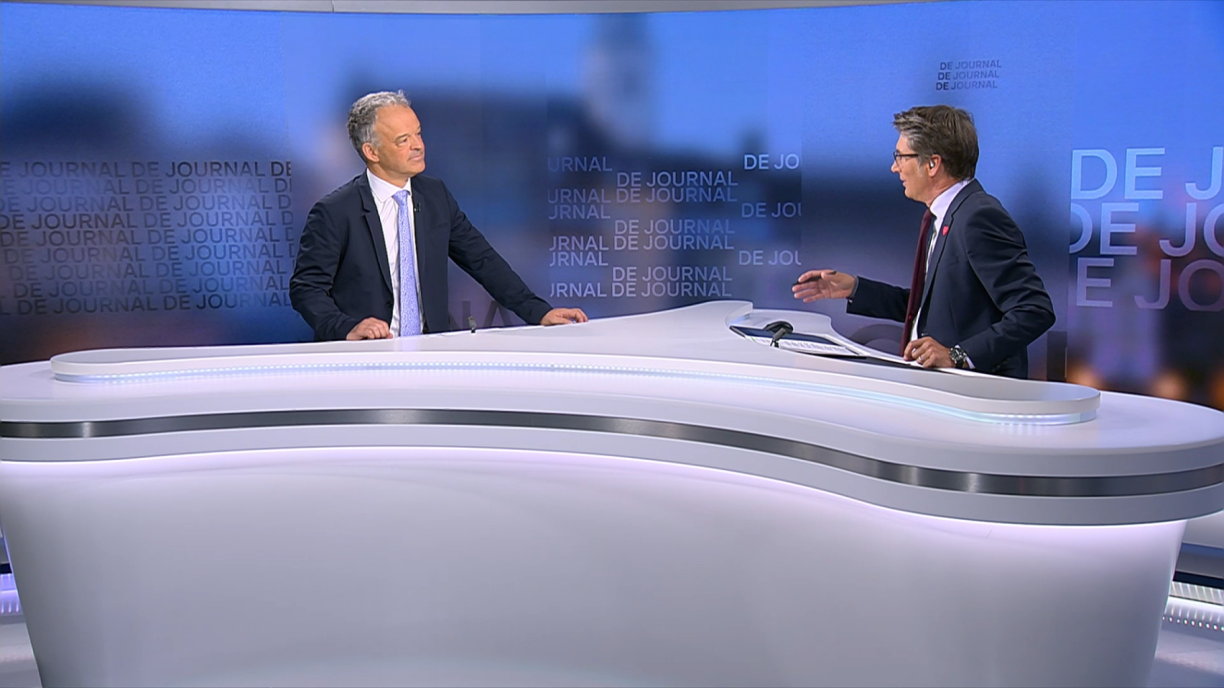
In the context of growing tensions over wages, inflation, and economic uncertainty in Luxembourg, Michel Reckinger, president of the Union of Luxembourg Enterprises (UEL) set out the employers' perspective on the current debate in an interview with RTL on Tuesday.
Reckinger reacted to the discussion between the president of the Independent Luxembourg Trade Union Confederation (OGBL), Nora Back, and Labour Minister Marc Spautz, held on Tuesday morning at RTL Radio.
He noted that the arguments from both sides were already well known, meaning there was little that was new, though he still found it worthwhile to follow the discussion.
Reckinger pointed out that the UEL represents business federations and professional chambers, meaning it has an overarching view of the economy. From this perspective, he stressed that the situation is far from positive.
According to Reckinger, there has been no economic growth since 2022, which in practical terms means a lack of profitability and that businesses are no longer generating earnings. He warned that without profits, there is no investment, and without investment, no new jobs are created.
He highlighted that unemployment has risen sharply, by around 50% compared to 2022, and that job creation has dropped significantly, from 11,000 new jobs in 2022 to just 4,500 last year, with most of those in the public sector and related institutions.
Reckinger emphasised that these figures must be kept in mind when discussing current socio-economic issues.
When asked whether these debates should take place within a tripartite framework, Reckinger said that PM Luc Frieden had already been approached two weeks earlier with a request to organise such talks.
Reckinger also argued that the conflict in Iran could have even more serious economic consequences than the war in Ukraine.
Explaining that rising oil prices are already pushing up energy costs, which in turn affect the entire economy and could eventually lead to higher food prices. Describing how higher energy costs first drive up fertiliser prices, followed by increases in materials such as steel and plastics, which are closely tied to oil.
Once steel and plastics become more expensive, Reckinger explained that costs rise for businesses. For example, pipes and insulation materials, before ultimately feeding through to higher food prices at the end of the chain.
According to Reckinger, this process can take up to two years to fully unfold and had already proven highly damaging in the past. He therefore stressed the need for a tripartite meeting to discuss measures before the situation deteriorates further.
Responding to criticism that a proposed 0% adjustment to the minimum wage was too extreme, Reckinger maintained that people in financial difficulty should be supported through targeted state measures rather than across-the-board increases.
Reckinger argued that raising the minimum wage applies a blanket approach and puts pressure on businesses, which are then forced to pass costs directly on to consumers. He explained that in sectors such as hospitality and personal services, labour costs make up a large share of prices, meaning wage increases inevitably lead to higher prices for goods and services.
He also acknowledged that the government's current decision does not fully align with the UEL's position, but welcomed the fact that the state will compensate businesses for 1.3 percentage points of the total 3.8% adjustment. Adding that the exact details still need to be discussed with the government and that more targeted measures would have been preferable.
On the question of whether the indexation system should be suspended, Reckinger stated that the UEL supports reforming and capping the system. He indicated that such a cap could apply to salaries at two or three times the minimum wage, acknowledging that this would affect employees broadly but arguing that exceptional circumstances require exceptional measures.
Following recent announcements by Economy Minister Lex Delles and Labour Minister Marc Spautz, the UEL initially expressed disappointment, with Reckinger stating that the organisation felt its views had not been taken into account.
He explained that, in line with EU directives, discussions should first have taken place within a commission to define clear criteria for what constitutes an adequate minimum wage in Luxembourg. He noted that while the commonly cited benchmark is 60% of the median wage, other factors, such as the availability of free public services, should also be considered.
Reckinger further pointed out that in sectors such as hospitality, crafts, and retail, the current minimum wage already exceeds what would result from applying the 60% median benchmark by around €200. He argued that this reflects Luxembourg's specific situation, where high salaries in the public sector and banking inflate the median wage, placing additional pressure on smaller businesses to raise wages beyond what they can sustainably afford.
Reckinger concluded by reaffirming the employers' commitment to continuing social dialogue. However, he said he did not understand why trade unions were currently not engaging in discussions. Adding that he shared Spautz' impression that unions might not be seeking dialogue at all, suggesting that avoiding discussions allows them to ignore opposing arguments and instead communicate simplified positions publicly.





