On International Holocaust Remembrance Day, marking the 81st anniversary of the liberation of Auschwitz-Birkenau, remembrance ceremonies took place around the world in honour of the Jewish victims of the Nazi regime.
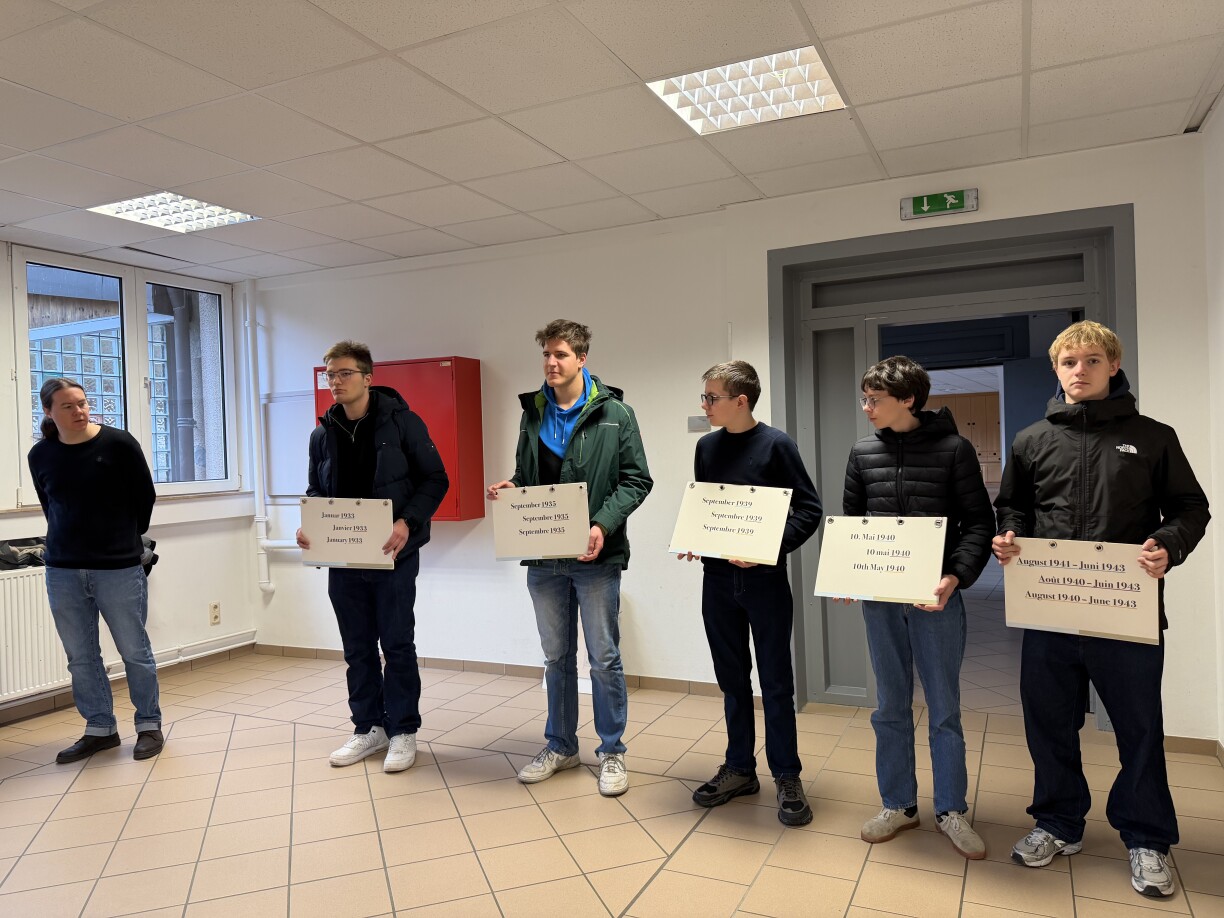
In Luxembourg, remembrance also took the form of dialogue. At the former monastery of Cinqfontaines, families from the second and third generations of Holocaust survivors met with pupils from the Atert-Lycée to reflect together on memory, suffering, and the responsibility of keeping the history of the Shoah alive. Organisers say such encounters with witnesses and descendants are essential to ensure that younger generations understand the Holocaust and recognise the importance of standing against antisemitism and exclusion today.
Speaking at the memorial to the victims of the Shoah in Luxembourg City, PM Luc Frieden stressed that the day of remembrance only has meaning if it leads to concrete commitment. He underlined that defending human rights and the rule of law is more necessary than ever, internationally, but also within Luxembourg itself. According to him, remembrance must translate into action, and democracy ultimately draws its strength from truth.
For the pupils, the day meant leaving the classroom behind. The site, Cinqfontaines, was originally a monastery belonging to the Jesuit order, but in 1941 it was repurposed by the Nazi authorities as a so-called Jewish retirement home. From there, around 300 Jewish people were regrouped before being deported in secrecy to ghettos and concentration camps. Nineteen people died on site, a small number managed to escape, and the vast majority were deported. Only 26 women and men survived.
Educational activities were organised by the Centre for Political Education in cooperation with the National Youth Service. The initiative is considered particularly important as some technical-stream secondary classes no longer include formal history lessons. Organisers say that learning about the past outside the classroom is crucial not only for understanding history, but also for making sense of current events.
Among those taking part was Rob Ruijs, whose grandfather died in Auschwitz. He told pupils that rising antisemitism and discrimination around the world make it all the more important to share these family histories. He explained that his grandfather's story shows where hatred can lead, and that although people once promised "never again", similar patterns are still visible today. Sharing his family's past, he said, is his way of issuing a warning.
The pupils themselves also reflected on what they had learned. One student, Luc, said he was struck by how recent the events still are. He noted that today's wars and conflicts show that humanity often fails to learn from its mistakes. For him, the most shocking aspect is that people could be persecuted and murdered simply for being different.
The pupils also paid tribute at the memorial created by Luxembourgish artist Lucien Wercolier, who was himself deported during the Second World War.
Among the survivors linked to the site is Betty Hirschmann, born in 1940. As a baby, she was taken to Cinqfontaines with her grandmother after Luxembourg was occupied by Nazi Germany. Today, she is one of the few survivors still able to share her story, doing so, she says, to ensure that what happened is never forgotten.
As a next step, the pupils will visit a former concentration camp with their school, continuing a process aimed at passing remembrance from one generation to the next.





