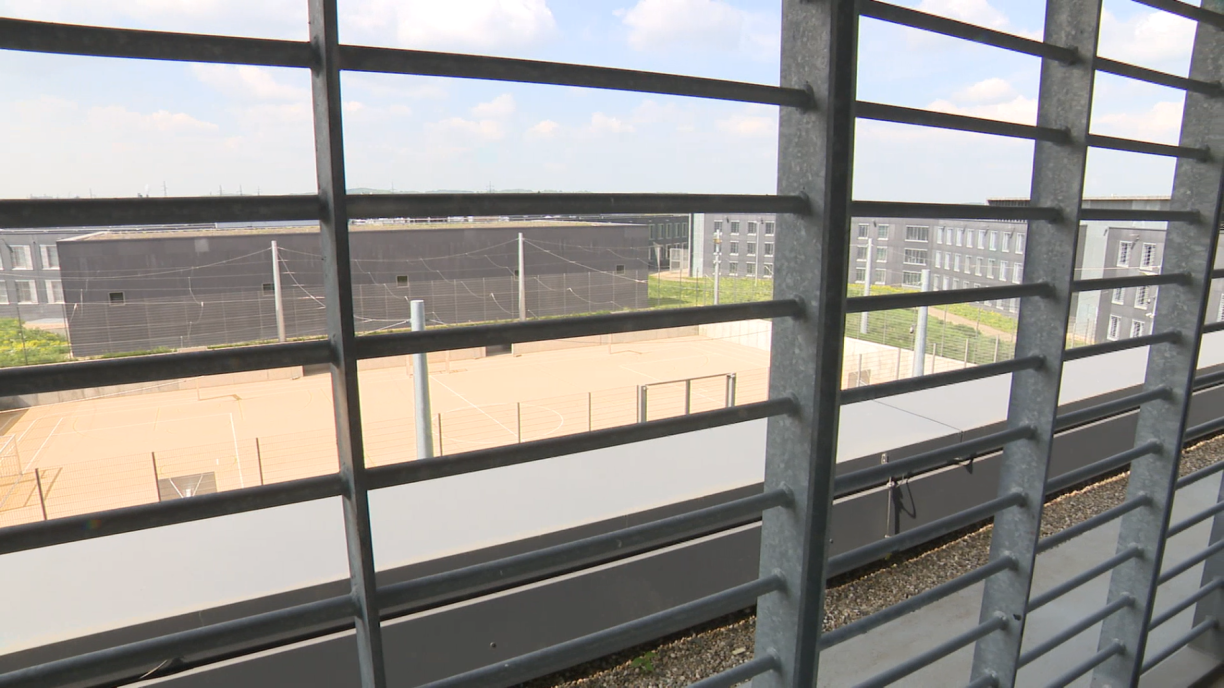
Luxembourg currently has 40 female prisoners, 33 of whom are held in Schrassig and seven in Givenich. Their detention conditions were the subject of a parliamentary debate in the Chamber of Deputies on Tuesday, with MPs from across the political spectrum pointing to the Ombudsman's recent report and acknowledging that significant improvements are still needed.
Women make up around 10% of the prison population, and this means they often receive only 10% of political attention, according to parliamentary group president Taina Bofferding of the Luxembourg Socialist Workers' Party (LSAP), who had requested the debate on the situation of women in prison.
Gender should not have an impact on the quality of accommodation, she said. At present, however, the situation for women is still significantly worse than for men in many areas, Bofferding said.
For example, in Block F, the only block in Schrassig where women are housed, no separation is made according to prisoner profiles, according to Bofferding.
"Convicted women live in the same block as women in pre-trial detention, minors alongside adults, and traumatised women alongside women who have themselves committed violence", Bofferding said. "That is not a challenge; it is a structural failure. It leads to tensions and conflicts, and it means that individual needs are not taken sufficiently into account."
MP Stéphanie Weydert of the Christian Social People's Party (CSV) focused on the work prisoners can do while serving their sentence. Although women in Schrassig are offered work, she argued that these activities are no longer up to date.
"Ironing, laundry, sewing, a bit of embroidery, recycling, and small craft tasks, of course, these jobs have their value", she said. "But are they not somewhat old-fashioned? Do they not take us back to traditional gender roles and offer only limited professional prospects?"
At the semi-open prison in Givenich, she said, it had become clear that allowing women and men to work together in workshops brings added value.
MP Carole Hartmann of the Democratic Party (DP) said one of the biggest challenges was the constant rise in the number of prisoners. For that reason, she argued, alternatives to traditional prison sentences should also be considered.
Hartmann argued that alternatives to traditional prison sentences should be considered more seriously, particularly in cases involving shorter sentences.
She pointed to electronic tagging, noting that electronic monitoring is still "used relatively little" in the prison system, even though these are "precisely the kinds of cases" where such an alternative could be considered. The option is also provided for by law as part of judicial supervision of defendants, she added.
MP Dan Hardy of the Alternative Democratic Reform Party (ADR) also said there were areas where improvements were needed, but added that the situation was not catastrophic. He said it was normal for gender-specific differences to be taken into account in the organisation of the prison system.
MP Sam Tanson of The Greens (déi gréng) regretted that, following the opening of the Uerschterhaff remand prison, not much additional space had been created for female prisoners in Schrassig, as Uerschterhaff itself is already heavily occupied. She suggested that consideration may need to be given to creating a dedicated facility for women.
Meanwhile, MP Sven Clement of the Pirate Party (Piratepartei) criticised the fact that there is still considerable room for improvement in the psychological care provided to women in prison. Unlike people, he said, mental illnesses cannot simply be locked away.
MP Marc Baum of The Left (déi Lénk) asked why no dedicated spaces for women had been planned when the Uerschterhaff prison was designed.
Minister of Justice Elisabeth Margue stressed that conditions could probably only be improved permanently through the construction of a new prison. However, such a project is likely to take several more years.





