A few hours before RTL's interview, Lydie Polfer had read three accounts from shopkeepers gathered by colleagues at RTL Infos.
Cédric Teynat, the head of security for a large city-centre store, recounted having been pricked five times by a man armed with a syringe as he tried to stop him from stealing from a shop. Fabienne Belnou, a jeweller who has been based in the historic district for 33 years, explained that some of her staff no longer dared to wear their own jewellery in public. Alexandre De Toffol, manager of several restaurants, lamented the rise in thefts, drug use and problematic behaviour on the streets around his businesses.
The mayor did not, in truth, need to read the shopkeepers' testimonies to appreciate the scale of the problem. She engages with them almost daily, the mayor said, and they regularly send her their photos. Unfortunately, she added, the situation is nothing new. She has been fighting this, in her words, for 10 years.
The city has teams from its hygiene department who work seven days a week across the pedestrian zone and public squares. As Polfer put it, they pick up whatever they find, from litter and syringes to excrement, all "terrible things".
According to figures provided by the mayor, the cleaning department has more than 130 employees, working in the Upper Town, around the Gare district and and in Bonnevoie. A specific team is deployed in the pedestrian zone, first thing in the morning and again in the afternoon.
Even then, the work sometimes has to be done all over again a few hours later. You can leave things spotless, Polfer said, only to find rubbish strewn about again a few hours on.
Polfer said she has repeatedly alerted national authorities, writing to successive ministers. Speaking of Léon Gloden, the current Minister for Home Affairs, the mayor feels they are "being listened to more closely".
She cited the reinforced Platzverweis, introduced in July, which allows police to order troublemakers to leave specific areas for up to 48 hours, or even 15 days in certain cases. The exclusion zone can extend up to 1km, and police may also designate precise locations.
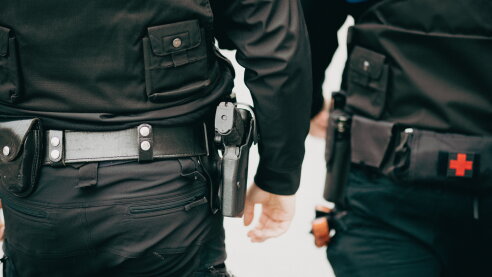
Police presence, she said, has increased since the restructuring of the local force, which business owners themselves have observed. However, Polfer insisted that policing alone is not enough: "There has to be judicial follow-up also."
Polfer recalls two incidents during the ING Night Marathon this year, where two pickpockets caught in the act were taken to the police station and presented to a judge, but were immediately released. She also recalled a car burglary in which the suspect was found bloodied after breaking a window.
For the mayor, these cases show the need for coordinated action. She referenced the Drogendësch 2.0 action plan, an inter-ministerial initiative launched last year that brings together the Ministries of Justice, Home Affairs, Health, and Family, along with Luxembourg City, to address such issues in a unified way.
Polfer acknowledged the importance of supporting people affected by addiction: "They are ill, that much is certain. But when someone is ill, you help them, you do not leave them on the street. Otherwise, it gives the impression that nobody cares." she said.
She reiterated a demand she has made for years, having long called for the creation of a social emergency service, a social SAMU social. The Ministry of Health, she said, keeps telling her the service is almost ready, but she is still waiting for a full commitment. "I am surviving on hope and patience", she remarked.
Meanwhile, the Luxembourg Red Cross continues to operate harm reduction services for people with addictions. Its PASS-By programme told RTL that it is extremely rare to find discarded syringes near its activities. Each time beneficiaries receive a kit with two syringes, and must return used ones to receive more.
The Red Cross reports a return rate of about 76% percent. Several centres, including K28, Abrigado, Marga, and PASS-By, offer syringe returns, and special containers are installed at various locations across Luxembourg City. Still, as the Red Cross acknowledged, 76% percent is not 100%, a return rate that the organisation deems impossible to attain.
Nonetheless, the organisation emphasised that effective harm reduction and public safety are not contradictory, for high-quality support for people with addictions directly improves safety, cleanliness, and the sense of security in public spaces.
Business owners have also observed that issues once concentrated in Luxembourg-Gare have spread into the city centre. Polfer agreed, noting that it is not the tram's fault per se, "but the fact is that movement is easy along the tramline".
Free public transport system further facilitates this mobility, in her opinion. Police are aware of the trend, she added, and have increased their presence on trams, with preventative messages now regularly broadcast onboard.
The City has also implemented the À vos côtés ("by your side") initiative, with mediators, educators, and sports staff patrolling the city centre to reassure residents, business owners, and passers-by. They can accompany people who feel unsafe on their journey or provide a visible presence outside shops and restaurants.
Polfer acknowledged the challenges but rejected the idea that Luxembourg City is becoming unliveable. "These situations are certainly unpleasant, and they can frighten people, including the elderly and children", she admitted. Yet she pointed to international rankings that regularly place Luxembourg among the cities with the highest quality of life. "It is not perfect, but we know what the problems are, and we working hard on addressing them". To the mayor, efforts are being made in the right direction, "but we can do even better".
Looking ahead, Polfer said it remains to be seen whether new measures will bring lasting improvements. Regarding the reinforced Platzverweis, she noted that "we first need to see how the police apply the measure, because only the police can do so".