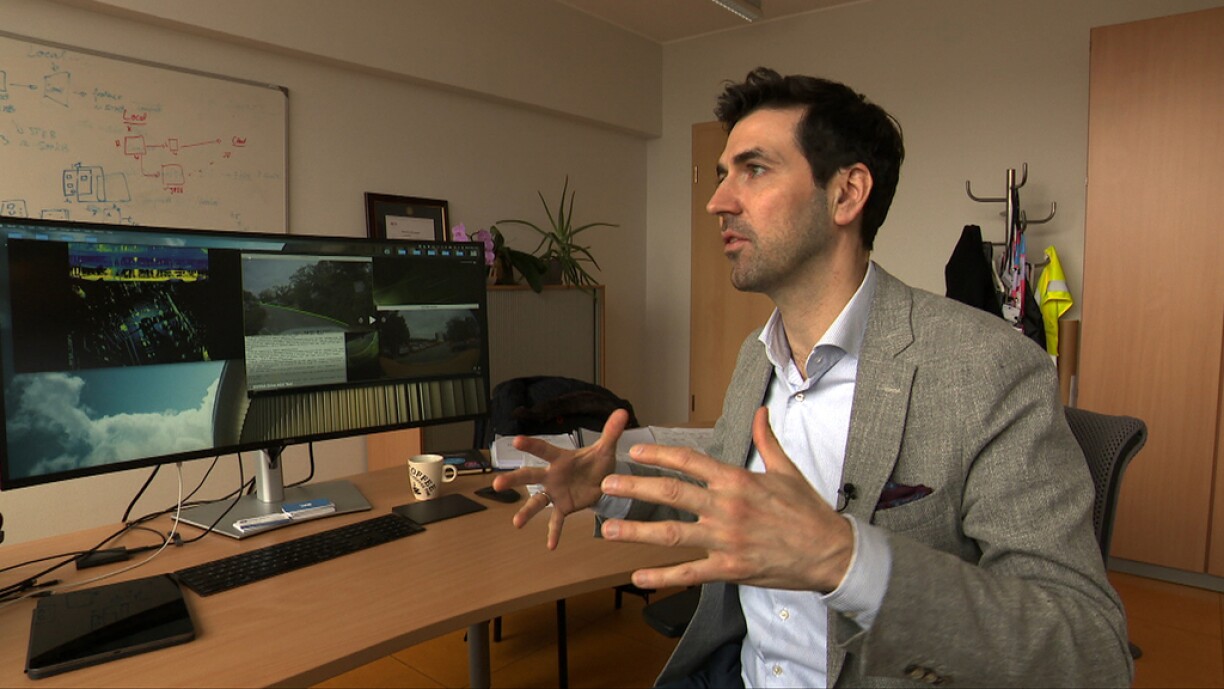
Frank has been interested in technology since early childhood. But when the time came to go to university, he started having doubts about his passion. He first started studying communication science, which his sister recommended to him.
It only took Frank a semester to realise that this was the wrong choice, so he enrolled at the former IST to study engineering and informatics, which was more to his liking. After graduating with a degree in engineering, he went on to complete a master's programme in cryptography in France before returning to the Grand Duchy for a PhD in informatics at the University of Luxembourg.
Frank's PhD focus were so-called 'distributed systems', meaning networks of distant computers that communicate messages and coordinate their actions.
Distributed systems play an important role in autonomous driving. Frank explained that autonomous vehicles can therefore be regarded as "computers on wheels", which do in fact communicate and coordinate.
Autonomous vehicles are usually conceptualised across five different levels. Level five, 'Full Driving Automation', is used for completely autonomous vehicles, which might do not even have a steering wheel. Level four, 'High Driving Automation' designates highly autonomous types, meaning that the vehicle is able to drive by itself most of the time.
Most of the vehicles currently on our streets have assistance systems that support a human driver, who holds responsibility at all times. Frank expressed his belief that driving will become increasingly autonomous in the future, which would eventually allow vehicles to hold responsibility rather than motorists.
Frank argued that Luxembourg is suited to testing autonomous driving technologies due to its small size. The field is already one of the strategic pillars of the University of Luxembourg's research centre. Research here focuses on improving sensors and safety.
However, it is not the goal of the university to develop autonomous cars as private companies are already experienced in this domain, explained Frank. Although Luxembourg does not have one of its own, many international companies still opt to come to the Grand Duchy to carry out different tests.
Recently, an Australian company that collaborates with national railway company CFL on an autonomous shuttle installed its European HQ here. The University of Luxembourg is currently in contact with this enterprise to plan a joint research project.
Frank stressed the importance of setting up an adequate legal framework before autonomous driving becomes engrained in everyday life. He elaborated that this will help prevent that systems that only function 90% of the time enter our roads and potentially endanger people's safety, which he deemed irresponsible and the wrong political signal.
There is already a procedure in place to demand and conduct experimental tests with autonomous cars in regular traffic. This regulation allowed the University of Luxembourg to analyse their self-driving car.
Autonomous driving is currently mostly used to cover initial and final sections of journeys. This means that a human driver is still behind the wheel most of the time. Assistance systems in cars are expected to also become increasingly autonomous in the future.
According to Frank, individual mobility will in the long run develop towards "mobility on demand", a service covered by autonomous vehicles that are ordered when needed. This will significantly reduce the number of cars on the road, he said.
Frank further argued that the technology will improve traffic flow. However, the situation here in Luxembourg will also depend on other factors, such as population growth, urbanisation, or teleworking practices.
It will still take some time before autonomous vehicles start circulating our roads as it has to be ensured that they can react to the different circumstances of motorways, country roads, and inner towns. Also, the construction of autonomous vehicles is not yet cost-effective enough for the wider society to accept them.
Frank believes that societal acceptance will come once autonomous vehicles have become safer than regular ones. Nevertheless, even if autonomous driving eventually becomes the norm, there will still be driving for pleasure, he said.
While autonomous vehicles will likely become more accurate than human drivers, that will not mean that they are infallible. People can still be injured in accidents, which is always difficult for society to accept. Frank thinks however that generations that have grown up with more autonomous technologies will be less sceptical towards them.
Though hard to assess when fully autonomous mobility on demand will become a reality, Frank is able to situate the technological aspect of the process in his role as a researcher. He explained that regardless of technological progress, the question can only be answered once the ethical, legal, and societal aspects of the technology have been settled.
Most experts in the field estimate that autonomous driving services will be operational by 2050.
A technical problem that still needs to be resolved by then is that of so-called 'edge cases', meaning extraordinary situations for which there are no universal solutions. The central issue here is how systems react to never before seen circumstances and whether human interaction will be needed after all.
Some systems currently work as they should 95% of the time, so there is still room for improvement argues Frank. He also thinks that human agency will still have to remain a permanent option for quite some time.
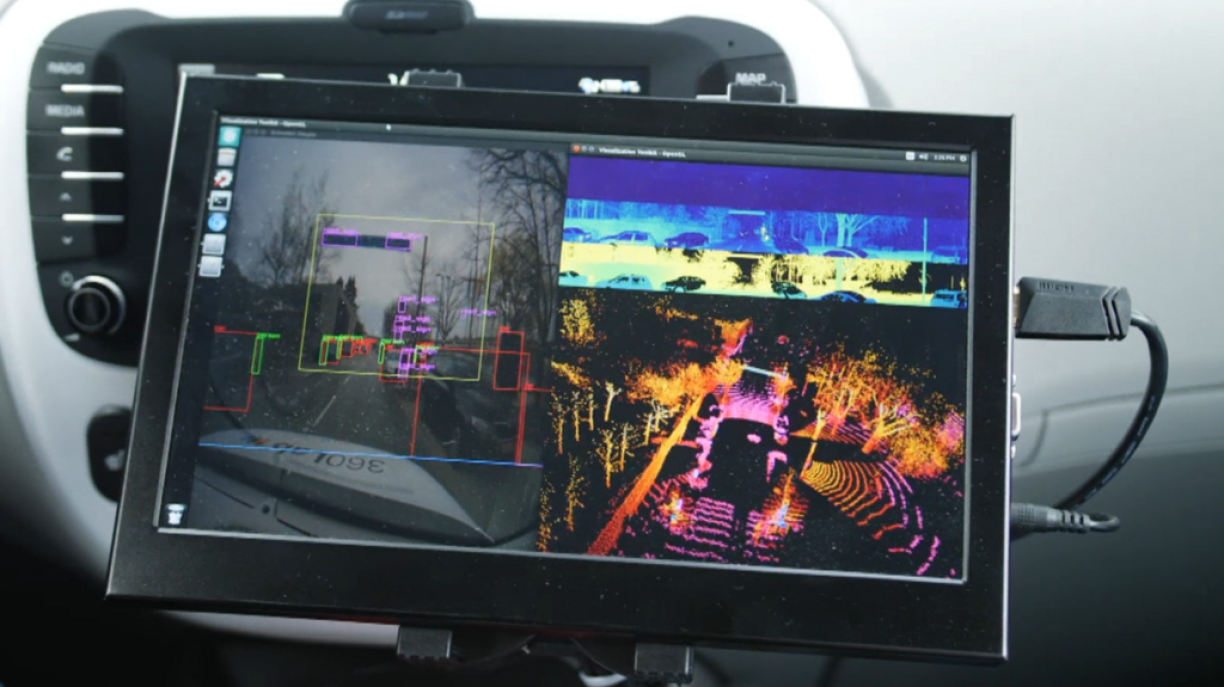
For now, sensors inside the vehicles are being improved to better recognise whether a driver is watching the road or distracted by something else. Studies on reaction time are therefore being carried out at the moment, an issue that will remain extremely important for years to come.
At some point, it might be the case that cities are designed to specifically accommodate autonomous vehicles. Once the majority of cars are self-driving, the number of edge cases will therefore decrease.
Frank explained that the majority of experts believe that most autonomous vehicles will be electric, which is why energy research and engineering will also be of crucial importance to the success of autonomous driving.
Frank believes that Luxembourg has the necessary financial means to carry out important research efforts. However, he lamented that there are still regulatory barriers that make cross-border tests in the greater region difficult. Similarly, access to the 'Automotive Campus' in Bissen is considered to be difficult in terms of procedures.





