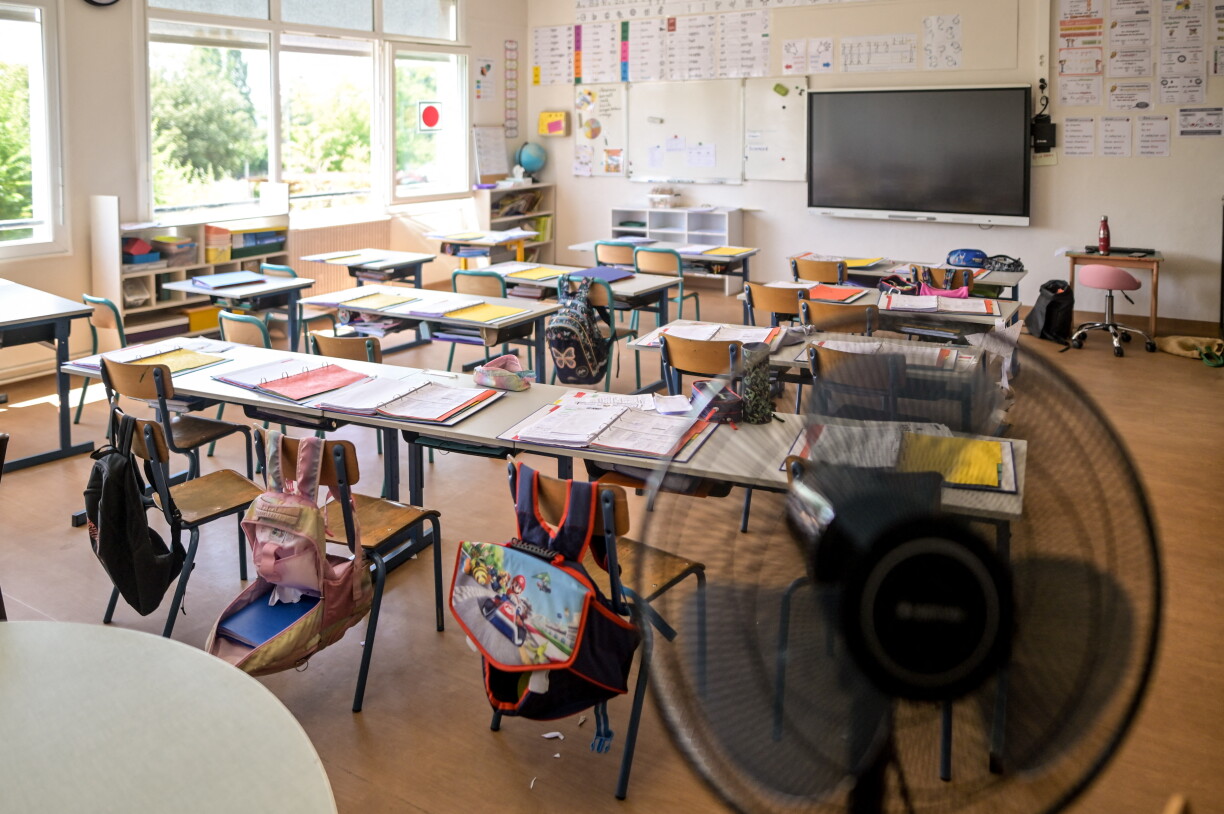
Luxembourg is currently in the grip of a severe heatwave, with temperatures climbing above 35°C in many areas and forecasts predicting up to 40°C by the weekend.
The extreme heat has prompted a patchwork of responses across the country's schools, sparking criticism from parents, students, teaching staff, and the teachers' union SEW/OGBL. While some primary schools have granted time off on Wednesday and Friday afternoons, others have not, and secondary schools have likewise adopted varying approaches. Critics have decried the lack of a uniform policy as confusing and poorly organised, with each municipality left to decide individually whether to grant time off.
Education Minister Claude Meisch has sought to put the criticism into perspective, arguing that a one-size-fits-all rule is not feasible. He noted that school premises vary considerably, and that primary school buildings fall under municipal authority, making it difficult for the Ministry of Education to maintain a comprehensive overview. Regarding secondary schools, Meisch pointed out that there is a natural difference between a building constructed three years ago and one that is a century old. "You can't just do everything you want in them as far as protection against the heat is concerned," he said, adding that this is precisely why decisions are being handled locally. "I trust both the teachers and the school management to find reasonable solutions," the minister concluded.
For the SEW, however, the core issue is not whether students are granted time off, but rather the inadequate conditions inside school buildings, as spokesperson Vera Dockendorf explained. The union had already issued an open letter and a press release in 2025, and again this year, as their concerns have largely gone unaddressed.
While the SEW agrees with Minister Meisch that a blanket cancellation of classes nationwide is not the solution, the union stresses that urgent investments are needed to ensure schools are equipped to handle future heatwaves. According to Dockendorf, many classrooms lack proper shading and windows that can be opened adequately. The union is demanding that classrooms exceeding certain temperature thresholds be retrofitted with ventilation systems and, where necessary, air conditioning.
Minister Meisch has defended the current approach, emphasising that the Ministry of Education has established national guidelines to ensure vulnerable children – such as very young students, those with special educational needs, or those with health problems – can stay at home and be excused from classes. At the same time, however, he acknowledged that many parents rely on school-provided childcare, making a blanket solution impractical.
"It is not that simple to say children should stay at home," Meisch argued. He pointed out, first, that the heat is also an issue inside homes, and second, that many children would otherwise be left unsupervised or exposed to the heat alone. "It is not as if we live in a country where everyone has a swimming pool in the garden and air conditioning at home," he said.
Meisch further stressed that Luxembourg has a national rule requiring that children, particularly in primary schools, must always have access to supervision. Uniformly cancelling classes across the board, he warned, would "bring the country to a standstill" by preventing parents from going to work.
Looking to the future, Meisch acknowledged that Luxembourg must explore ways to position itself differently and make its schools more resilient to extreme heat. He also offered a broader perspective, noting that the heat affects everyone equally: "It is hot for everyone. No matter where you work, whether you work at a school, go to school, or are at home."





