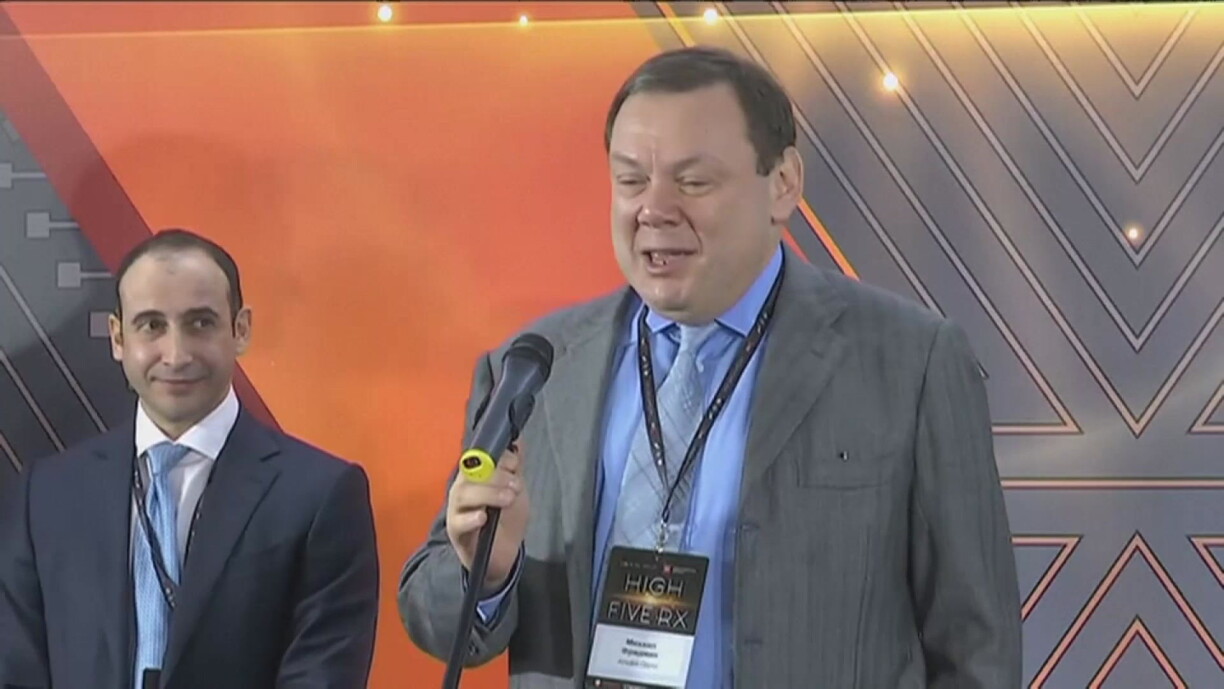
The government argues that it wants to shield Luxembourg from harm, linking that stance to Fridman's claim for $16 billion in damages from the country.
The Russian-Israeli businessman filed the claim in 2024 after the EU General Court ruled in his favour, finding that the Council of the EU, representing the EU member states, had failed to substantiate the reasons for placing him on the sanctions list in 2022 following the Russian invasion of Ukraine.
Mikhail Fridman was born in 1964 in Ukraine, then part of the Soviet Union. After the Soviet Union collapsed, he obtained a Russian passport. In 2014, he also took up Israeli citizenship.
According to his lawyers, he set up small businesses in the 1980s and 1990s with university colleagues German Khan and Alexey Kuzmichev, who were also placed on the EU sanctions list in 2022.
Those ventures included window cleaning, selling women's scarves and shawls, and dealing in upholstered furniture. He also co-founded the Alfa financial group, which includes Alfa-Bank, and which grew into one of the largest financial groups in the former Soviet states.
In Ukraine, notably, Alfa-Bank became Sense-Bank, which was nationalised by the Ukrainian government following the Russian invasion. In 1993, Petr Aven, who had served as Minister of Foreign Economic Relations under Boris Yeltsin, joined the group.
He also served on the boards of Fridman's Luxembourg-based holding companies, ABH and Letter One, until he too was placed on the EU sanctions list in February 2022.
Over the 2000s, Fridman moved his business activities to Western Europe, setting up holding companies in Luxembourg and the Netherlands. He also acquired ATB Bank in the Netherlands. Like other oligarchs, he bought up real estate in London, assets that were later frozen under British sanctions.
Fridman is not only active in finance but also in energy. Through a joint venture with British Petroleum, he and his associates banked billions in profits on the venture's sale in 2013.
His financial interests are grouped under ABH Holdings, while his energy businesses fall under Letter One Holdings. The latter was involved, among other things, in the Nord Stream 2 gas pipeline, which was blown up in 2022.
He is also active in retail, holding stakes in the Holland & Barrett chain and in the Russian supermarket chain X5. In Luxembourg, these interests are grouped under the CTF holding company.
Fridman is a co-founder of the Russian Jewish Congress. He has also been active as a philanthropist, sponsoring art prizes, and festivals. In the past, he announced that on his death, his fortune would not go to his four children but would instead be given to charity.
Fridman has, however, been embroiled in various controversies before. The oil tanker Prestige, which caused a major oil spill off the Spanish coast in 2002, belonged to his group.
In the so-called Steele file on Russian interference in US elections, he and Petr Aven were accused of informally advising Vladimir Putin and of having handed him "large sums of cash" during his time as Mayor of Moscow.
In the US, he lost a defamation lawsuit against Christopher Steele. In Britain, however, they won a case over those same allegations.
The matter is currently being handled by an arbitral tribunal made up of three judges chosen by the parties. This is not a court tied to any particular state.
The claim is based on an inter-state treaty, in this case a treaty signed by Luxembourg, Belgium, and the Soviet Union in 1989 to protect mutual investments.
The parties, Fridman, and the Luxembourg State, agreed on Hong Kong as the seat of the arbitration.
Legal expert Javier Garcia Olmedo of the University of Luxembourg explains that the seat matters because it determines where the arbitrators' decision can later be challenged if one of the parties disagrees.
The grounds for doing so, however, are very narrow; for instance, if the arbitrators were shown not to have been neutral. One reason for annulling an arbitral award, he pointed out, is if it breaches the public policy of the place of arbitration. Luxembourg, on that front, could raise several arguments.
Had the seat of arbitration been in Europe or in a country that had adopted sanctions against Russia, things would look rather different, which is precisely why the location matters, and why the parties chose Hong Kong, where there are no sanctions against Russia.
Alongside the $16 billion claim against Luxembourg, Fridman has also sued the Netherlands for damages over EU sanctions. Dubai was chosen as the seat of arbitration in that case. Those proceedings began a year after the case against Luxembourg, and the procedural timetable includes dates running through to 2029.
Fridman is seeking "no less than several hundred million dollars" from the Netherlands, arguing that the Dutch bank ATB was driven into bankruptcy as a result of the sanctions. In their own statement of claim, however, his lawyers explain that it was primarily US sanctions that crippled the bank, since software providers revoked their licences.
According to that filing, Microsoft prevented ATB from accessing systems such as email and cloud services because of the sanctions, and Amazon reportedly intended to follow suit. The bank's insolvency administrators also laid less of the blame on EU sanctions.
According to the insolvency report, the issue primarily involved sanctions imposed by the United States and the United Kingdom, which meant, for instance, that ATB could no longer make use of certain essential administrative and payment systems.
The Luxembourg-based holding company ABH is seeking $1 billion in damages from Ukraine through arbitration proceedings, following Ukraine's nationalisation of Sense Bank. Another Luxembourg-based holding company, CTF, has a separate arbitration case pending against Ukraine. The amount of damages being claimed there is not known.
Because of the sanctions, he lost access to his assets and his companies. Financial statements from the holding company Letter One show that around $300 million in dividends had built up there, which could not be paid out to the sanctioned partners.
The holding company ABH recorded write-downs totalling $8.8 billion in 2024 because the group lost control of its banking and insurance operations in Russia. Those operations had been designated by Moscow as "economically significant organisations", at the holding company's own request, according to Interfax.
Fridman and Petr Aven subsequently recovered their stakes in Russia and were able to sell them for $2.5 billion. The loss therefore appears on the books of the Luxembourg holding company, though not to the same extent for Fridman personally.
The holding company CTF similarly recorded write-downs after losing control of the X5 supermarket chain in Russia. The shareholders later regained their rights to those assets in Russia as well. Here again, this represents a loss on the books of the Luxembourg holding company, rather than for the shareholders themselves.
Fridman was added to the sanctions list on 28 February 2022. The justification given in the Official Journal of the EU was relatively general. He was accused of being close to the Kremlin and of financing Vladimir Putin's inner circle. He was said to have funded a charity project led by Putin's eldest daughter. He had also reportedly travelled to Washington in 2018 to relay Putin's messages opposing US sanctions.
In April 2024, Fridman and his business partner Petr Aven won their case at the EU General Court, the court of first instance, which ruled that the Council had failed to adequately substantiate their inclusion on the list, and annulled the Council's decision to place them on the sanctions list between February 2022 and March 2023.
Latvia lodged an appeal against that first-instance decision with the European Court of Justice, the higher court. No ruling has yet been handed down, though in October 2025 Advocate General Andrea Biondi recommended upholding the initial decision.
The Council kept both men on the list at each of the six-monthly renewals, and subsequently broadened its arguments. It accuses his insurance company, AlfaStrakhovanie, of insuring vehicles belonging to the Russian National Guard as well as those used by Vladimir Putin's bodyguards.
The same goes for companies such as JSC Kalashnikov, whose weapons are used by the Russian military, including in Bucha.
The X5 Group is also said to cooperate with sanctioned companies that organise food and laundry services for the Russian military.
Among other things, the Council accuses Fridman of circumventing EU sanctions through the moves that led to Alfa-Bank in Russia being designated as an "economically significant organisation", allowing him to regain control and sell off the shares.
He is, the statement of reasons puts it, a person who benefited from a compulsory transfer of ownership and control of an entity established in Russia.
The fact that he has now been taken off the European list does not necessarily mean that he will immediately regain access to his companies and his assets. He remains on the US sanctions list.
As a result, if his companies want to avoid the risk of US penalties, or scenarios in which Microsoft blocks their emails or Amazon revokes their software licences, as happened with the bank in the Netherlands, they will likely have to keep cutting ties with him.
Luxembourg's advocacy for Fridman is intended to strengthen the country's position in the arbitration case over the $16 billion. Prime Minister Luc Frieden said the government took this step to shield the country from harm.
His removal from the list shows that the measure is neither permanent nor irreversible, which makes it harder for his lawyers to argue that he was expropriated, a key plank of their lawsuit against the Netherlands.
The investor protection treaties on which such lawsuits rely are specifically designed to shield investors against expropriation. On top of that, financial data from his companies suggest that the losses those companies incurred cannot be equated with his own.
In their lawsuit against the Netherlands, Fridman's lawyers accuse the country of failing to make use of its discretion regarding the veto during the sanctions vote.
It could, on their reading, have hidden behind the fact that it was an EU regulation. "The Netherlands cannot hide behind the EU; unanimous consent from every Member State in the Council of the EU (including the Netherlands) was required for the proposed restrictive measures to become EU law. In other words, the Netherlands had to proactively approve the measures against Mr Fridman for the EU to designate him. It did so."
They also point to press reports indicating that, as far back as March 2025, Luxembourg, alongside Hungary, had already advocated for Fridman's removal from the list.
This week, one of his lawyers told Paperjam that Fridman welcomed Luxembourg's positive role. On that basis, his lawyers can no longer credibly claim that Luxembourg failed to make use of its veto.
Asked last week whether an agreement had been reached with Fridman for him to withdraw his lawsuit, Prime Minister Luc Frieden said he could not make a statement on the matter.
Legal expert and researcher Javier Garcia Olmedo notes, however, that in principle it is possible for the arbitration proceedings to be halted. There could, in his view, be a settlement and a termination of the proceedings.
The treaty with the Soviet Union stipulates that such arbitration rulings are final and must be enforced in accordance with national law. Luxembourg is also a signatory to the 1958 New York Convention, under which states commit to recognising and enforcing such arbitral awards.
Since the 18th sanctions package against Russia in the summer of 2025, however, the EU has brought in a clause stipulating that EU member states must not recognise or enforce arbitral awards based on investor protection treaties that are issued in favour of sanctioned individuals or companies.
There is therefore a certain tension between the New York Convention on the one hand and European sanctions regulations on the other.
If Fridman is awarded damages from Luxembourg, the money comes from tax revenue, regardless of whether Luxembourg reaches a settlement and pays voluntarily or not.
If no settlement is reached and he is awarded damages in arbitration, he could try to enforce the claim through courts in third countries and have assets frozen. Asked what such assets might be, Garcia Olmedo answers that they would be commercial assets belonging to the State. Those could be buildings or securities held in commercial banks.
He cites the example of the intergenerational sovereign wealth fund, set up in 2015 by then-Finance Minister Pierre Gramegna as a "rainy-day fund", which invests in shares and bonds worldwide, assets that are not necessarily physically located in Luxembourg.
By the end of last year, the State had built up around €785 million in that fund. However, the fund is a public institution, meaning it has its own legal personality and is distinct from the State itself. The expert explains that this creates an additional hurdle should an aggrieved investor wish to bring a claim.
The pension reserve compensation fund, which stood at €25 billion at the end of 2025, is also a public institution. Furthermore, the SICAV through which the pension reserve is invested constitutes yet another separate company. The State also holds direct stakes in a range of companies, such as ArcelorMittal and BNP Paribas.





