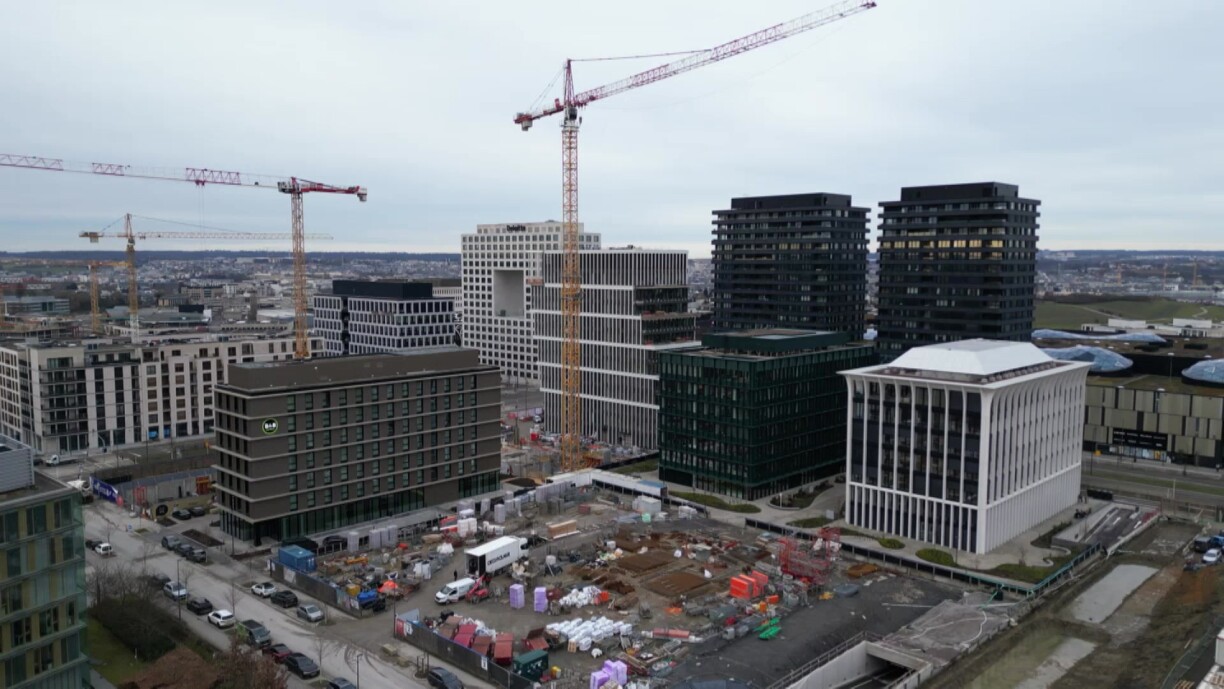
After a period of uncertainty in the immediate aftermath of the Covid-19 pandemic, the Luxembourg office market appears to be regaining momentum. Figures from the sector point to a clear recovery, both in terms of new construction projects and company demand.
However, it is not only the volume of office space that has changed – the way offices are used, and what companies expect from them, has also evolved.
In the years following the pandemic, the market experienced a sharp slowdown. Hybrid working models, economic and political uncertainty, and cautious investment strategies led many companies to postpone decisions on leasing or buying new office space. A few years on, the picture looks very different.
According to Jean-Paul Scheuren from the Luxembourg Real Estate Chamber, there was a long phase during which companies questioned whether offices were still needed at all, as homeworking became widespread. However, he clarified that over the past two years, demand has clearly picked up again, and by 2025 the market largely returned to a more stable, pre-crisis footing.
The figures support this assessment. After several weaker years that saw around 120,000 square metres of new office space developed annually, current volumes have risen again to around 180,000 square metres being built, leased, or sold each year.
Demand continues to be led by the financial and insurance sectors. Scheuren noted that large-scale operations by European institutions, combined with the strong activity of the Luxembourg state, are playing a significant role. In addition, major industrial players such as ArcelorMittal are also positioning themselves in the market.
Small and medium-sized enterprises are also active, but tend to look for smaller units and often favour renting rather than buying. Co-working spaces and shared offices are becoming more visible, yet compared with other countries they still represent only a relatively small share of the overall market.
The way office space is used has shifted significantly in recent years, shaped by hybrid and remote work. While the average amount of space per employee has declined slightly, this reduction remains modest compared with trends seen abroad.
Michaël Taelman, real estate adviser, explained in conversation with RTL that offices are now used primarily as places for collaboration, training, and meetings, rather than for individual desk work, which can often be done elsewhere. He also pointed out that Luxembourg's policy framework, particularly the limits on remote work for cross-border workers, continues to play a role.
At the same time, Taelman observes a clear trend towards offices allocating more space to meeting rooms and shared areas, reflecting the office's growing role as a social and collaborative environment.
Geographically, Luxembourg City remains the most sought-after location, with between 75% and 80% of office activity still concentrated in the capital and its immediate surroundings. Areas such as Cloche d'Or and Kirchberg continue to develop rapidly.
At the same time, Belval is becoming increasingly attractive, helped by improved transport links and a growing range of shops and restaurants.
Rents have risen in recent years, particularly in premium locations, but overall increases have broadly followed inflation rather than exceeding it significantly.
In an international comparison, one of the defining features of Luxembourg's office market is its exceptionally low vacancy rate.
Taelman noted that over the past 20 years, the total amount of office space in Luxembourg has doubled to around five million square metres. Despite this expansion, current vacancy stands at just around 4%, which he describes as extremely low. In prime areas such as Cloche d'Or and Kirchberg, vacancy rates even fall below 2%.
For advisers and developers, this creates a clear challenge: demand often outstrips supply, meaning that new buildings are usually taken up very quickly once completed.
As a result, stakeholders in the sector are calling on policymakers to act urgently by releasing more land for development and improving mobility and transport links around potential business zones, in order to support future growth.





