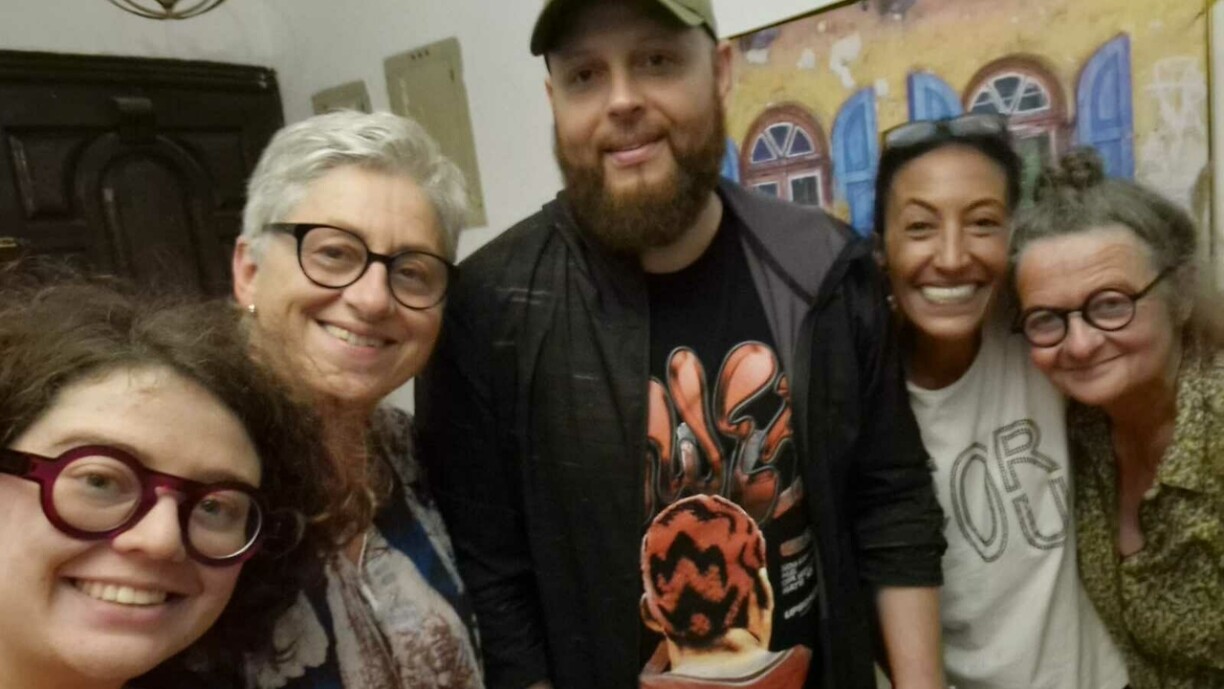
The five residents of Luxembourg took part last week in the Global March to Gaza, a movement that aimed to peacefully reach the Rafah border crossing from Egypt, to draw attention to the humanitarian crisis in Gaza. However, the participants never made it to Rafah.
According to the activists, the Egyptian authorities intervened forcefully to prevent the demonstration, including temporary detention of participants. On Tuesday, the group shared their experiences during a press conference.
Despite the disruption, the Luxembourg delegation expressed their determination to keep pushing forward. "We're still marching", they insisted, refusing to be discouraged by what they described as days filled with uncertainty.
One of the activists, Lalla Zeinab Bouanani, recounted being detained for twelve hours upon arriving at Cairo airport. She said she had been confined in a small room with around sixty others, where there were only fourteen mattresses and one toilet. She added that phones and belongings were confiscated, that no explanations were given, and that detainees had no idea how long they would be held.
Thanks to a phone smuggled in by another person, Bouanani was eventually able to alert her team in Luxembourg. And twelve hours later, she was released.
The group of five then attempted to reach the starting point of the march using private taxis. But at the very first checkpoint, most of them were again stopped by Egyptian police. The peaceful demonstration quickly descended into confusion and chaos.
Patrick Bosch, who coordinated the Luxembourg delegation from back home, said he received disturbing video footage and messages describing how police officers used force and forced protesters into windowless buses while people were being beaten. He immediately contacted Luxembourg's emergency consular services.
Around an hour later, a representative from the diplomatic corps called him back and said they had reached out to Egyptian officials and requested specific details to provide support.
For the Luxembourg group, the fact they did not manage to reach Rafah was not seen as a failure. They emphasised that their main goal was to make a statement, and that work would continue. More solidarity marches are now being planned across Europe in hopes of raising awareness among European governments.
Bouanani stressed the importance of taking action, especially to protect children in Gaza, questioning whether the word genocide had lost all meaning. She expressed hope that Europe could set a better example and wondered aloud whether Luxembourg could be the one to start doing so.
Given the severity of the humanitarian crisis in Gaza, the five activists maintained that inaction was not an option. They said they had consciously chosen to travel to Egypt, fully aware of the potential risks involved.
In total, some 4,000 activists travelled to Egypt to take part in the march. Around 500 were ultimately deported, but further actions are reportedly in the works.





