The exact circumstances of the crash remain unclear while the investigation continues, but experts have unanimously pointed out that the addition of an emergency brake assist could have limited the fallout of the crash. The collision on the A6 left two people dead, and the Road Safety Association used the accident to reiterate its call for stricter controls on lorries.
Fatal crash on A6: Two dead after lorry collisionRTL visited the Sanem training centre for long distance and heavy goods drivers (CFS - Centre de Formation pour Conducteurs) to watch a demonstration of an emergency brake assist. This in turn raised the question - why exactly are so many lorry drivers reticent to employ emergency brake assistance and indeed, why are they sceptical with having technology involved in using the steering wheel or slowing down?
Older lorries are not fitted with the new technology and modern vehicles are able override the system, effectively making it redundant.
Tom Poos, a coach at the training centre, explained that many drivers dislike technological assistance, as they believe it activates too early. However, the coach pointed out that the system activates for a clear reason - they are driving too fast.
Using a styrofoam wall, the centre demonstrated how the emergency brake assist works, using a bus. It detects an obstacle and begins beeping, warning the driver to slow down. If the driver fails to do so, it then activates an emergency brake. Forcing the vehicle to slow down is enshrined in legislation, but emergency braking is not. Safety experts, such as the CFS's director, believe it is highly irresponsible that such safety systems are easily bypassed.
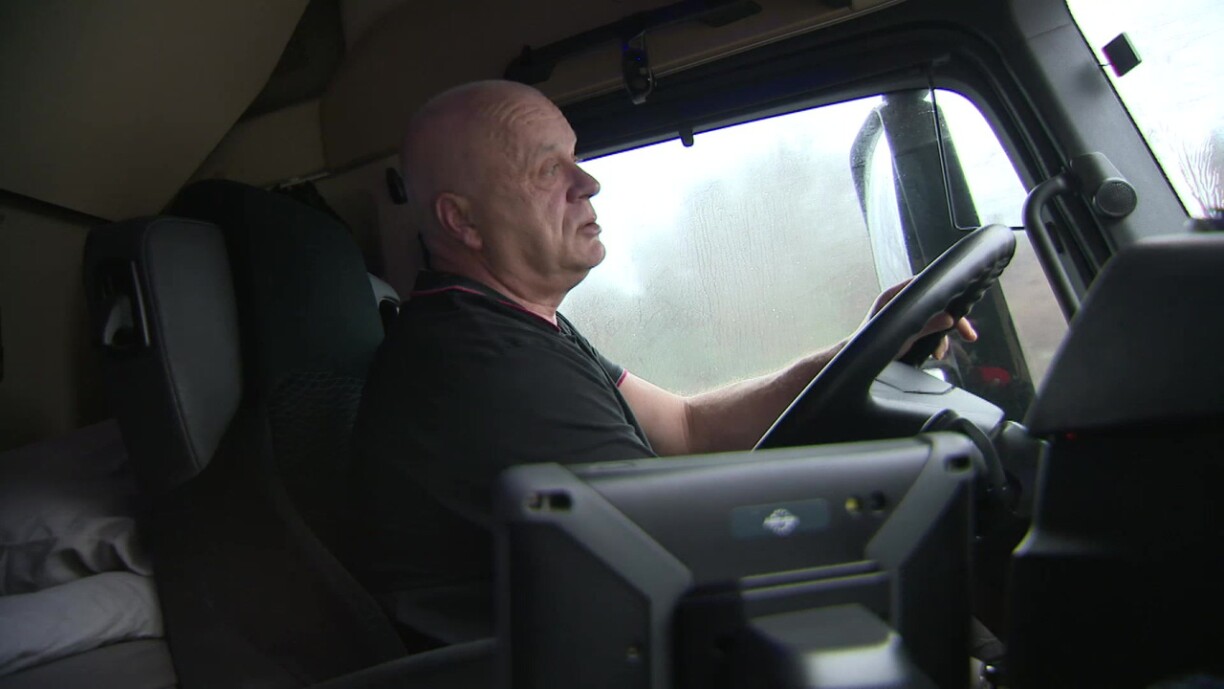
Marco Schiltz is perhaps one of the last Luxembourgish lorry drivers around and acknowledges the difficult job conditions. Lorry drivers must face the pressures of narrow margins, delivering just in time, and a competitive environment. The pressures of the job mean that drivers will often push the legal resting requirements and driving times to their limits, even cheating at the cost of their own health.
Schiltz admitted knowing of this practice, but said he was not sure how drivers for other firms push the boundaries. He was also reticent to talk negatively about his own colleagues. The lorry driver also highlighted the actions of car drivers, who fail to respect distances between cars and lorries. Often, he explained, lorry drivers are blamed for accidents caused by cars - such as when a car tries to cut across a lorry to exit, which forces the driver to brake suddenly.
Nevertheless, the lorry driver acknowledged that they are not blameless. Whilst not a fan of the emergency brake assist, he keeps his on. It's another story entirely for the lane-keeping assistant, which he prefers to switch off.
Video report in Luxembourgish.
The Customs and Excise Agency is in charge of stopping lorry drivers and making sure they conform to all safety precautions. On the road with customs officials, RTL witnessed a few lorries being stopped. One driver did not have his vignette, but, as the inspection revealed, was in the clear in all other matters.
Customs officials checked a lorry with broken headlights, quickly revealing more issues. Here, the lorry's brakes were faulty. To assist with the technical side of inspections, the Customs and Excise Agency works with the SNCT, who have their own mobile technical inspection station. This on-the-go inspection is nevertheless as precise as ones carried out in Sandweiler.
SNCT inspector Claude Puetz confirmed the brakes were not in good order, which meant the customs officials escorted the driver to the nearest garage before letting him continue his journey. Puetz highlighted the dangers of broken brakes. The lorry was carrying a cargo of 40 tonnes, which could prove highly dangerous if the driver had to brake on a downward slope.
The EU regulates check-ups on lorries, and Luxembourg must undertake 1,000 checks a year. Of those, 16% fail. Customs officials also face the battle of knowing a company is at fault. They encountered workers trying to fix an engine at a motorway stop. Officials confronted the men, pointing out how dangerous the ad hoc repairs were. Ultimately, they know that the fault lies with the logistics firm, which forces workers to try and cut corners timewise.
An official explained the reasoning for the strict enforcement: two years ago, a man died while trying to carry out repairs on a lorry in a car park.
Whilst perhaps considered an inconvenience to lorry drivers, there is a reason emergency brake assists exist. In the fatal January crash, the deployment of an emergency brake assist could have drastically reduced the severity of the accident.





