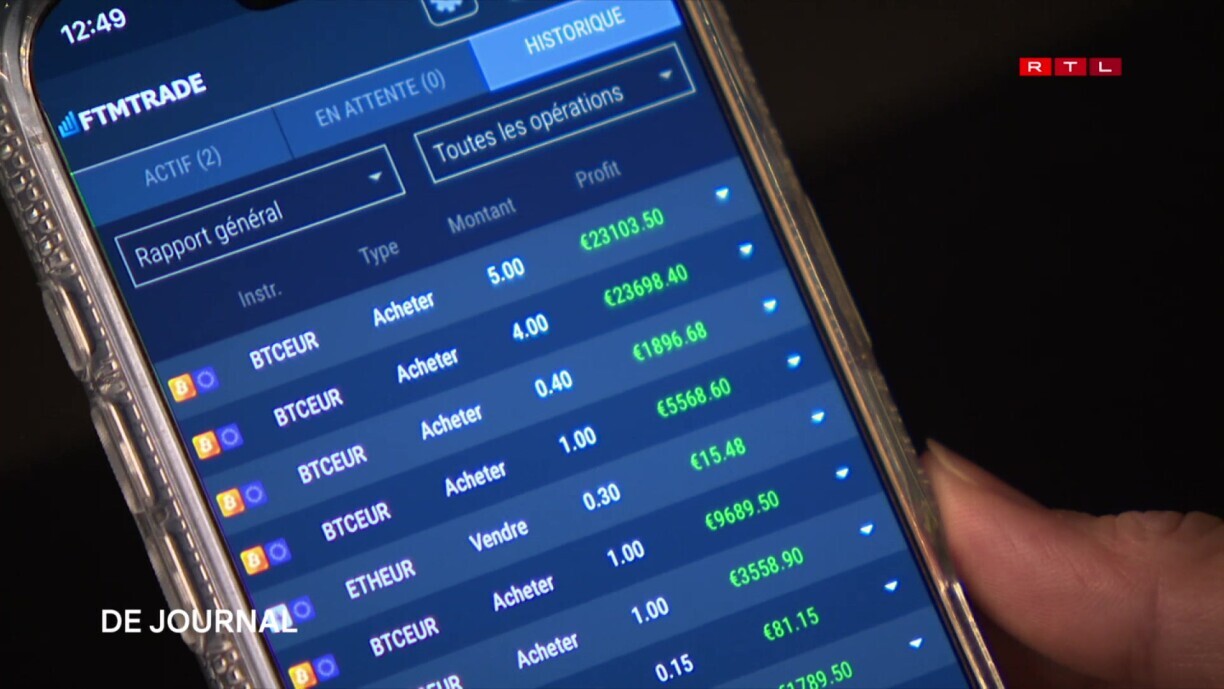
Time and again, people in Luxembourg fall victim to so-called "investment fraud." Lawyer Max Mailliet has recently dealt with a number of such cases in which victims lost large sums. Some clients were defrauded of several thousand euros or more. One even had half a million euros stolen.
"These are truly awful amounts", Mailliet said, "Unfortunately, people are then ashamed to even make a complaint or go to a lawyer, because they say: 'I was fooled.'"
In Mailliet's experience, it is often vulnerable people going through a difficult phase in life who fall into the fraudsters' clutches – frequently via dating apps, where an online relationship is built up over months. Once trust is established, the victim is told about a superb opportunity to invest.
"That can be in the crypto sector, but it can also be, for example, shares in companies that will soon float on the stock exchange", the lawyer explained.
The investment platforms appear entirely legitimate and are built in a highly sophisticated way. They show how one's "investment" is developing day by day. In reality, however, the money is quickly gone.
This is confirmed by Max Braun, director of the Financial Intelligence Unit (CRF). In 2025, this entity, which operates under the Public Prosecutor's Office, dealt with 20 cases of investment fraud.
"If people realise it early – meaning within 24 hours after they have made the bank transfer – there is still a chance to get the money back. If they realise it later, then it becomes increasingly difficult", Braun said.
Behind investment fraud lie criminal organisations with an efficient division of labour. Some members build relationships and manipulate the victims – and are themselves often victims of human trafficking. Others possess the technical know-how to simulate investments on fraudulent platforms. The third link in the chain are the money launderers, who are in the crosshairs of the CRF.
"These are the people who receive the money first and then transfer it onwards, often across the whole world, sometimes also investing it, to ensure that later on the criminals can access that money", Braun explained.
According to Mailliet's experience, people often only realise that their "invested" money has been stolen when they try to withdraw a sum. When they do so, they are frequently instructed to pay additional transaction fees. "It is usually at that point that they come to me", Mailliet said.
Other clients may even pay the transaction fees but receive nothing in return. If they then complain to the platform, a second stage of fraud comes into play. So-called "recovery agencies" – often the same people behind the investment fraud – contact the victim, explaining that they are aware many people have fallen victim to scams and that they can help recover the money. However, this is just another trap. The lawyer advises very clearly: do not throw good money after bad. He admitted that he cannot do much for his clients in these cases.
The most important measures are prevention and information, but also encouraging victims to talk about the fraud, Mailliet said. Many are ashamed, but they are also suffering significantly behind the scenes. People need psychological support, the lawyer stressed.
"What is too good to be true is usually not true. And that is certainly the case with these investments", the director of the CRF warned.
The CRF is networked with 180 other financial intelligence units worldwide. There is a rapid-response programme to recover money as quickly as possible, but this remains immensely complicated. Nevertheless, those affected should not lose all hope, Braun said. He noted that the CRF investigates money laundering networks, which are often only busted after years. But when they are, large sums are seized, and then there is hope again that victims will get something back.
It is also advised to work only with regulated companies in the crypto sector. Such companies now exist in Luxembourg as well.
The Financial Sector Supervisory Commission (CSSF) regularly publishes warnings about dishonest websites on its platform.
Meanwhile, a draft law is making its way through the legislative process that would enable the CRF to report suspicious bank accounts used for fraud to the banks.





