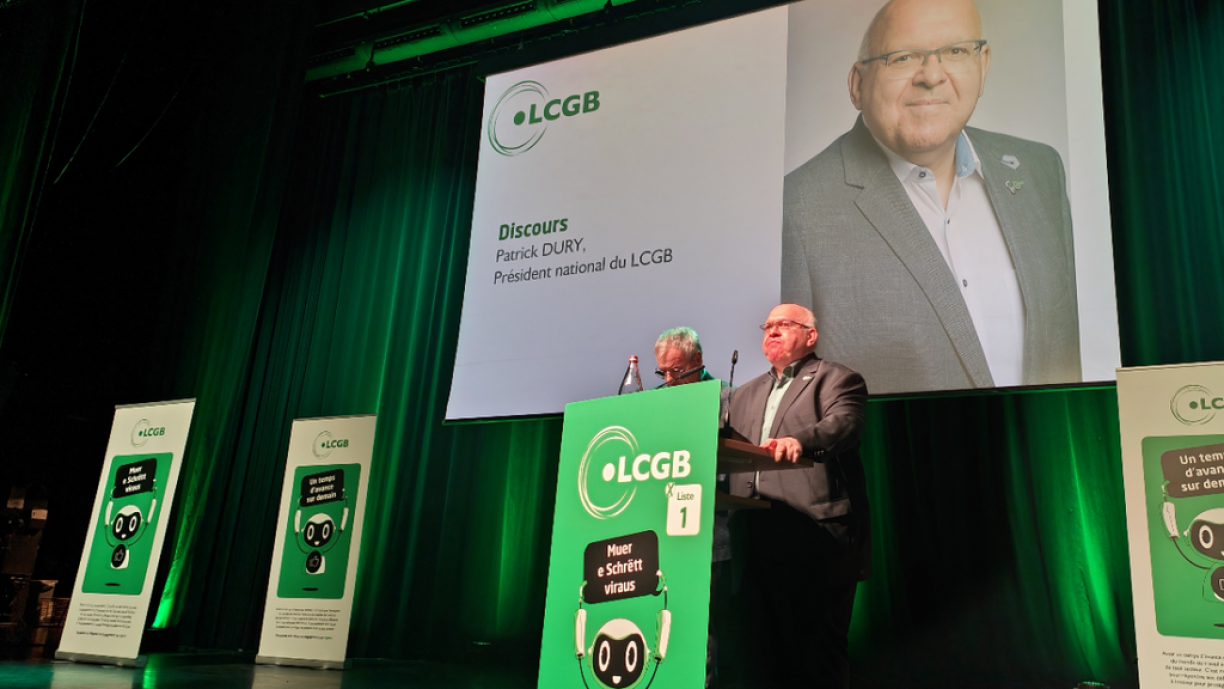
Defending purchasing power, advocating for state support for construction workers, and safeguarding the pension system are key priorities on the LCGB's busy agenda for 2024. As the social elections approach, the Luxembourg Confederation of Independent Trade Unions (LCGB) is positioning itself as the defender of employees' interests and issues a warning to the government.
LCGB president Patrick Dury addressed the new Frieden-Bettel government and delivered a candid speech at the confederation's New Year's reception at the Casino in Mondorf-les-Bains. He urged the government to swiftly act in order to tackle the ongoing crisis in the construction sector. Additionally, he cautioned against the temptation to privatise public pension schemes or to create a "two-class society" that favours civil servants at the expense of private sector employees.
"Prime Minister, you should be aware that privatisation, specifically replacing our pension system with supplementary pensions, cannot be considered a serious option", declared Dury while addressing Luc Frieden.
The message was also directed at employers. Indeed, the dismantling of the public pension scheme "means the end of the tripartite model and jeopardises social peace", underlined Dury.
The primary focus of his speech was securing the future of the pension system, marked by a steadfast rejection of any dismantling. Dury directly criticised the new Minister for Social Security, Martine Deprez, accusing her of "complete amateurism" and employing a "populist and demagogic" approach. He refuted her claim that the system is on the brink of bankruptcy. He instead asserts that "the opposite is true! The reserves of €24.5 billion will secure our pension system for decades to come without any problems".


Duprez is criticised for fostering a "social apartheid" by creating a distinction between "first-class voters," mainly comprising civil servants, and a second class, consisting of private sector employees who would receive only "crumbs". The minister, being a civil servant herself, is reminded that "it is private sector employees who create wealth in the country, it is them who finance our social security schemes and who pay the ministers, and not the opposite!"
On thorny topics such as the pensions one, the LCGB is prepared to "cooperate with other unions" to build strength in numbers. However, in the run-up to the social elections on 12 March, the Christian union (list 1) will be differentiating itself by "the fact that people are at the center of our concerns and that the interests of employees are our main priority", according to officials.
The LCGB advocates for secure purchasing power, digitisation, a restructuring of working time, increased social justice, enhanced job security, and improved workplace comfort. Additionally, the confederation is committed to securing employees' jobs amid the risks of illness and unemployment, along with the right to lifelong learning.
Dury asserts that the beginning of 2024 has been notably "tense" due to widespread uncertainty among the public regarding their future, jobs, and even their existence. In the realm of various industries, disruptive energy prices persist, fostering unfair competition between European countries and the rest of the world amplifying uncertainty wherever.
However, the sector causing the most concern for the LCGB is the construction industry: "Every week we receive calls from people not getting paid due to various bankruptcies."
The proposed solution is the implementation of a "sectorial maintenance plan". If unions fail to negotiate such a plan, then "the government must acknowledge its responsibilities and officially declare a state of crisis for the construction industry. This would enable the use of partial unemployment as a temporary measure to bridge the gap until the government implements its plan to revitalise the sector," summarised Dury.
The LCGB demands that action be taken swiftly, stating that each day brings a heightened risk of bankruptcy for many businesses.
With the social elections approaching, the LCGB is "motivated" and aims to outperform its 2019 performance, where it secured 18 seats, three more than five years prior.





