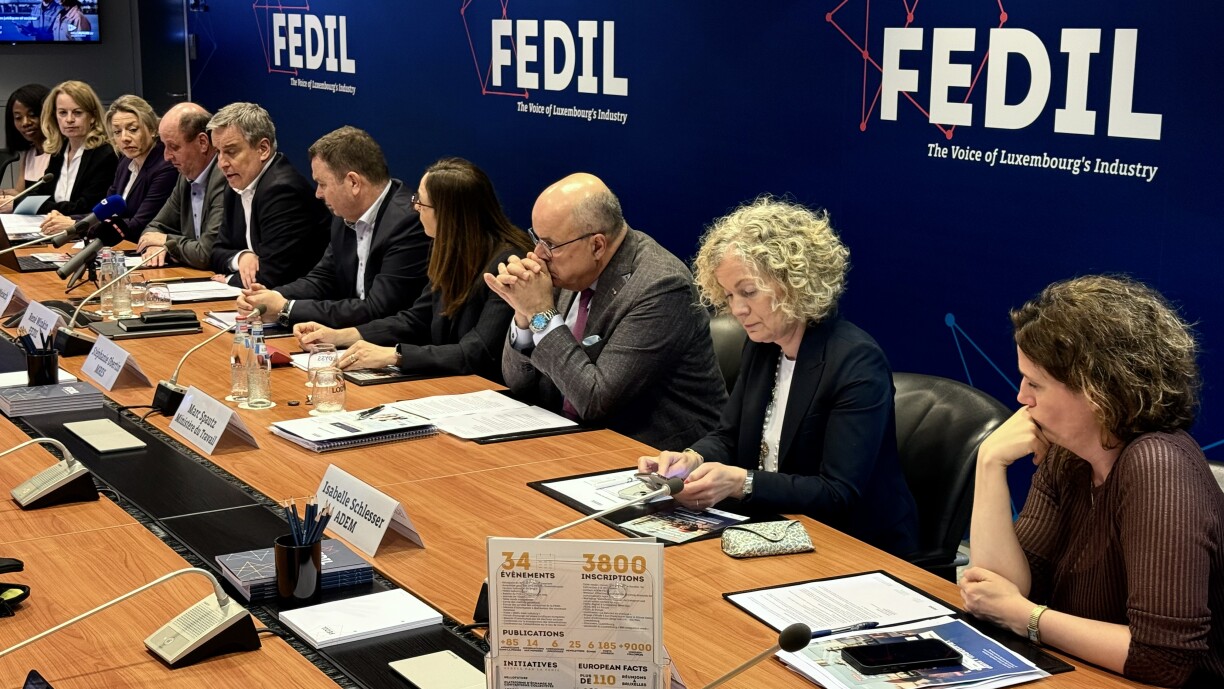
The Federation of Luxembourg Industrialists (FEDIL) has identified a new "positive dynamic" in the employment market for qualified professionals, forecasting a significant increase in hiring over the next two years.
Presenting the results of a survey of 92 industrial companies to the press on Wednesday, alongside three government ministers, FEDIL reported that the sector is set to hire around 3,000 people over the next two years. This figure represents a 53% increase compared to the previous survey conducted in 2024. Half of these positions will be in industrial processes. The construction sector also shows strong demand, with 590 jobs to fill. Additionally, nearly 400 positions are available in IT, and a similar number for administrative roles. More than half of these openings are newly created jobs, while the remainder are positions to be refilled.
FEDIL Director René Winkin expressed confidence that these positions can be filled, even though industry competes with the "different league" of the financial centre and the public sector. He asserted that Luxembourg's industry is "absolutely attractive" compared to other countries, highlighting its appeal through the manual nature of the work and distinct career opportunities. However, he acknowledged that recruiting people from abroad would be necessary to "fill the gaps."
Minister of Education Claude Meisch echoed this view, noting that the number of graduates from Luxembourg's own schools, at best, only replaces those retiring. He stated that out of roughly 6,000 school-leavers each year, about three-quarters hold a qualification. Meisch added that he is optimistic this rate can be improved through a "whole range of initiatives."
Regarding the specific qualifications sought, FEDIL noted a significant increase in demand for candidates with a bachelor's degree, which is now required for a third of companies' hiring intentions. This is followed by demand for holders of a Vocational Aptitude Diploma (DAP) and a Technician's Diploma (DT). According to FEDIL representatives, this breakdown underscores the growing need for technical and IT skills, or a combination of both.
Minister for Digitalisation and Higher Education Stéphanie Obertin viewed the findings as confirmation of industry's ongoing transformation. She stated that the FEDIL study helps identify workforce needs and guide programme adaptations, though she noted that "bachelor's and master's degrees adapt much more slowly and with much more difficulty than, for example, the BTS (Higher Technician Certificate)." This, she said, is why BTS programmes are being expanded.
When posed with the provocative question of why a university graduate would choose a career in industry, where average salaries are lower than in the public sector or financial centre, the assembled officials hesitated momentarily. Minister of Labour Marc Spautz was the first to respond.
"I know many who want to work for the state. But I also know many who say, 'I'd rather get some practical experience first, I want to go work in a company,'" Spautz said. He added that he is even aware of someone who resigned from the public sector to work in the private sector, though he conceded such moves are "rarer". Spautz, a former mechanic and trade unionist, also cautioned that the rigid career "mould" of 40 years ago no longer exists.
For those seeking employment today, a willingness to adapt or retrain is increasingly essential. When asked which profiles are registered with the National Employment Agency (ADEM) or which qualifications are struggling to find work, ADEM Director Isabelle Schlesser cautioned against broad generalisations.
Schlesser stated that one "cannot make a blanket statement" that jobseekers have simply chosen the wrong career path. She observed, however, that diplomas held by individuals from third countries are often not recognised and frequently do not align with current market needs.
Among the young people registered with ADEM, Schlesser clarified that it is not necessarily those with degrees in fields such as art history or marine biology who face difficulties. The agency also sees economists, lawyers, and even journalists among the jobseekers. She emphasised that while jobseekers need to remain open-minded, the same expectation applies to companies.
Those interested in pursuing a career in industry can find further information at hellofuture.lu.






