
This trend is fuelled by the allure of the prosperous Grand Duchy and a recent law aimed at simplifying the recruitment of immigrant workers.
However, experts from the Association for the Support of Immigrant Workers (ASTI) caution that not all advice from these videos is reliable.
A quick search for Luxembourg on various social media platforms will yield the usual portrayals of the world's wealthiest nation and some videos on city trips to do in the Grand Duchy.
But amongst these, one can find videos with enticing titles like "Immigrate to Luxembourg for free," "Do this to get a job in Luxembourg," or "Why you should move from Canada to Luxembourg."
These videos paint Luxembourg as an El Dorado, and its reputation certainly supports this perception. However, gaining access to the Grand Duchy's territory and labour market is not as straightforward, despite the removal of one obstacle by a recent law change.

The new law, effective since 1 September 2023, has a clear objective: to simplify the hiring process for third-country nationals (those from countries outside the European Union). This change stems from the mounting pressure on the Luxembourg job market.
A glance at the extensive list of occupations currently experiencing shortages reveals the challenges faced by the nation. Occupations such as credit analysts, financial market front-office roles, nurses, electronics technicians, teachers, lawyers, and various types of engineers are in high demand, with insufficient local applicants to fill these often highly skilled positions.
Previously, when an employer sought to fill these roles, the National Employment Agency (ADEM) was obligated to conduct a "market test" within three weeks, offering the job to registered jobseekers. European Union nationals were given preference. However, the new law eliminates this market test, allowing employers to directly hire candidates from outside the EU.
For positions not on the shortage list, the market test will still be enforced, albeit with shorter timeframes. The law also streamlines access to the labour market for third-country nationals benefiting from family reunification (further details are available here).
In summary, the new law aims to dismantle certain barriers that had previously favoured local labour, a development welcomed by the job market and third-country nationals.
Consequently, influencers on social media platforms have eagerly shared this information. But is all the advice offered trustworthy? To delve into this question, our colleagues from RTL Infos consulted an expert from ASTI.
The recently implemented law seeks to address labour shortages rather than simplify immigration procedures. It is expected to ease access to the labour market for specific professions facing shortages. According to Laurence Hever, a social worker at ASTI, the law, if correctly applied, could impact the number of applications for residence permits from employed workers.
However, Hever emphasises an essential detail, stating, "The application for this permit must be submitted before entering Luxembourg, either from the country of origin or from another European country if the applicant holds a residence permit in that European nation. Any application made from within Luxembourg will be deemed inadmissible."

To illustrate this point, Hever provides an example involving a Cape Verdean individual possessing a residence permit for Portugal. She clarifies, "This Portuguese residence permit is solely valid for Portugal, barring them from residing or working in Luxembourg. Such an individual may visit Luxembourg as a tourist for a maximum of three months. However, if they intend to work in Luxembourg, they need not return to Cape Verde to apply but can do so from Portugal."
In addition, Hever underscores that the residence permit's validity is limited to Luxembourg, and immigrants do not have the right to relocate across borders to circumvent property prices in Luxembourg.
She warns against such actions, stating, "Since their residence permit is only applicable in Luxembourg, they do not have the right to move to Arlon or Thionville. Doing so or providing a fictitious address in Luxembourg constitutes fraudulent behaviour."
The introduction of the recent law and the proliferation of informative videos on social media platforms have not yet led to a noticeable surge in applications for residence permits. According to Hever, it is too early to gauge the full impact of the law's implementation, and at ASTI's level, they have not observed a significant increase in applications. Instead, they have witnessed a rising trend in requests for information.
It is worth noting that some individuals misunderstood the law when it was initially introduced, assuming it was designed to regulate the status of undocumented migrants. Hever clarifies that this law necessitates an application process before entering Luxembourg, rendering it irrelevant for undocumented migrants. Therefore, the new law does not affect this particular group.
Hever also underscores the need for simplified and accessible communication regarding the chances of obtaining a residence permit and the consequences of irregular situations, both in legal texts and on Guichet.lu, the administrative procedures portal. Complex information can lead to misunderstandings and foster unrealistic expectations that may ultimately lead to disappointment.
While companies in search of highly skilled professionals often handle global recruitment and assist with administrative formalities, the path to Luxembourg poses challenges for others. The issue of diploma recognition is one such challenge, as a diploma obtained in a third country may not be acknowledged in Luxembourg.
This can result in a person obtaining a residence permit but subsequently turning out to be unsuitable for a job due to qualifications or behaviour. In such cases, employers may terminate trial periods, leading individuals to seek employment elsewhere, leave Luxembourg, or potentially become undocumented. Hever believes that the coming years will provide insights into the outcomes and trajectories of these individuals in the labour market.
Simplistic narratives surrounding immigration to Luxembourg do not sit well with Laurence Hever. She stresses the multitude of pathways to establish oneself in the country, asserting that there are numerous factors at play. Whether a third-country national is married to a Belgian residing in Luxembourg, possesses high qualifications, holds an employment contract, or has established contacts in Luxembourg, each situation presents unique circumstances that can influence the process, she notes.
When questioned about the number of migrants who may be disillusioned with the "Luxembourg dream," Hever highlights the complexity of the issue. She believes that individuals arriving in Luxembourg often bring differing expectations of reality, which may be either positive or negative.
While some may be shocked regarding housing prices, she underscores that other expenses are as high as they are in most places. However, she suggests that housing costs alone are unlikely to compel people to leave. Disappointment with the country is not the primary reason for departures. She clarifies, "People may feel that way, but most choose to stay because their circumstances here are still preferable to those in their countries of origin."
ASTI's role involves providing information about rights and responsibilities. If an individual has little chance of obtaining a residence permit, they are reminded of their obligation to return to their home country. It is not ASTI's role to persuade individuals to leave, but rather to inform them of the associated legal and exploitation risks. Undocumented individuals lack legal protections and are consistently vulnerable to exploitation, not only in terms of employment but also through various other forms of mistreatment. This includes the absence of overtime pay, paid holidays, family allowances, compensation for disability, unemployment benefits, and more.

The surge in the number of these videos has raised concerns about potential criminal networks hiding behind these online tutorials. Hever acknowledges that such a possibility is conceivable.
She notes that criminal schemes have historically existed in various forms, with some individuals disseminating immigration advice for financial gain, constituting scams. According to Hever, the rise of social networks has facilitated this process and underscores the need to question the motives behind these videos. Some creators may be motivated solely by a desire for social media recognition, while others may have ulterior motives, such as connections to networks that demand payment for assistance.
Hever also dispels the misconception that one must have a Luxembourg postal address before immigrating to the country. She stresses that the official requirement is an employment contract, rather than a pre-established address. She adds that those who plan their immigration effectively often have contacts in Luxembourg who can provide accommodation until they start working, considering the challenges posed by high housing prices.
Regarding concerns of potential social dumping resulting from the relaxation of immigration laws, Hever believes that the risk applies equally to third-country nationals and individuals from EU member states. She highlights that the Inspectorate of Labour and Mines has bolstered its staff, even if "it's still not enough." Recent inspections have led to the dismissal of many individuals lacking valid residence permits. These individuals cannot be regularised and may remain in undocumented situations, according to Hever.
The recent change has yet to significantly impact the number of residence permits issued, according to the Immigration Department. Data shared with RTL Infos indicates that, instead of witnessing an increase, there has been a decrease in the issuance of first-time residence permits.

Meanwhile, ADEM welcomes the new law as it grants them the ability to assess employers' job vacancy declarations in relation to the demands of the Luxembourg labour market. It is considered an advantage for attracting talent to the country, particularly during a period marked by labour shortages across various sectors, the Agency told our colleagues.
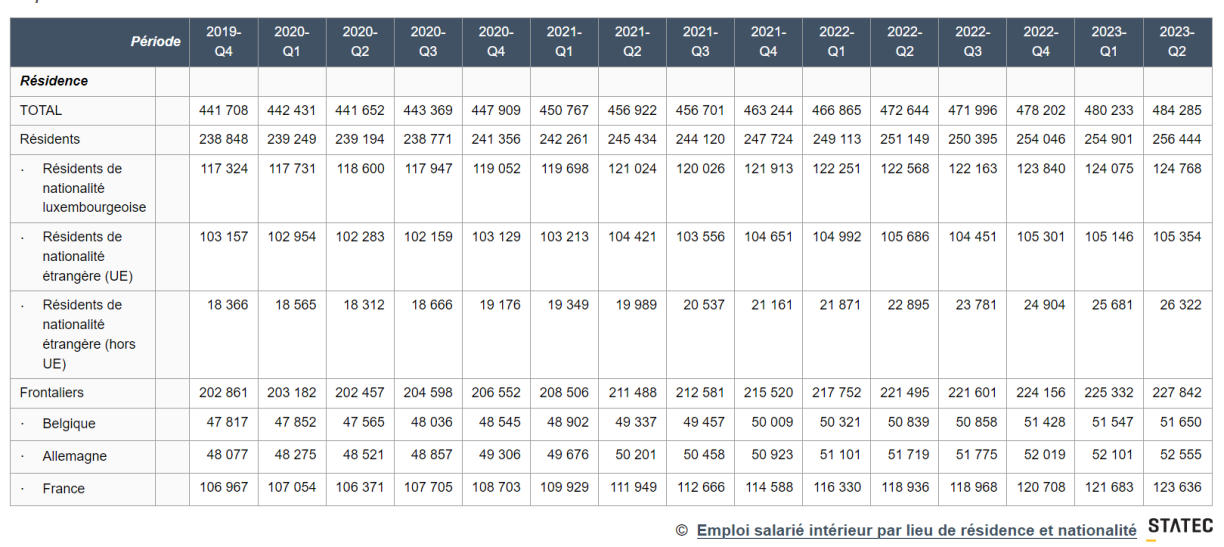
Over the years, the use of foreign labour has been on the rise. The number of "foreign labour" certificates issued by ADEM reflects this trend.

However, in the context of total salaried employment, the proportion of workers from non-EU countries remains relatively low, hovering at approximately 5%.
Regarding the return of third-country nationals to their home countries or their deportation to another EU member state, 189 such cases were recorded in 2022. This included 121 voluntary returns and 68 deportations. Nevertheless, ASTI emphasises the challenges in determining the exact number of individuals residing in Luxembourg without valid residence permits. Due to the risks associated with potential reporting, detention, or deportation to their home countries, many individuals "tend to be discreet about their situation and live in hiding," according to ASTI.





