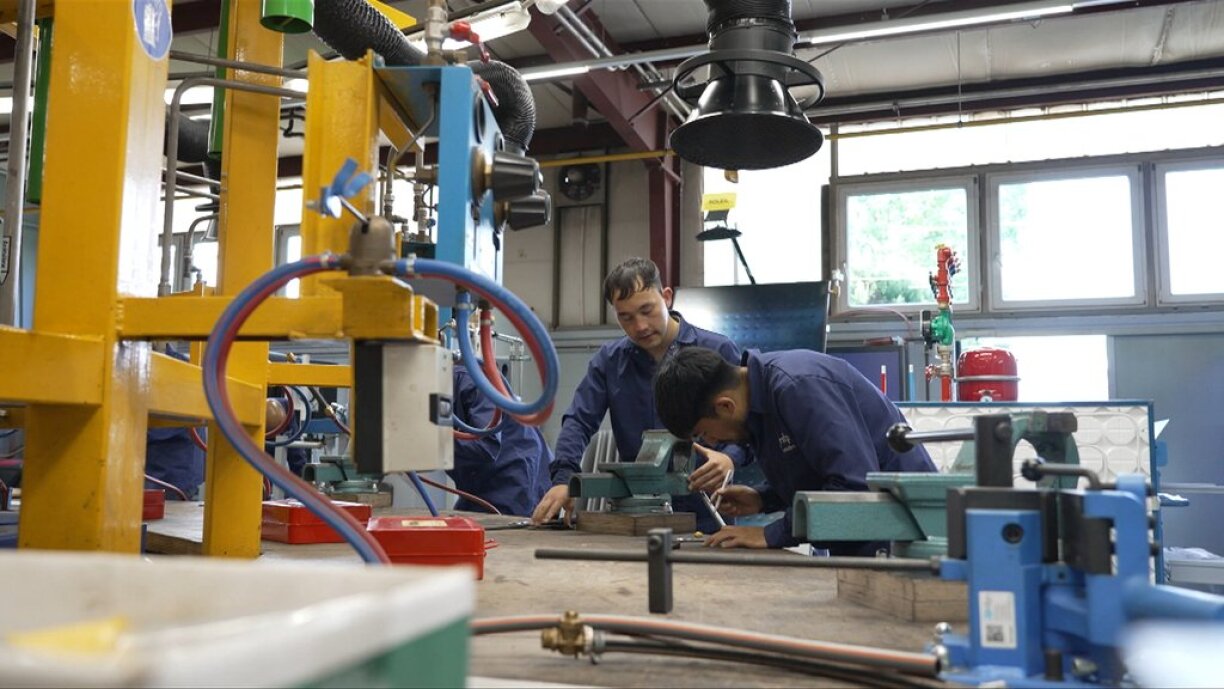
At the CNFPC (Centre national de formation professionnelle) training centre in Ettelbruck, vocational training is helping young refugees acquire practical skills and establish a foothold in the local job market. The programme, launched by the Education Ministry, combines trade-specific instruction with targeted language courses.
CCP Integration participants are young refugees who have completed a preparatory integration class (ALDILT) but do not yet have the French proficiency required for a standard apprenticeship. Instead of joining an employer, they begin their training at the CNFPC, where they spend 40 hours per week in a full-time work-like environment.
"We tried to achieve a result with the little French they knew", says veteran instructor Patrick Brust, who has been teaching at CNFPC for 35 years. "They've made huge progress. We speak together, explain on site, and include French in every practical session. And that's what leads to results."
Both the language and vocational courses are held on the same site. "They're incredibly grateful", Brust says. "Some even come into my office just to say thank you when we finish for the day." Internships in the private sector are part of the preparation to get them ready.
The programme, founded by the Education Ministry, is offered both in Ettelbruck and Esch-sur-Alzette and currently includes nine trades – ranging from catering to auto repair. Participants receive 60% of the apprenticeship allowance in their first year – between €363 and €549 per month, depending on the course.
Once placed with an employer under adult apprenticeship, they receive the national minimum wage of €2,704 per month.
In conversation with RTL, Education Minister Claude Meisch emphasised the need to offer refugees real prospects, not only as a matter of social responsibility but as a key factor in successful integration. Without access to work, he noted, integration becomes significantly more difficult.
Meisch added that the programme also provides valuable support to sectors facing skills shortages, particularly in the trades, by helping to train and recruit motivated individuals who are eager to build a future in Luxembourg.
For Brust, the first year has already shown results. "They've made real progress, they enjoy the work, and they're thankful for the opportunity", he says. It is important to him to give everyone, even the "weaker" students, the feeling that they are learning, because a lot of them never had that feeling before.
78 female and male apprentices began one of the nine training programmes in the 2024–2025 school year. Of those, 65 remained in the programme, including Collins, who, at 36, is the oldest in the sanitary technician group.
The apprentices come from various countries, including Afghanistan, Eritrea, Nigeria, Syria, and Somalia. Many arrive in Luxembourg without any French and speak languages that French teacher Béatrice Remillieux does not understand, which can pose additional challenges during lessons.
For her, it is important not to overwhelm the apprentices with too much grammar but rather to encourage them to speak freely. "French helps them integrate, and some even learn Luxembourgish", she explains. "But it's true that the most present language in their work and school life is French. They've understood that it's important if they want to integrate and work here."
As part of the state initiative, Collins from Nigeria is learning plumbing and heating. Holding a university degree in finance, Collins left his home country under forced circumstances. Now he is determined to integrate through both language and qualification. "The work is a bit difficult but manageable. The language is harder", he admits. "But I try my best – I understand better now and I speak too."
Lazgin, originally from Syria and the youngest in the programme, had his schooling disrupted by war and finds the prospect of working for a real employer exciting. "It'll be hard, but I see it as a good opportunity for me", he says.
Nuwairat from Tanzania has been living in Luxembourg for 12 and a half years and is currently learning French at the centre. Previously qualified as a medical lab technician, she is now training to become a cook.
"I arrived in Luxembourg without speaking French. I learned everything here", she says, adding that she already knows where she wants to work next: at a maison relais.
For Collins, it is all about what comes next. "It's a new beginning", he says. "Everything's kind of strange and new – but I can't wait."





