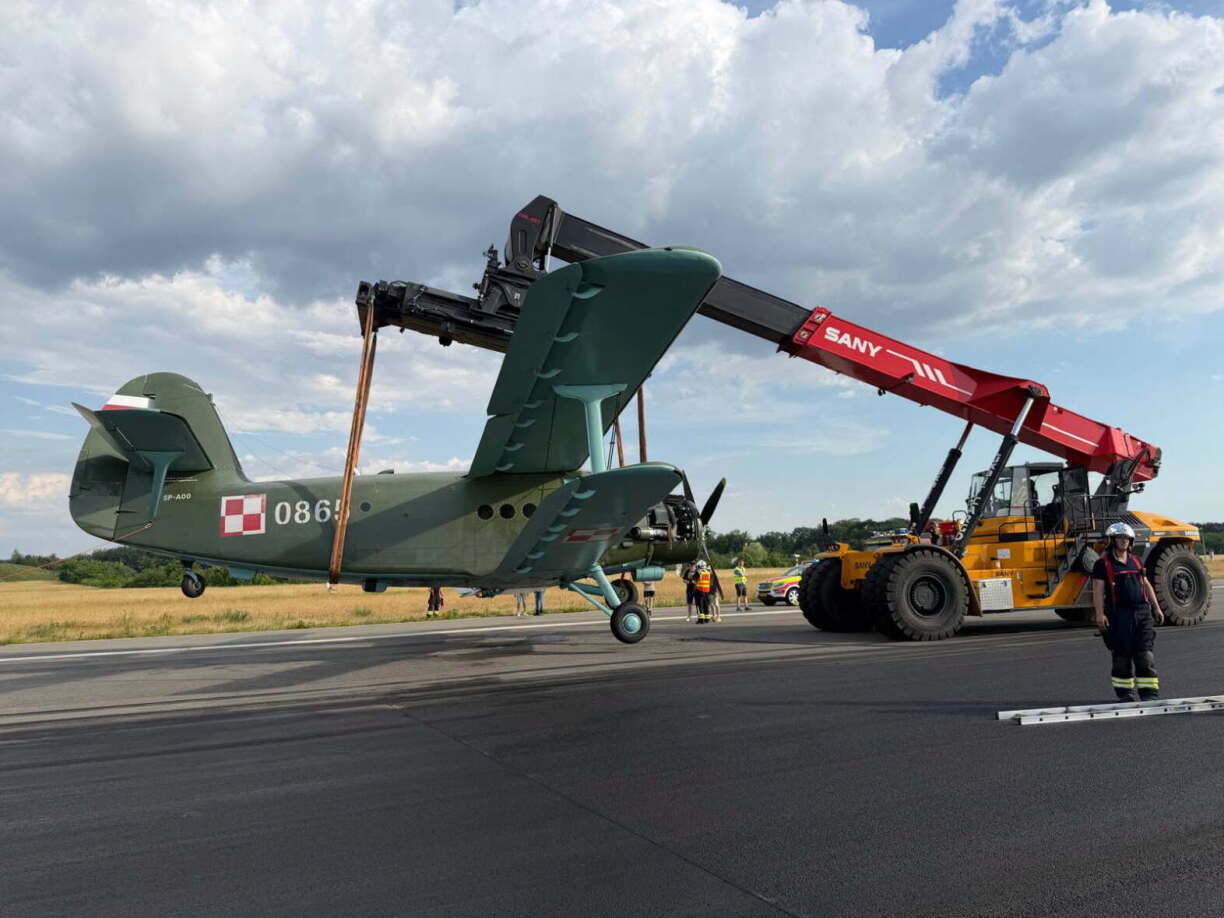
A vintage plane, the Antonov AN-2, had an accident on the runway at Findel shortly before 5pm on a Sunday afternoon. No one was hurt. It appears that the landing gear gave way, leaving the plane no longer under control, according to the director of Lux-Airport, Alexander Flassak. Three hours later, the runway was able to reopen.
The most important thing, Flassak said, was that nothing had happened to the ten passengers, the pilot or the co-pilot. After the accident, the priority was to get the runway open again as quickly as possible. The technical investigation, he explained, first had to release the aircraft. The Grand Ducal Fire and Rescue Corps (CGDIS) then had to work out how the plane could be recovered, an operation that took three hours, as it had the day before. The runway was inspected, everything was cleaned and flight operations were once again deemed safe.
Flassak did not want to speculate on what had caused the accident, saying a technical analysis would provide clarity. The pilot of the Antonov, who has been flying the aircraft for 15 years, spoke to RTL about a side wind that he believes caused the left tyre of the plane to buckle and the wing to break open on the runway. The incident had knock-on effects for 5,200 passengers, around a third of all flight passengers on a Sunday at Findel.
Luxair director Gilles Feith puts the damage to the airline at an estimated €200,000, made up of hotel costs and rebookings. More than 3,500 Luxair passengers and 44 flights were affected.
The fact that planes were still able to take off but not land was down to the entire runway not being available, the Lux-Airport director said. Operational constraints had to be dealt with afterwards, he added, with a view to seeing what could be improved in future, although in his view the best had been made of the situation on Sunday.
Sunday's accident was not the first of its kind, and the mix of private and commercial aviation at Findel, against a backdrop of heavy traffic, is becoming increasingly fraught. Coexistence at the airport is getting harder, Flassak said. In November last year, air traffic was severely disrupted after a light sports aircraft accident, and now Sunday had brought another such event, with huge knock-on effects over the three hours that followed.
In the long term, the picture is clear, namely that sports aircraft should no longer operate out of Findel. That position is also reflected in the master plan for the airport's future. He noted that Lux-Airport was not opposed to sports aviation, and would like to see the hobby and the sport preserved, but said it was hard to reconcile with the large cargo aircraft, the commercial planes and the strong growth at Findel. Even minor disturbances, he noted, now have outsized consequences.
Every aircraft allowed to fly into the airport, including private ones, holds a licence and has been checked for safety, Flassak pointed out. The Antonov involved in Sunday's incident, a post-Second World War design, was registered in Poland but was permitted to operate at Findel, where it was based.
The Lux-Airport director also clarified that no damage to the runway had been found during the inspection that followed the accident. He pointed instead to the report now being drawn up, which will shed light on what caused the crash.





