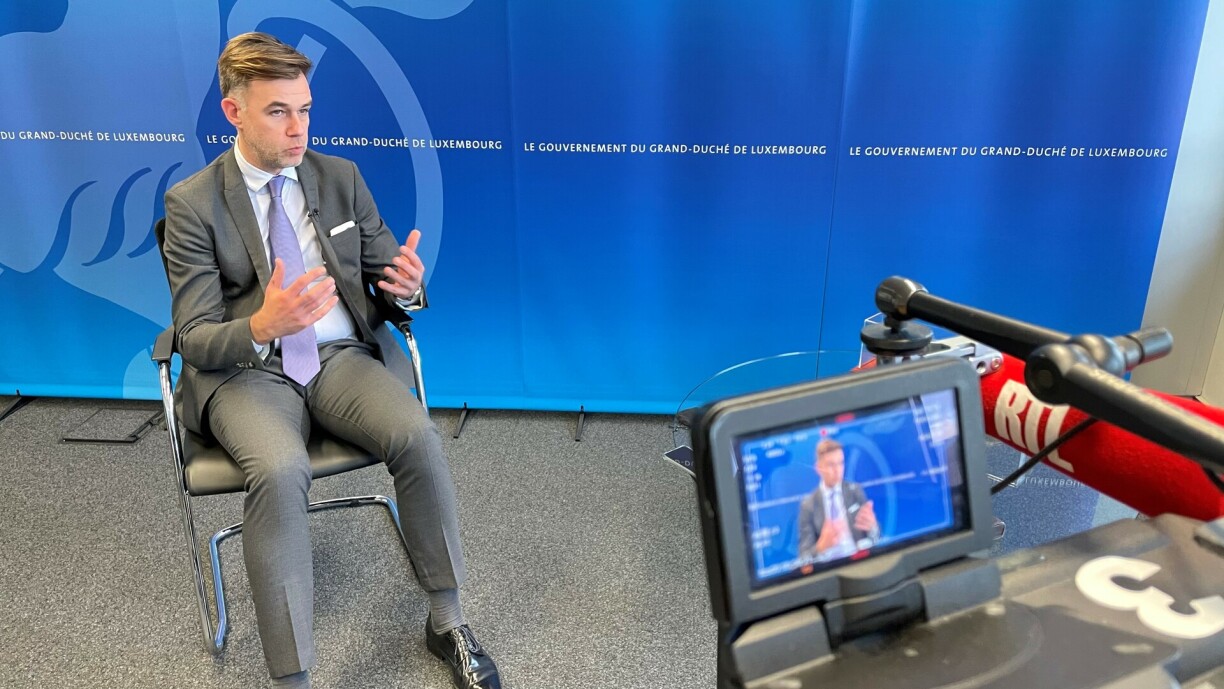
December 2020 marks ten months into the health crisis, accompanied by restrictions that will continue well into January 2021.
It remains "a difficult year but with hope of a good recovery next year," Franz Fayot says. As the country's Minister of the Economy, he assures that Luxembourg's economy "is in better shape than that of our neighbours and that of the euro zone", and considers the Grand Duchy "relatively resistant" to the waves of the virus.
Video report in French:
While the service sector, led by the financial centre, has been able to work fairly normally and success stories such as that of B Medical Systems (which produces freezers for vaccines) are emerging, the overall picture remains "fairly mixed". 2020 is "still a horrible year, a very difficult year, especially for vulnerable sectors such as the Horesca, tourism and events, which are suffering enormously".
RTL: What are the positive aspects revealed by the crisis?
Franz Fayot: One positive aspect is our solid resistance capacity. We have strong companies, a healthy economic fabric. Through our stabilisation measures and through "Neistart", we have been able to support companies, to preserve employment with short-time working. With all our instruments of aid and advances that we have made available we have stabilised our companies, which is great news.
The other positive aspect is that we have become aware that we cannot go back to our previous state. The idea of green recovery and digitalisation, which is very strong, has shown that we must invest more into the circular economy. We have to move away from this previous linear model which was too intense in terms of consumption of resources. I think that these concepts appeared more clearly with this pandemic and has encouraged us to take a a different revival approach.
What weaknesses have emerged and how should they be addressed?
Covid-19 is not a democratic virus - it hit the weakest, the people who were already socially vulnerable. It increased inequalities. It is first and foremost those who are on short-time work, earning only 80% of their income and who work mostly in vulnerable sectors that are most affected.
What's more is that after then months it's starting to get very difficult psychologically. And of course there is bankruptcy looming in some companies that we must fear now, especially with this second wave.
Which sectors are most affected?
The hospitality sector and everything that depends on event tourism, which had a strong presence in Luxembourg, from caterers to advertising agencies. We have decided to help all these professions, to support them through this ongoing crisis, and we will continue to do so. But it is a fact that all these professions are suffering.
.
In addition, there is bad news in certain industries: at Guardian Luxguard, the decision was taken to shut down the furnace in Dudelange, with as a result a number of jobs being cut. Fortunately the worst was avoided thanks to a social plan.
We also have ongoing restructuring at ArcelorMittal which involves job cuts. Here too, we are doing everything possible to make it as socially bearable as possible. Furthermore, with regards to civil aviation, Luxair has been hit hard and mostly grounded. But within the framework of a tripartite approach a solution has been found that I think is effective.
Read also: Franz Fayot: Retail to close in the event of a "hard lockdown"
Partial unemployment, social minimum wages, business support... how long will the state be able to put its hands in its pockets to support the economy?
The European framework for Covid aid has been extended until June. The political question now arises as to whether the states would like to extend it further. But it is clear that we cannot open up the floodgates forever.
There is a question of managing public finances with a deficit that continues to grow, a debt that is becoming increasingly large and that must continue to remain bearable, especially for the small states. We know that Luxembourg is heavily dependent on its good rating to be able to refinance itself.
.
At some point, a transition mode will have to be reached. We're going to come out of this very broad aid package and I think that it will arrive in spring together with the vaccine, which will still be widely present. But it will undoubtedly be necessary to arrive at much more precise, more granular aid plan than what we did initially.
We are already proposing aids in this spirit of virtuous, green, digital, etc. revival, such as Covid aid that we are going to extend until the middle of next year.
Read also: Exclusive interview with PM Xavier Bettel
What projects will be urgent for you in 2021?
I set myself the goal of trying to transform the economy into a more sustainable, more circular and more digital economy. The pandemic has accelerated this agenda and this is perhaps the only good news of the year: we have all realised together, including at European level, that we must now transform our economies in the direction of green infrastructure, renewable energy, increased digitalisation. We must generate growth that is kinder to the environment, more equal on a social level.
The Covid filter shows us that our excessive development has reached a point of no return ...
Absolutely. I'm convinced. This pandemic, rightly interpreted as a crisis in our consumption pattern and a certain violation of our ecosystem, has also helped us to have the political courage that we perhaps lacked previously to resolutely enter into this transition.
In the past you have been in favour of higher taxes on capital. Today, as Minister of the Economy, do you still support it?
Yes, but be careful, I have always said that I was in favour of stronger taxation on heritage and especially of heritage which is not productive. As we have seen with the Covid, the most resilient companies are those in which shareholders and investors have always continued to invest.
What has always bothered me is this imbalance between the taxation of labour income and the low taxation on the capital invested in real estate, the non-productive rents which generate inequalities and which are not no longer very good for the economy.
I am still of this opinion but we must find the right formula and a tax that is efficient, fair and that does not penalise investment in the economy.
Read also: Claude Meisch: "I'm proud we insisted on keeping schools open."





