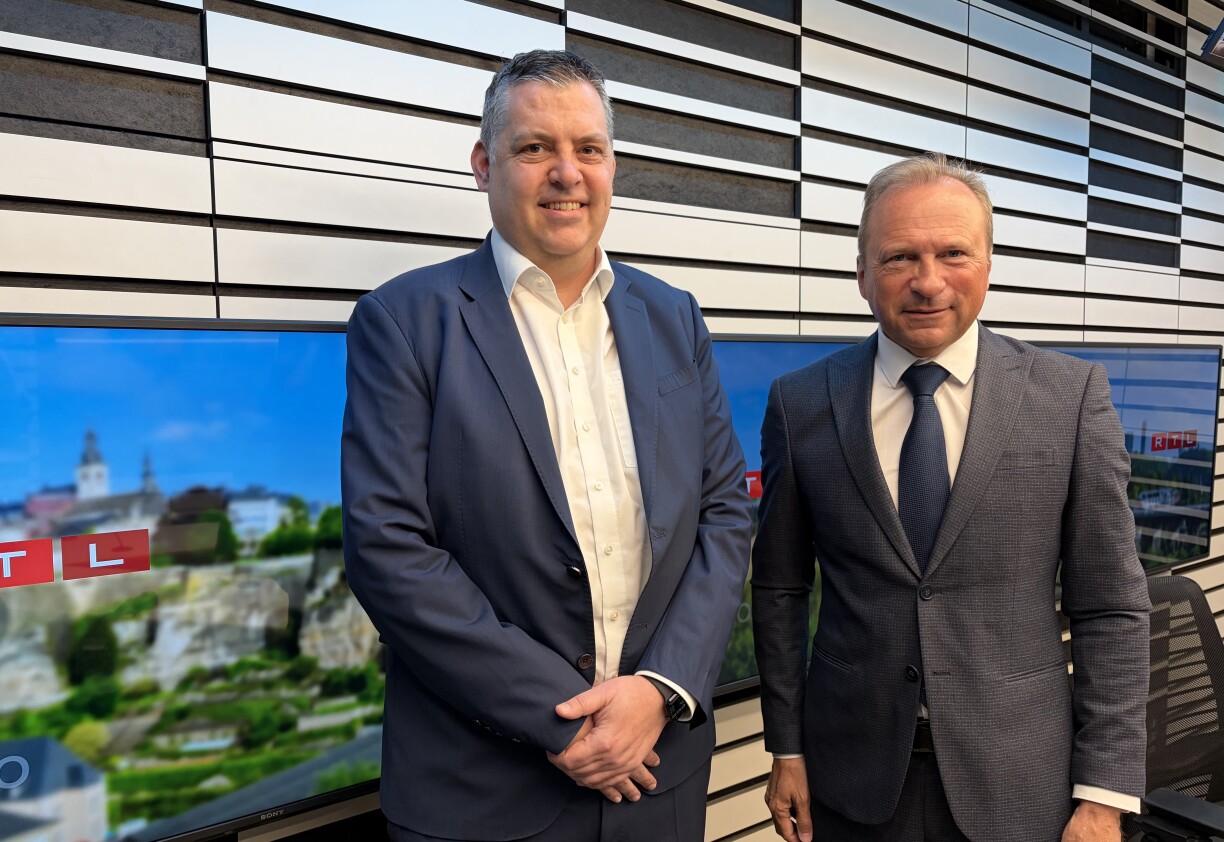
In an RTL face-to-face debate, Luxembourg's Finance Minister Gilles Roth and Chamber of Employees (CSL) director Sylvain Hoffmann discussed how fair the country's tax system is, amid ongoing reform plans and calls for greater equity. The debate comes as the CSL has launched a campaign calling for a fairer, more ambitious, and more sustainable tax reform, while the government is itself working on changes to the tax system.
For Hoffmann, the central problem is clear: labour remains too heavily taxed, while capital and wealth are not taxed enough. He argued that inequalities in Luxembourg are historically high, not only in terms of income but even more so in terms of wealth.
In his view, the tax system does not sufficiently respect the principle that people should contribute according to their means. He pointed out that capital income is taxed less heavily than income from work, and said the system is also not progressive enough at the top end.
Roth acknowledged that no tax system is ever perfect, including Luxembourg's, but stressed that the country already has a progressive system under which higher incomes pay more tax.
He highlighted measures taken to ease the burden on lower incomes, including making the minimum wage tax-free, and said it was especially important not to place ever more pressure on the broad working middle class. He also defended the government's plan for a single tax class and regular adjustments of the tax scale to inflation.
A key point of disagreement concerned the taxation of capital gains. When asked whether it was fair that someone earning €100,000 through work is taxed differently from someone making the same amount by selling shares held for more than six months, Roth said he would be open to discussing a longer holding period. He suggested that the current six-month threshold for more lightly taxed capital gains on shares could potentially be extended to one year if that contributed to greater tax fairness and brought in additional revenue.
For Hoffmann, however, such a change would remain only a limited correction. He argued that the system's overall progressiveness is weakened by several mechanisms, including untaxed capital gains on shares, the partial taxation of dividends, and the special impatriate regime, under which highly paid workers recruited from abroad can benefit from major tax advantages.
In Hoffmann's view, this means the middle classes shoulder a disproportionate share of the tax burden, while the contribution of higher-income groups has tended to shrink.
The issue of top tax rates also divided the two interviewees. Hoffmann argued that Luxembourg's top rate should be higher and that additional tax brackets should be introduced. Roth replied that the government agenda does not provide for an increase in the top rate.
Roth nevertheless insisted that Luxembourg's current top rate is already high, reaching 45.78% once the solidarity surcharge is included. He also pointed out that 1.5% of private taxpayers account for 24% of all personal income tax receipts, while 4.5% of taxpayers contribute 45% of the total, which he said showed that broader shoulders already bear more of the burden.
Hoffmann countered that the burden remains too concentrated on middle-income earners, especially between roughly €26,000 and €50,000 a year, where tax progression is steepest. He also criticised the government's proposed inflation-adjustment mechanism, saying it would come too late and would in effect mean many households pre-financing the reform through years of paying too much tax through bracket creep.
The CSL director also called for greater taxation of wealth. He cited inheritance and property taxation as two areas where Luxembourg remains far less demanding than many other countries.
He argued that large fortunes are especially favoured and said reforms targeting major property owners and large inheritances could generate additional revenue at a time when the state faces growing social, environmental, and digital challenges.
Roth rejected the idea of introducing an inheritance tax in the direct line, noting that the government agenda does not provide for it and that both coalition parties were clear on that during the election campaign. He also argued that the revenue potential would remain limited, given the relatively small number of very large inheritances each year.
On wealth taxation, he said such a tax had been abolished for private individuals in 2005 because it was difficult to assess assets fairly and because, at the time, those who declared everything honestly ended up paying, while others could more easily escape it.
On property tax, Roth stressed that this is a municipal rather than a state tax and said any increase would have to be handled carefully, especially in peri-urban and agricultural communes.
Another major area of disagreement concerned corporate taxation. Hoffmann criticised the planned reduction in corporate tax, saying it would deprive the state of revenue that could otherwise help finance tax reform more fairly.
He argued that while lower rates do not necessarily generate more revenue, they do often mean less money in the public purse. He also pointed to studies suggesting that companies' effective tax rate in Luxembourg is in practice far below the headline rate once deductions are taken into account.
Roth defended the government's approach, saying Luxembourg operates in an international environment and must remain competitive.
He noted that average corporate tax rates across the OECD have fallen significantly over the past 25 years and said Luxembourg is simply seeking to align itself with that broader trend. He also warned that a relatively small number of large companies account for the vast majority of corporate tax revenue, meaning tax policy must be handled with caution if the country wants to remain attractive.
Roth also defended the regime for highly qualified workers recruited from abroad, saying Luxembourg's financial centre depends on specialised talent and competes internationally for such profiles. He argued that the scheme is subject to conditions and time limits and is necessary to support sectors that play a major role in economic growth and tax revenues.
Hoffmann, for his part, said he disliked the very term "talent", arguing that all those who come to work in Luxembourg bring talent, and that more effort should be made to remain attractive to cross-border workers too, not only to highly paid specialists in finance.
Towards the end of the debate, the discussion widened to the current economic situation. Hoffmann said relief measures should be discussed in light of high energy prices, which tend to hit lower-income households hardest, especially those who rely on their cars to get to work and cannot necessarily afford electric vehicles.
Asked whether a tripartite meeting might be announced later in the day, Roth said that such a format had indeed been called for from almost all sides, but added that it would be up to PM Luc Frieden to make any formal announcement. Pressed on the matter, Roth said he was naturally open to social dialogue.





