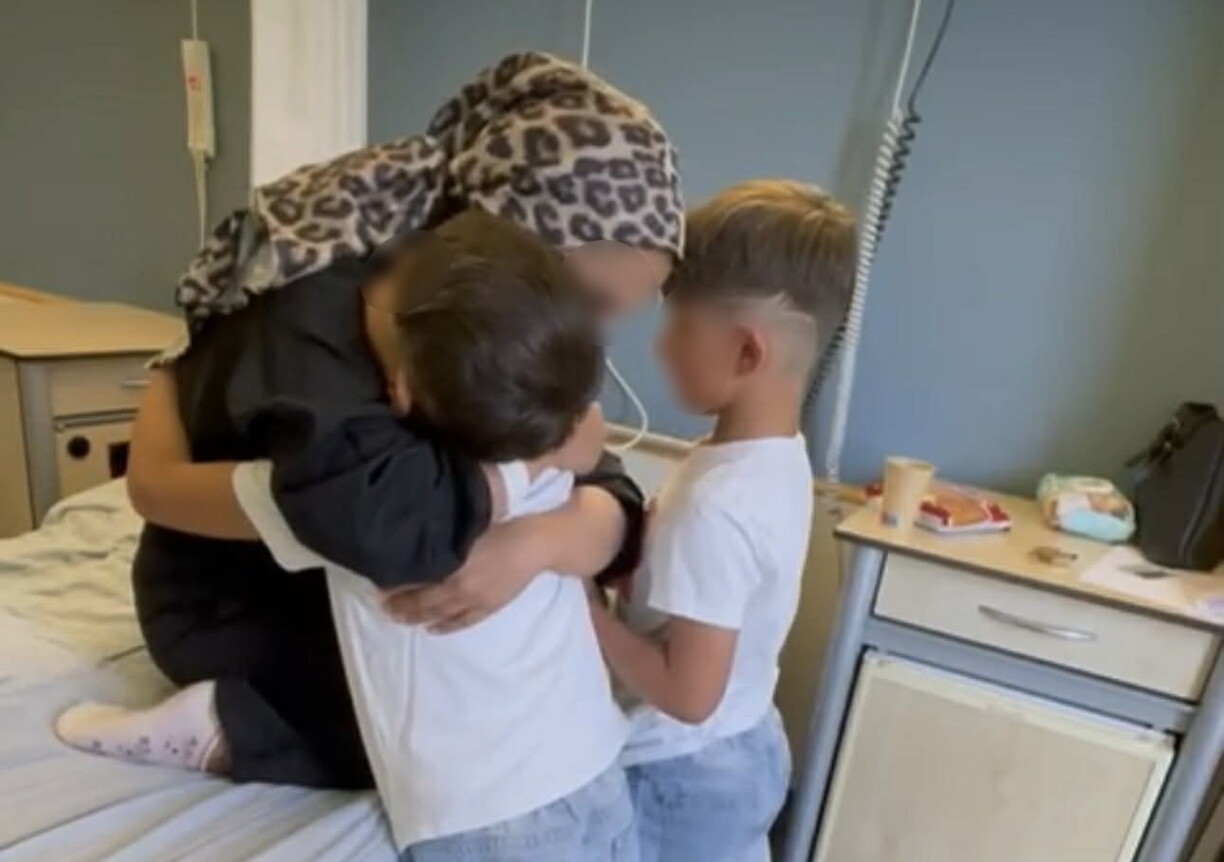
Editors' note: The woman in this story requested anonymity for personal reasons. Her identity has been verified and her name changed.
Each morning, Zainab Karimi wakes in a small room in a Red Cross Camp in Luxembourg, sharing it with her two children, aged nine and six. She faces the same impossible choice: continue chemotherapy in conditions that are destroying her mental health, or abandon treatment and risk her life. She has chosen to stop treatment.
"In such a confined space, the treatment itself is even harder than the illness", she says.
Her story highlights a systemic gap: asylum and housing policies fail to account for urgent healthcare needs.
Karimi, a Syrian woman in her 30s, is from a village near Aleppo. She was studying engineering when the war began. In 2013, she fled to Turkey and lived there for more than a decade, facing what she describes as "severe discrimination".
Hoping to secure a better future, her husband left for Luxembourg, secured employment and a residence permit, and then arranged for her and their children to join him.
Shortly after arriving in the Grand Duchy in 2025, she was diagnosed with cancer. "From that moment, our suffering began", she recalls.
Karimi's husband has lived in Luxembourg for four years, working full-time at Stëmm on a recurring one-year contract, earning enough to pay rent. Despite this, their family remains in a camp with conditions unsuitable for a person undergoing cancer treatment.
The barrier is not money. It is bureaucracy. To obtain a residence permit as a family reunification case, Luxembourg requires a fixed housing address outside the camps. But to rent an apartment in the private market, landlords demand a residence permit, permanent work contract, and proof that household income is at least twice the rent.
The system creates a deadlock. "We are trying to find housing, but we are not able to secure anything", she explains. "When we do find something, the response is that they require a permanent work contract, residence permits, and that our income be at least twice the rent."
When the family approached housing organisations for help, they were told the same thing: "We cannot help you without residence permits, and many others are waiting for housing opportunities and already have permits."
Karimi and her two young children have been in limbo for a year.
The psychological toll of living in an overcrowded center – four people in one small room, shared kitchens, no privacy – has become incompatible with her recovery. Doctors have urged her to continue chemotherapy, but Karimi has refused.
"The most important factor in my recovery is my psychological state, and it is completely absent", she says. "I am extremely mentally exhausted because of the pressure I am living under, which makes recovery from my illness almost impossible."
The camp conditions are affecting not only her health but her children's as well. "My children are suffering psychologically because of the lack of stability", she says. "We are living in a camp, all four of us in one small room, without privacy or comfort. They see my struggle with illness every day, and they are constantly afraid of losing me. This makes me even more distressed for them than for myself."
The hygiene conditions compound the stress. A shared kitchen used by more than ten families is located next to her room. "The smells and noise disturb me every day", she describes.
When Karimi raised concerns about the camp conditions, she says the responses have not led to real change. "My condition is urgent and requires immediate attention, yet I still feel that my situation is not being taken into consideration."
The medical care itself is relatively good; most of her treatment is free, but the environment in which she must recover is actively undermining that care. She is caught between a healthcare system that can treat her disease and a housing system that prevents her from recovering in adequate conditions.
Her husband's employment, which should be a pathway to stability, has become almost irrelevant.
"It is very painful to feel that all solutions are blocked, especially since my husband works and does not receive any assistance", she says. "We are trying to rely on ourselves, and we can afford to pay rent. We just need a chance to get an apartment, so I can continue my treatment and we can obtain our residence permits."
Karimi's case is not unique. Many families in the camp have expressed similar concerns. Some have remained there for years. The overcrowding, noise, and poor hygiene affect everyone, especially children and people suffering from serious illness.
Luxembourg's asylum housing system is under strain. The private rental market is competitive and expensive, with landlords reluctant to rent to people without residence permits or permanent contracts. As a result, many vulnerable people remain trapped.
When asked what she would say to readers, Karimi says: "We are all human beings who deserve dignity and suitable conditions. I appeal to you to help me and save my life for my children's sake. If someone is willing to rent me an apartment, I can pay rent and resume my treatment."
On the urgency: "Housing is the only barrier between me and a potential recovery. Time is not in my favor due to the progression of my illness. I need housing as soon as possible."
Karimi's hopes for the future are modest: to live in peace with her children, for them to have a better future, and to return to her profession in non-surgical cosmetic medicine after she recovers.
But recovery requires more than medicine. It requires a home of her own, a door she can close, and a system that recognises that some barriers to housing are barriers to life itself.





