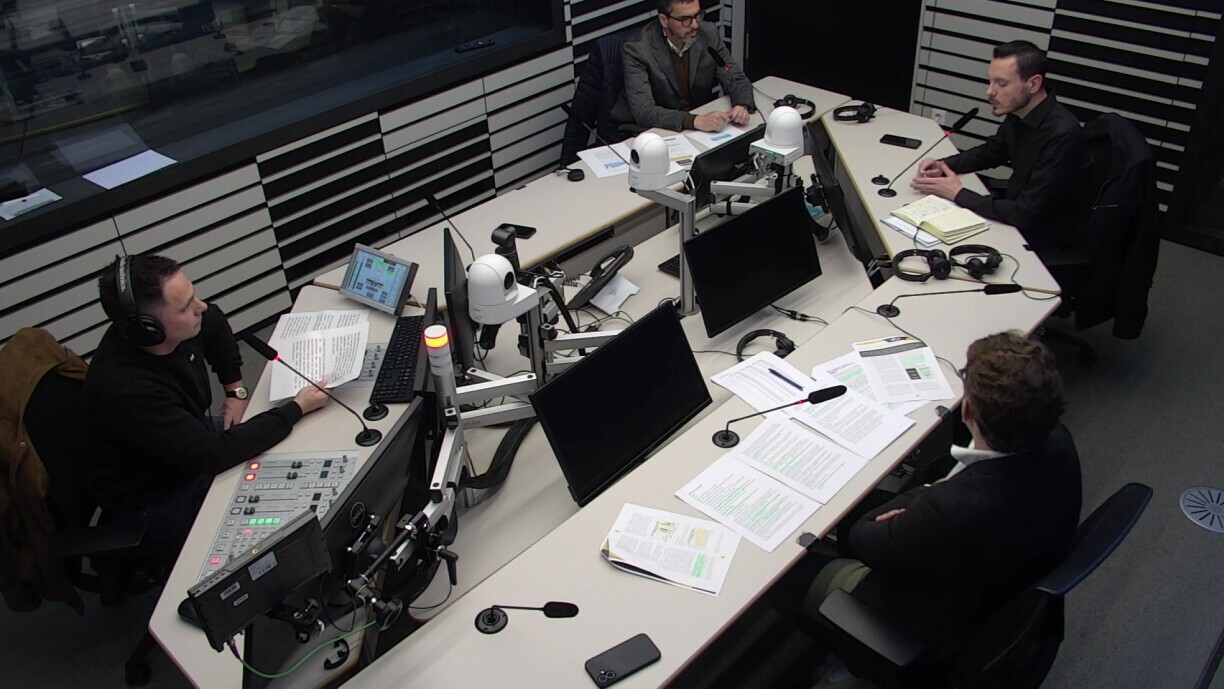
Our colleagues from RTL Infos discussed the current state of Luxembourg's housing sector with guests Pierre Clément, director of Nexvia; Julien Licheron, researcher at the Luxembourg Institute for Socio-Economic Research (LISER); and Soufiane Saadi, CEO of the atHome group.
The year 2025 proved challenging for the off-plan (VEFA) market, with the final quarter proving particularly difficult – a trend Steve Vermeer had correctly predicted last December. The bottlenecks remain unchanged. The existing property market, however, appears to have found its equilibrium.
The end of 2025 was revealing for Luxembourg's property market. The sharp decline in new-build activity (-62.4%) confirms the windfall effect created by government subsidies, which expired last summer. While activity in the existing property sector also fell compared to the end of 2024, the drop was far less pronounced (-25.6%). In the final quarter of 2025, 996 sales were completed in the existing market, compared to 146 in the off-plan market. "This is good news," said Nexvia director Pierre Clément, noting that for him, it shows the existing market is in balance.
Unlike the new-build sector, where activity collapsed, there was no sudden halt after the housing package ended – despite the State buying up certain property projects. The Luxembourg government's efforts, though substantial, do not appear to have achieved the desired effect. Activity was boosted for a few months, but this led to a slight increase in prices followed by a steep drop once subsidies were no longer available. "That is the problem with subsidising demand," Julien Licheron pointed out.
Speaking to RTL Infos recently, Antoine Paccoud provided an insightful explanation of the windfall effect: the underlying problem is not being solved, only postponed. Traditional mechanisms seem to have lost their effectiveness, as interest rates and prices have become too high to generate attractive yields for buy-to-let investors. Those who once drove the property market no longer find it worthwhile – and they are not alone. As has been heard often in recent years: "All the investors have disappeared."
As a result, Luxembourg is now building very little. Soufiane Saadi, CEO of the atHome group, confirmed that the few people still interested in off-plan properties today are looking for a home to live in, not to rent out. According to Minister of Housing Claude Meisch, this is a model that must and will reinvent itself. Measures to that effect are planned in the next housing package, though details remain scarce even as time is of the essence.
"We do not even know when it will be announced," Clément noted. For any measures to take effect in 2026, they need to be introduced quickly. The Nexvia director recalled that there is a lag between the announcement, public awareness, and full understanding of new policies. "Property takes time," he insisted, "You apply for financing, then you look for the property, you visit several of them." Regardless of the housing package, he added, the headache is far from resolved.
The effects of the war in Iran are only beginning to be felt in Europe, with talk already emerging of interest rate hikes and rising construction costs. The surge in fuel and energy prices will inevitably be passed on to a multitude of sectors, including construction. This comes even as a window of opportunity appeared to have opened with the decline in land prices over the past two years. "By paying less for land, we can offer projects at lower prices," Licheron observed.





