Parc Merveilleux has become one of Luxembourg's most recognisable family attractions, welcoming generations of visitors since opening its doors on 17 May 1956. Now celebrating its 70th anniversary, the Bettembourg park, which today attracts nearly 300,000 visitors a year and employs around 200 people during peak season, is reflecting on a history marked by rapid success, financial struggles, and an eventual revival under the management of the social care association APEMH.
The idea for the park originated with Dutch landscape designer Wilhelm ter Brake, who had organised a flower exhibition in Mondorf-les-Bains the previous year that drew around 150,000 visitors from across the Greater Region. Inspired by the success, ter Brake proposed creating a permanent fairytale park featuring plants, animals, and playgrounds.
After other locations – including Mondorf, Kockelscheuer, and Weiler-la-Tour – failed to materialise, a site was eventually secured in the Mosselter forest in Bettembourg with the support of the local municipality and private investors. When the park officially opened on 17 May 1956, visitors discovered a large playground, a driving circuit for children, a restaurant, a stage, animal enclosures, and the famous fairytale houses inspired by the stories of the Brothers Grimm.
The attraction quickly became a success: During its first season alone, the park welcomed around 111,000 visitors. By August 1963, it had already received its millionth guest.
Throughout the 1970s, the park became one of Luxembourg's leading tourist destinations and in 1976, it recorded a then-record 219,000 visitors.
What many visitors do not realise, according to the park's technical director Marc Neu, is that the site has a much darker history predating the leisure park itself. During the Second World War, the area was reportedly used by the German army as a Reich Labour Service camp, while also being the site of military exercises.
Despite the site's wartime past, development moved ahead rapidly after municipal approval was granted in late 1955.
After years of growth, the park entered a difficult period in the late 1970s and 1980s. In conversation with RTL, Neu said visitor numbers were strong and money was flowing in at the time, but insufficient reinvestment eventually took its toll.
"When profits are distributed to shareholders instead of being reinvested, you eventually notice the consequences", he said.
The park gradually lost its appeal as facilities deteriorated and new competitors emerged, including large municipal playgrounds and attractions across the French border, such as the zoo in Amnéville and the Big Bang Schtroumpf theme park (known today as Walygator Grand Est).
Visitor numbers collapsed from 130,000 in 1989 to just 108,000 the following year. Efforts to attract investors failed, with one German group proposing rollercoasters and a Chinese investor reportedly wanting to clear part of the forest to build a pagoda-themed village.
A turning point came in 1997 when APEMH, a Luxembourg association supporting people with intellectual disabilities, stepped in after the park restaurant went bankrupt. The organisation had already been searching for a second operational site beyond its facilities in Bettange-sur-Mess and eventually took over ownership, using the park to expand its training programmes for people with disabilities.
The first challenge was restoring badly neglected infrastructure.
"Everything was dilapidated", Neu recalls. "Electrical cables were lying just five centimetres under the ground. Sometimes the old plans showed infrastructure where nothing existed anymore, and elsewhere there were things not shown on the plans."
By the early 2000s, management realised more ambitious investments were needed to fully revive the park, whose attendance had dropped to around 70,000 visitors annually.
With financial backing from the Luxembourg state, the Amazonia tropical house opened in 2003 and became a major attraction almost immediately. A Madagascar-themed area followed in 2008.
Beyond its role as a tourist attraction, the park also functions as an important workplace and training centre. Around 100 people with disabilities work or train at the site, supported by roughly 40 supervisors and administrative staff, alongside seasonal workers and students.
Speaking to RTL, animal caretaker Steve described his daily responsibilities as cleaning enclosures, preparing feed, and caring for animals in the petting zoo. "You need patience and you also have to be able to work independently", he said.
Another employee, Melissa, explained how she helps visitors interact safely with birds and other animals. "When I arrive with food, the animals come closer and I feed them by hand so people can see they are not dangerous", she said.
The park has been a permanent member of the European Association of Zoos and Aquaria since 2008 and now houses more demanding species, including wolves.
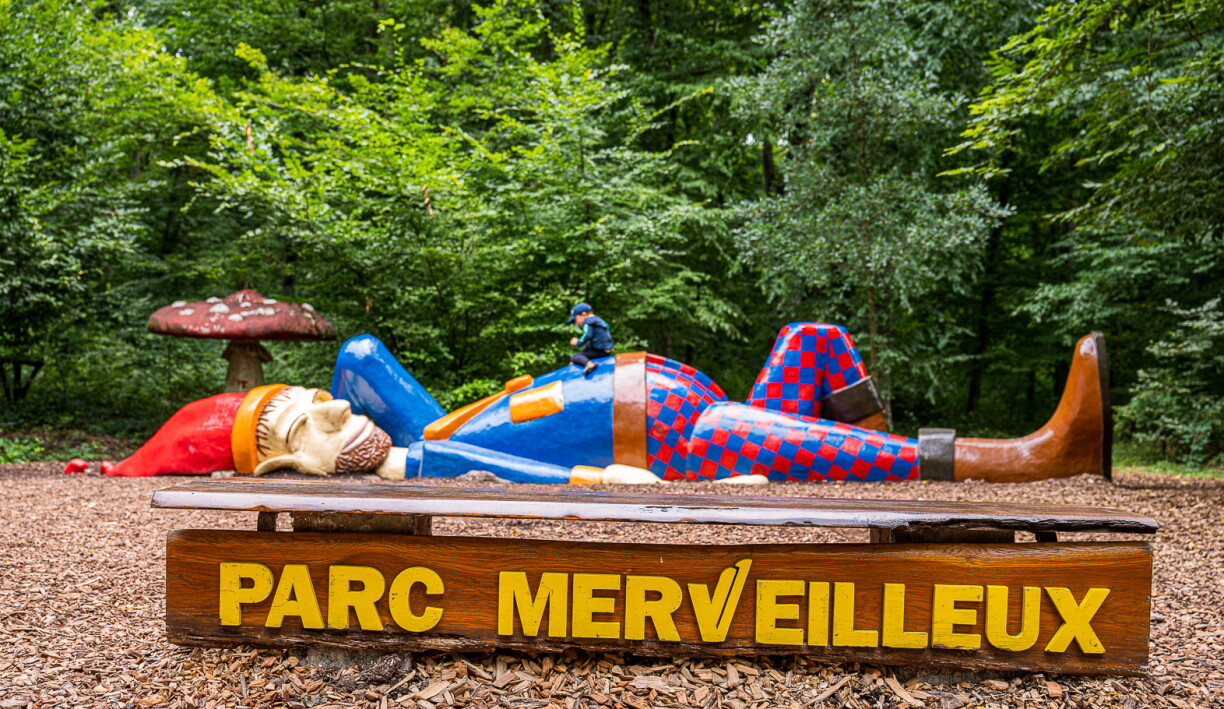
Among the park's best-known figures is the sleeping giant, originally part of the 'Little Thumbling' fairytale display. According to Neu, the giant once had a small figure standing beside him, but the character repeatedly disappeared after visitors took it home.
Eventually, management decided to give up on the smaller figure and leave the giant "alone".
The character was then revived through a comic book project titled 'De Ries geet op d'Rees' ('The giant goes on a journey'), which came to fruition in the context of Bettembourg's 2022 cultural programme. Today, it is undeniable that the giant has become "a bit of the park's mascot", according to Neu.
Although the park officially turned 70 this month, major celebrations are planned for 2027 to coincide with the 30th anniversary of APEMH taking over operations. Since the association assumed control, visitor numbers have rebounded strongly, reaching more than 290,000 in 2023.
Management says the park's mix of playgrounds, animals, and gastronomy, combined with relatively affordable ticket prices, continues to give it a unique place in Luxembourg's leisure landscape. However, directors warn that major structural renovations will soon be needed again – even if visitors may not immediately notice them.





