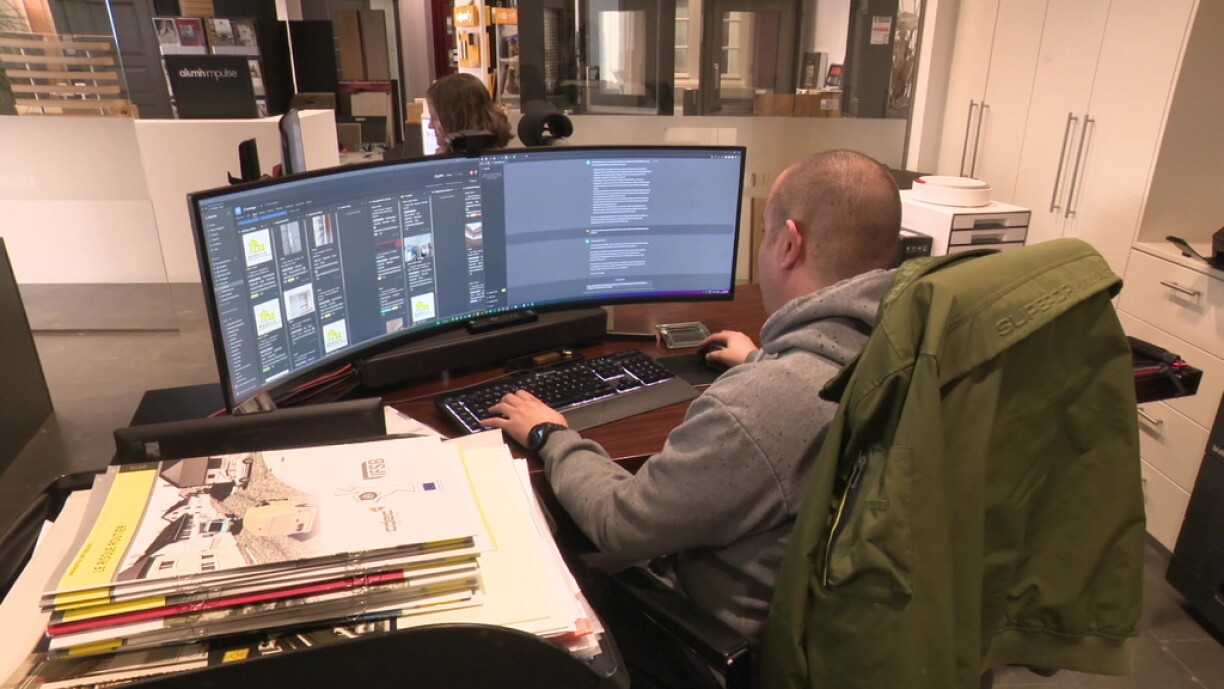
Thanks to ChatGPT, a carpenter's workshop in Hosingen is able to automate texts for its website and messages to customers, saving the company a lot of time.
While the artificial intelligence is still in a test phase, shop owner Paul Bisenius is already optimistic about future uses: "Once the system has access to our working hours, purchases, spending, and so on, then it will be able to make a full analysis and assess which sites are going well and which aren't. It can then help analyse potential problems."
ChatGPT is a programme launched by start-up company OpenAI. It is able to consult large online data sets and then compile responses to questions using artificial intelligence. These responses might range from one or two sentences to several paragraphs depending on the nature of the question.
At the moment, ChatGPT is growing faster than TikTok, with Microsoft recently investing $10 billion to integrate the programme into its Office software.
AI researcher Patrick Glauner from the Deggendorf Institute of Technology leads a bachelor's course on AI and allows his students to write part of their papers with the help of ChatGPT.
Glauner argues that this will prepare them for the working environment of the future: "Professions are changing, it has been like that since the industrial revolution, and it will happen here too. Those who are more likely to put people out of work are the competitors who use such tools. For example, if you're in contract hiring, your competitor might just be a hundred times more effective by using such tools, which means that you have a problem."
The university professor does not believe in resisting technological change. He estimates that ChatGPT might even be replaced by a more powerful programme in the not too distant future.
In Luxembourg City, one law office is aware of the advantages that AI can bring and has begun testing a specialised version of the programme called Harvey.
The use of AI saves lawyers an estimated two hours of work per week, says associate Patrick Mischo: "Harvey is an aid for lawyers, one can use it to conduct research, carry out an analysis, or draft a first project, such as a contract. But, Harvey is not flawless and can make potential mistakes by using wrong sources or wrongly associating texts. That means anything delivered first has to be checked."
At the same time, the lawyer drew attention to the fact that AI can only be used in certain areas and that it is unthinkable to have it act in a court of law or be in contact with clients.
Our colleagues from RTL also put ChatGPT to the test to see if it can be manipulated on purpose to spread false information. For instance, can it write an article about North Korea detonating an atomic bomb?
Also, the information used by ChatGPT only goes as far as September 2021. The use of the programme further raises questions of data protection and it might be that OpenAI will soon face legal issues as ChatGPT occasionally uses information protected by copy rights.
In any case, our interviewees believe that no jobs will be cut due to ChatGPT.





