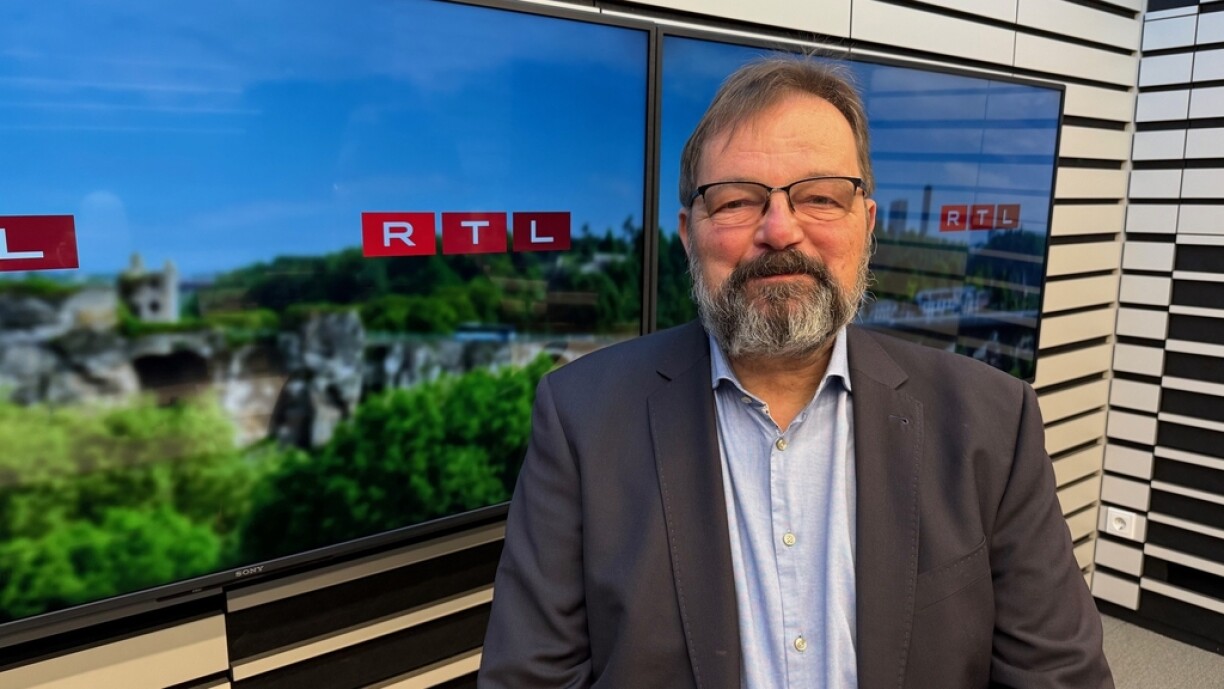
How far does the responsibility of board members extend? That is one of the main questions arising in the Caritas case, after it came to light on Radio 100,7’s podcast “Carambolage” that one member of the board knew that there were problems before everything became public. To help address this topic, Charles Muller was our guest on Monday morning’s “Invité vun der Redaktioun”.
The independent administrator and lawyer specializing in corporate law explained that he would not comment specifically on the Caritas scandal. However, in principle, a member of a board can be held liable if errors occur within a non-profit association (ASBL). Liability is based on three key points. First, a damage must occur. Second, a mistake must have been made. Then the question arises: who made the mistake and how? And third, there must also be what is called a “causal link.” This means it must be proven that it was exactly that mistake that caused the damage. This would require a lengthy process with many elements, and the judges would have to decide on it.
A board member must act as a “good head of the family.” Unfortunately, this definition is somewhat vague. But generally, there seems to be a lack of standards. These standards should be clearly defined, and that is where the state must come in. For example, it should be stated how often finances need to be reviewed and how the finances are organized. If these standards are not met, it would be considered a mistake. Then, someone could be held accountable.
Accordingly, it could also become costly for members of the Caritas board, as they had not extended their civil liability policy, a detail which also came up in the 100.7 podcast. In a case where a court decides that a mistake has occurred, this could have financial consequences, Muller explained.
Charles Muller highlighted the importance of insured administrative councils, even within smaller associations. In Luxembourg, it is not too expensive in the grand scheme of things, yet it saves later trouble. Smaller associations can also take advantage of lower costs.
“I believe that people who are volunteering for associations outside of their jobs, putting in many hours for the good of others, deserve to be insured, at least”, asserts Charles Muller.
In other countries, such standards are already in place. Some countries do not differentiate between non-profit organisations and companies. Charles Muller is an active participant in the ILA, the Luxembourg Institute of Governance, where people involved in the financial sector and on boards of directors come together to work out the above-mentioned lacking standards. They recently set up a work group focusing on developing standards for non-profit organisations as well. However,regardless of what standards may be set, they are not regularly monitored unless an error has happened, Muller explained.
Usually, it is the responsibility of a general assembly to oversee the board’s work, in order to prevent said mistakes.
The lawyer also chose not to comment on the case at Mudam. In January, president Patrick Majerus resigned after having pointed out issues with the new director for some time without anything being done. Charles Muller clarified, however, that Mudam is not an ASBL, but rather a “public establishment” with a very specific statute. Therefore, there is a law that applies to it. In this case, there are many decisions that the board cannot make without the approval of the minister. In general, however, it is the duty of a board member to raise issues. In the worst-case scenario, there could be a vote of no confidence if people disagree. If a person ends up in the minority, they would have to accept the consequences and effectively resign.





