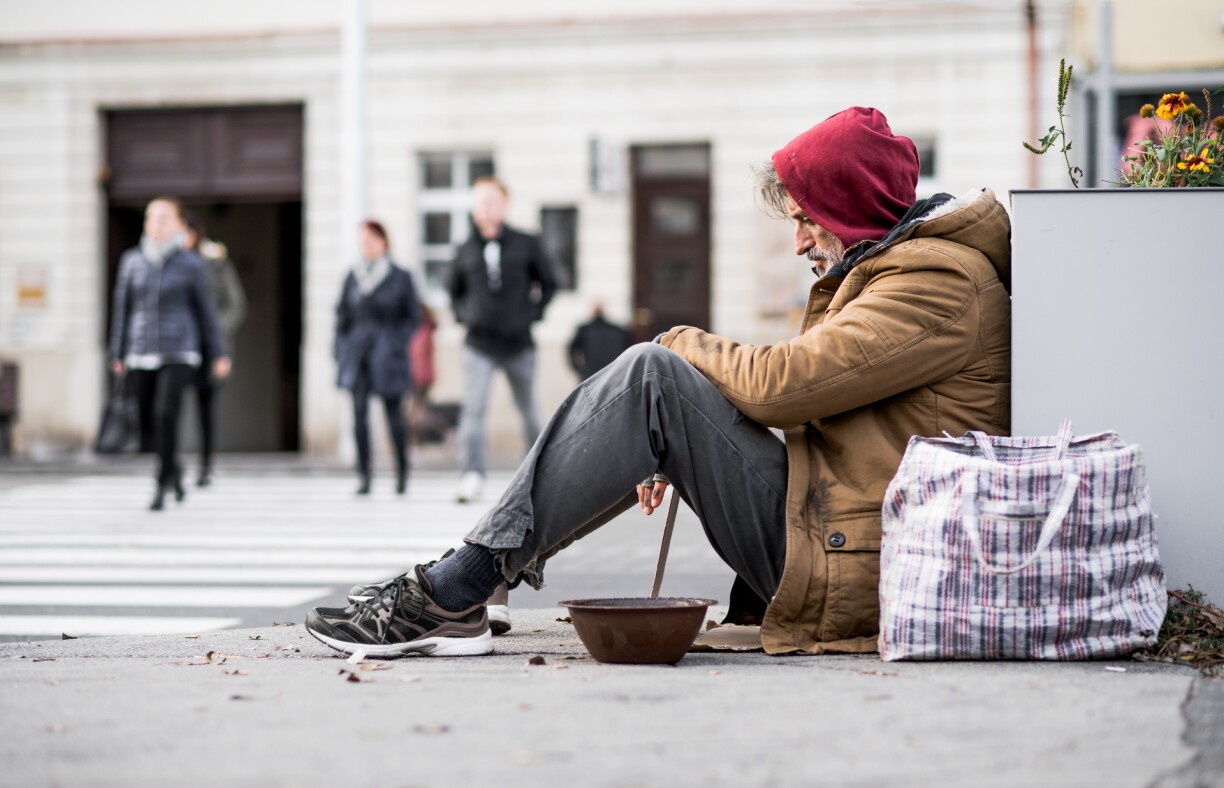
"Insecurity is currently one of the biggest problems" for the city's shop owners, Mireille Rahmé-Bley, president of the Luxembourg City Business Association (UCVL), told RTL Radio on Tuesday. This is undoubtedly a "recurring problem at the central railway station, but one that we have not seen to this extent in the city centre. And the scale of the phenomenon is growing", she said.
Rahmé-Bley highlights two phenomena in particular: organised begging and shoplifting. The president of the UCVL speaks of "beggar tourism". Beggars "are part of a city, and we have always had them", she says, before adding, "but it can't be that people purposefully come to Luxembourg City from abroad to sit on every corner of the city".
The trouble is that "there are simply too many of them at the moment". And the reason there are so many of them on the streets of the capital, according to Rahmé-Bley, is because "there is a lot of money to be made here, otherwise there wouldn't be so many of them". With just over a year to go before the local elections, the municipality's elected representatives "must do something", according to the UCVL president.
Rahmé-Bley wonders what shop owners are supposed to tell their customers: "Come to the city, but don't wear a watch and leave your jewellery at home and be careful with your wallet..."
Shoplifting, in addition to begging, is a "increasing concern." Shop owners have told Rahmé-Bley that "there is a lot of shoplifting going on in the shops." The big shops have a security service, "but the small shops cannot afford it", says the UCVL president.
Rahmé-Bley recognises the usefulness of the restraining order granted to the police since the respective law was passed in July, but the à vos côtés ("at your side") service launched by the non-profit Inter-Actions provides concrete help to show owners.
Insecurity, the tram construction site, expensive commercial leases, and the opening of the Cloche d'Or shopping centre "have driven shop owners away from the central railway station", the UCVL president explained.
While there is "a real demand" to open a business in the city centre the area around the central railway station is "more problematic".
Avenue de la Liberté is "very beautiful" today, but in Avenue de la Gare "there really are a lot of empty shops". This is particularly regrettable, Rahmé-Bley said, because these are "relatively large shops". "We'd need one or two 'big names'" to take over and "make others want to set up shop", she suggests.
The commercial season was "relatively good" and "the sales also went well", Rahmé-Bley acknowledges. This was mostly due to a "very hot summer" and the "return of tourists". But it is also partly because people "feel like" going out and engaging in consumerism after two years of Covid-19-related restrictions.
People "spend their money differently," according to the UCVL president, who added that "people calculate more and buy in a more targeted way." Everything is becoming more expensive, including food, "which has repercussions for the restaurant sector in particular."
Rahmé-Bley stated that most shopkeepers "are very satisfied with the street market". To compete with the shopping centres, the UCVL decided to extend the Grande Braderie to Saturday and Sunday, but with the message that "the real Braderie with outdoor stands takes place on Monday." On Saturday, the shops "could put out a few racks". On Sundays, the UCVL "always has the same problem that few shops participate," Rahmé-Bley stated. But this time, those who participated "were very satisfied with their Sunday sales".