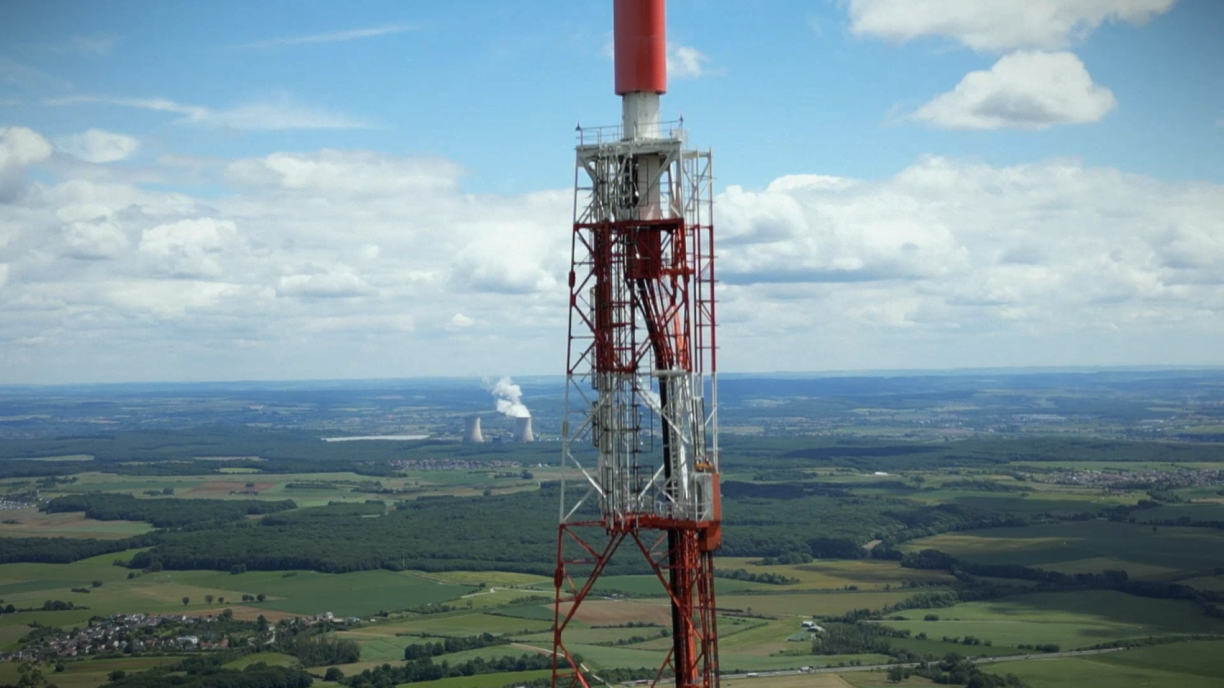
It is a true landmark for cross-border commuters travelling to Luxembourg via the A31 – as well as for Luxembourg residents returning home – and is visible from very far away.
Its summit is the highest point in Luxembourg. Standing on the spot known as "Ginzebierg" (427 metres), the Dudelange transmitter measures 300 metres in height – as tall as the Eiffel Tower. However, it weighs 10 times less: "only" 900 tonnes.
Along the A31, it serves as a marker in the landscape, visible from afar and very clearly from the Beauregard viaduct in Thionville, for example. For Luxembourg residents returning from holiday, as well as for the nearly 80,000 cross-border workers who daily use this motorway route – among the most congested in France – the aerial signals that they are approaching the border.
From its top, the view encompasses Dudelange, the entire south of Luxembourg, and the Cattenom nuclear power station. On a clear day, one can see as far as Nancy Cathedral in Meurthe-et-Moselle, and in the opposite direction, all the way to the church in Bastogne, Belgium. Both are situated more than 100 kilometres from the mast.
"The purpose of this pylon is to broadcast over a long distance. So you need height and transmission power", explains Vincent Demarque, a transmission engineer at Broadcasting Center Europe (BCE), a subsidiary of RTL Group that manages the transmitter, all the adjoining infrastructure, and the maintenance of the pylon.
Standing at the foot of the immense metallic behemoth – which has a 40-metre footprint – Demarque explained that it is the primary broadcasting site for Luxembourg media. The country's three main FM radio stations are located here, each with 100-kilowatt transmitters. Additionally, there is digital terrestrial television (DTT), including the Luxembourg television channel RTL Télé Lëtzebuerg and Dutch television channels. Since 1 December 2026, BCE has also been broadcasting digital radio in DAB+, with a dozen radio stations (RTL Radio Lëtzebuerg, Today Radio, Eldoradio, LORFM, Crooner Radio, and others) broadcast from the heights of Dudelange.
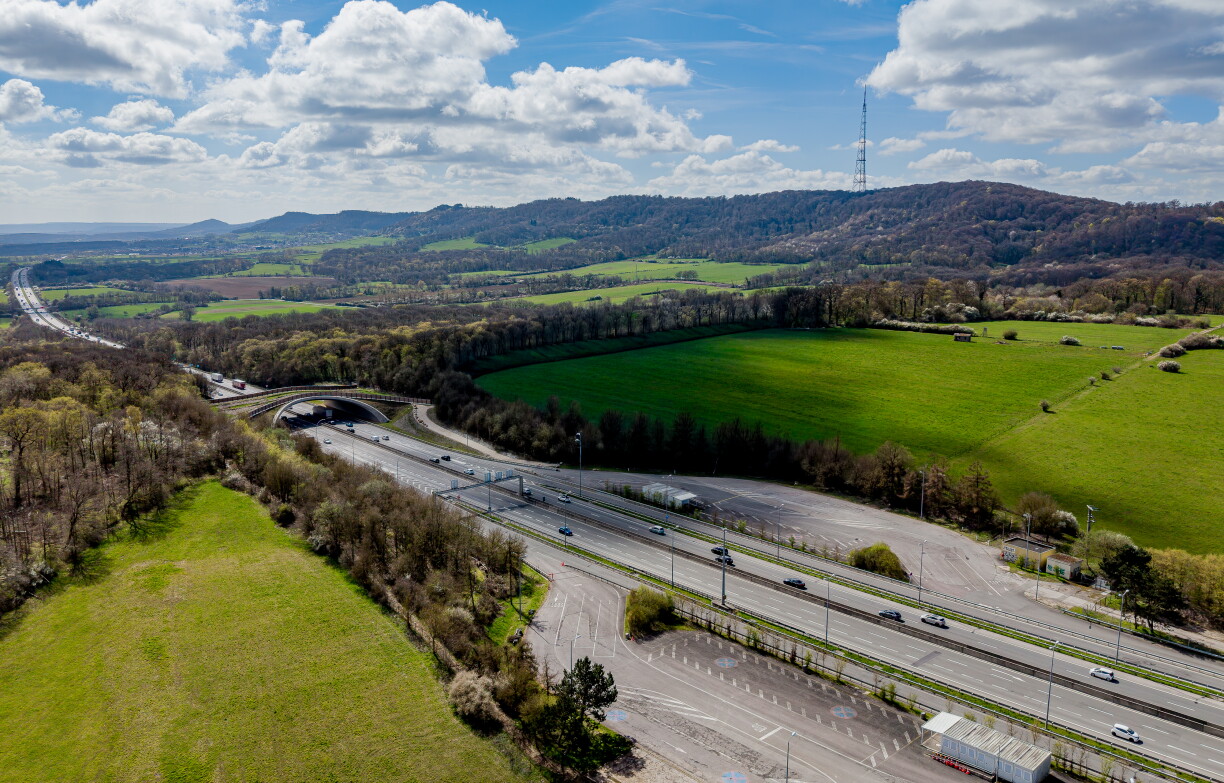
In reality, the three-legged mast, striped with red and white bands and flashing with lights at night, is merely a support structure. The aerials are attached to it. Before being routed to the aerials nearly 300 metres above ground and transmitted at high power over a radius of 150 kilometres, the waves are generated by transmitters. These are located in the technical rooms inside the "legendary" building constructed directly at the foot of the pylon.
The Dudelange transmitter site was the first television broadcasting site built in Luxembourg and housed the country's very first television studios. It was from there that the first television images were broadcast. The inaugural programme by Télé-Luxembourg – a historic pioneer of private channels in Europe – was broadcast from Dudelange on 23 January 1955. It was not until 1957 that Télé-Luxembourg relocated to the famous Villa Louvigny, very close to the centre of Luxembourg City.
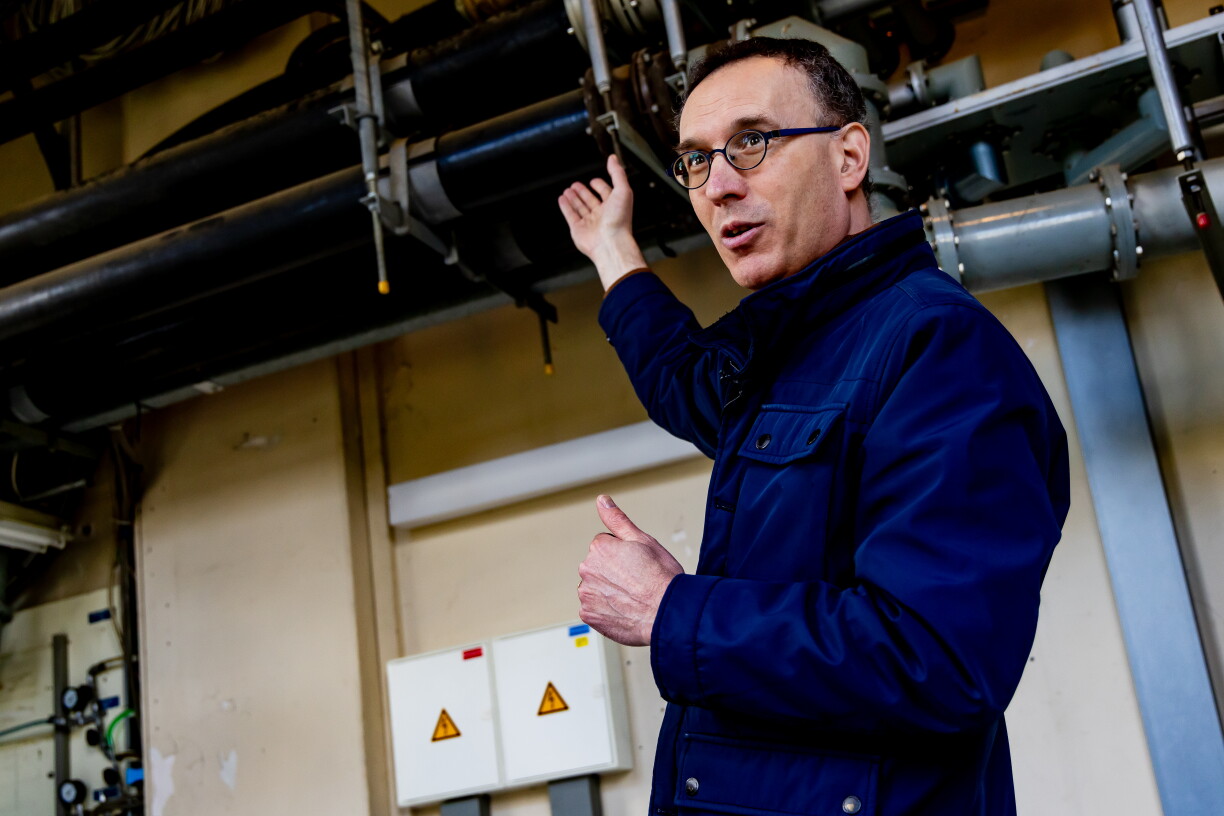
In the 1950s, demand for television and radio broadcasting was high, peaking in the 1970s and 1980s. Nowadays, transmitters take up much less space and demand has decreased. Demarque noted that channels such as RTL Belgique and RTL9 have moved to France. Today's transmitters are much smaller because they are far more efficient, miniaturised, and transistorised. In the past, they were bulky and energy-intensive. They heated up and had to be cooled, Demarque recounted while standing in what was once the main transmitter room, where modern cabinets now occupy infinitely less space.
But the history of the transmitter is not as straightforward as its silhouette suggests. The pylon visible today from the A31 has "shed its skin" over time and is now half of its former self.
The first pylon installed on the back of the Ginzebierg in 1954, right at the start of the venture, measured 213 metres. The concrete bases where the guy-wires were attached to secure this first mast are still clearly visible on the site. A new 300-metre-tall pylon was erected in 1972 by a French company named "Paris". But this is not exactly the pylon that remains today.
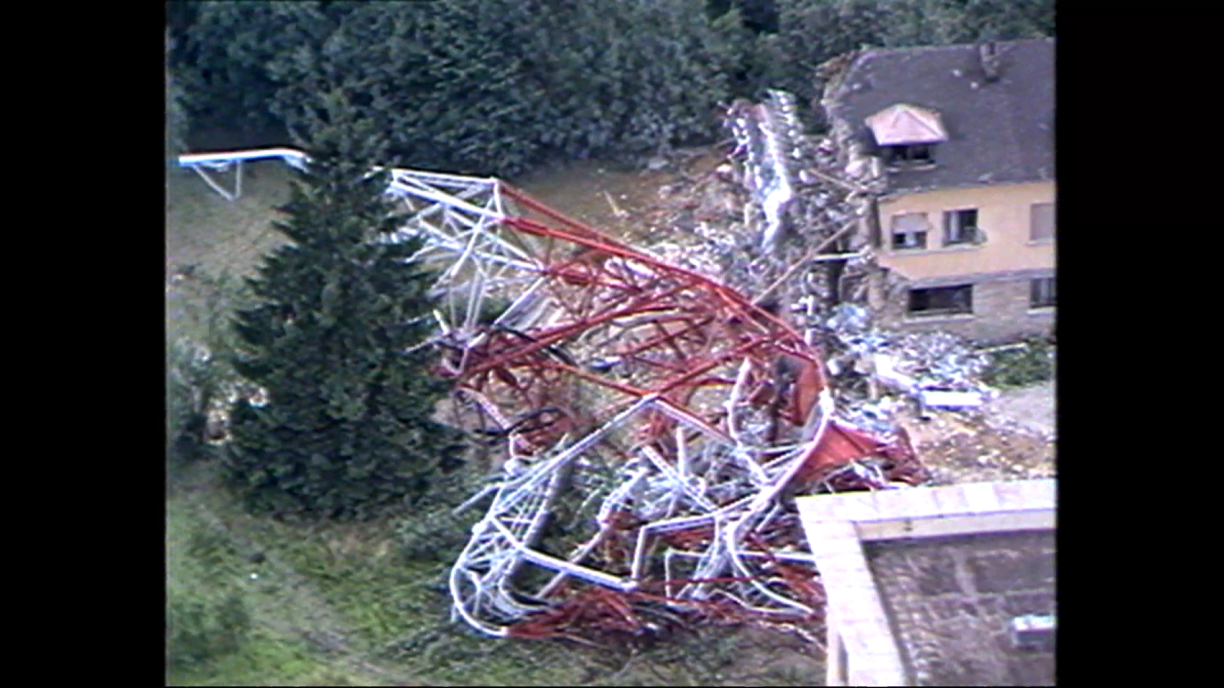
Indeed, a tragic event left its mark on the history of the Dudelange broadcasting site and RTL. For reasons that remain undetermined, a Mirage III – a Belgian military aeroplane – crashed into the middle of the Dudelange transmitter on 31 July 1981, shortly before 1.30pm.
The accident resulted in three deaths: the pilot was killed instantly, as were a Télé-Luxembourg technician and his wife, who were having lunch when the upper section of the pylon – 22 tonnes of scrap metal – crashed onto their house. Debris from the aircraft was scattered as far as the ARBED factory in Dudelange, more than three kilometres away. The entire upper section of the transmitter had to be rebuilt, a project that was completed in February 1982.
"Only the upper section was subsequently rebuilt. The lower section remains original. It is even very noticeable because the upper section [124 metres] is not constructed in the same way", Demarque indicated, pointing to the tower.
Unlike the Eiffel Tower, climbing the Dudelange transmitter is strictly prohibited. Yet for several years now, Luxembourg's transmitters – including the one in Dudelange – have not been immune to the phenomenon of base jumping, an extreme sport that consists of parachuting from great heights such as cliffs, buildings, or aerials. This involves an equally extreme danger and gives cold sweats to those who manage the infrastructure.
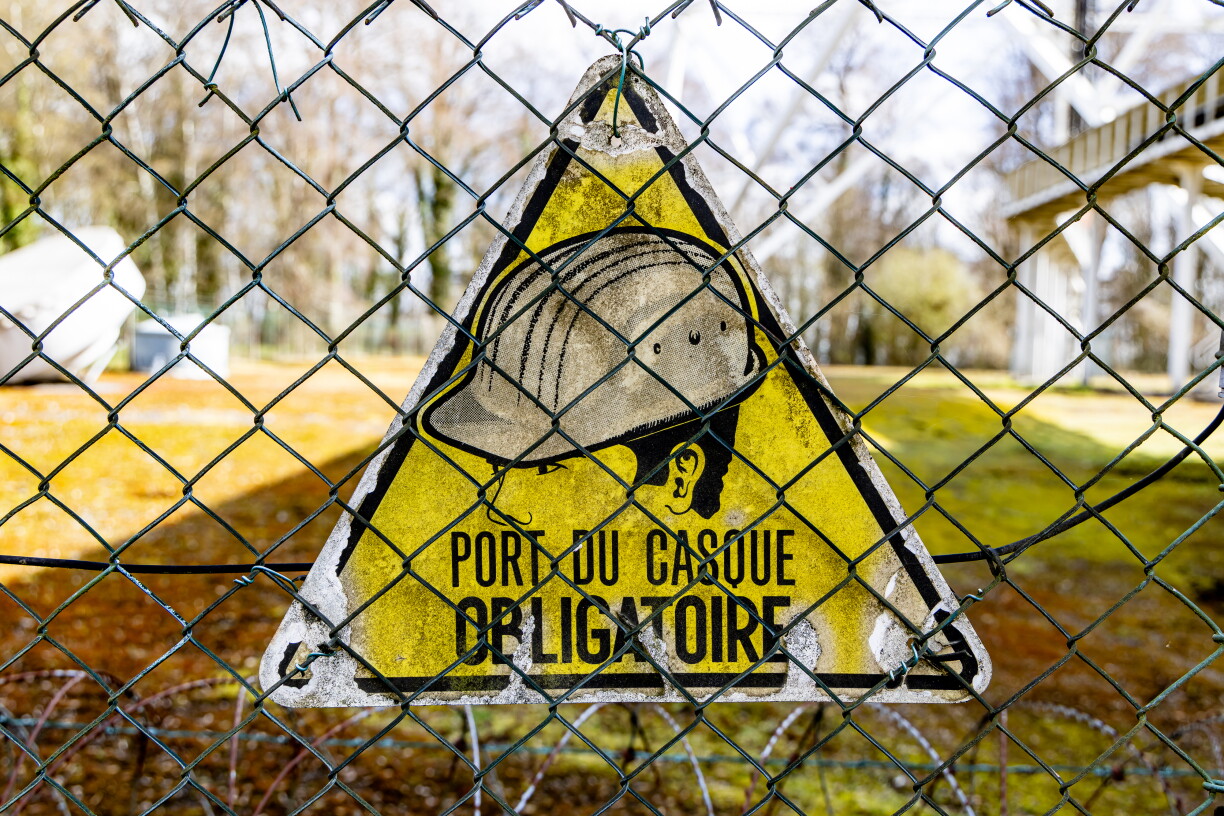
"Only authorised personnel climb it – and what's more, they do so with certain precautions", Demarque said. He pointed out that it is a high-power transmitter site, much like the Hosingen site in the north of the country. "As soon as you approach to a relatively short distance – I would say within 20 metres – you are subjected to an extremely strong electromagnetic field. This can be dangerous to your health", the transmission engineer warned.
To protect themselves, technicians climb wearing special suits that block the waves. From the ground, it is also possible to reduce the transmitters' power for the duration of a technical intervention.
Technology has certainly moved on, and the Dudelange site boasts over 70 years of operation and an eventful history. Nevertheless, the transmitter remains the main broadcasting site for all of Luxembourg's media.





