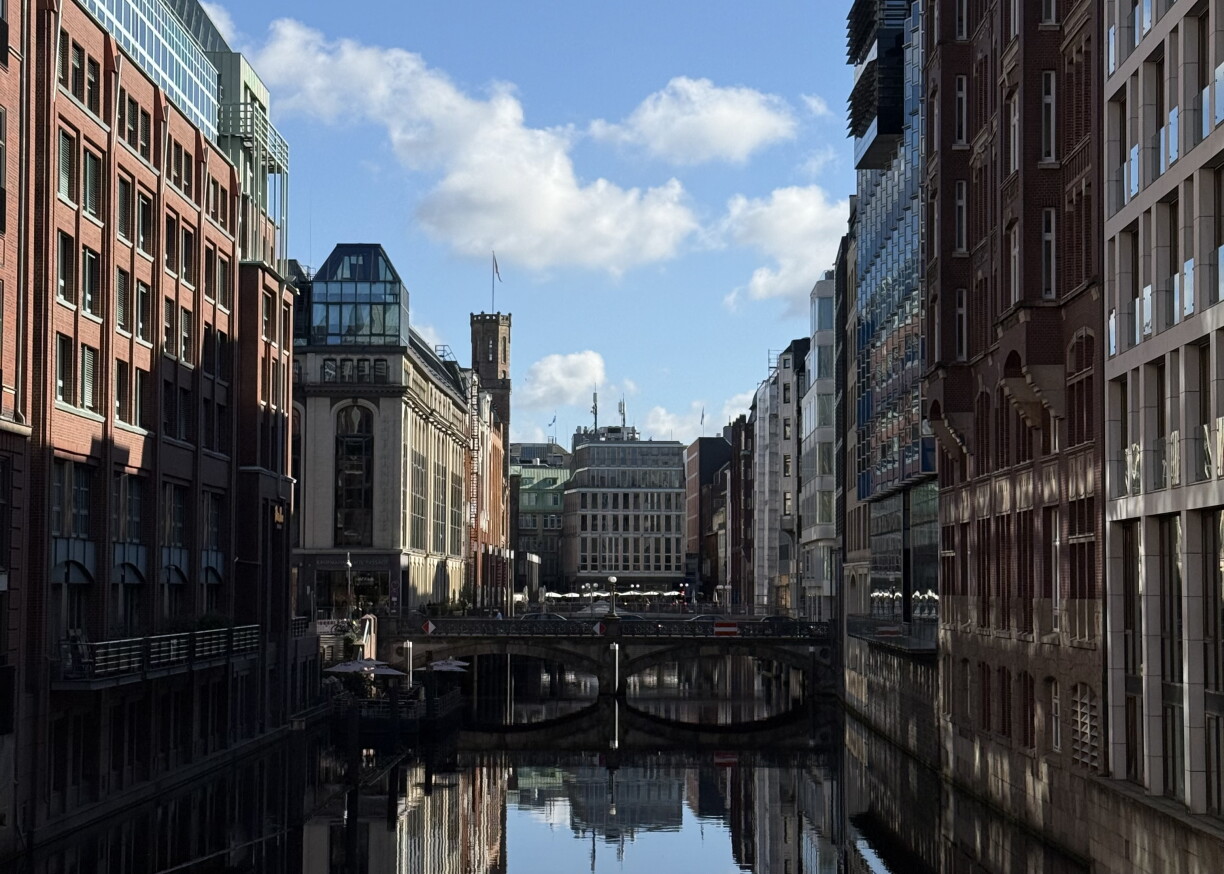
Hamburg's origins date back to 808, when Charlemagne had a fortress, known as Hammaburg, built between the Alster and Elbe rivers. Trading rights granted in 1189 set it on a commercial path, and in 1241 an alliance with Lübeck laid the groundwork for the Hanseatic League, turning Hamburg into a major hub for goods moving across Northern Europe. By 1510, it had become a Free Imperial City, governed by its citizens rather than a monarch.
The centuries since brought plague, fire, and near-total destruction in WWII bombing, but the city rebuilt each time. Today Hamburg is home to Germany's largest port and remains a key hub for trade, media, and tech.
Hamburg counts roughly 1.9 million inhabitants, making it the second-largest city in Germany. It's also one of the country's most international cities, shaped for centuries by its trading ties, with communities from Turkey, Poland, and beyond, plus a wave of Portuguese and Spanish migration that gave an area near the Elbe its nickname "Portugiesenviertel".
Hamburg actually beats both Amsterdam and Venice as the European city with the most bridges, boasting around 2,500 of them! Definitely necessary, given about eight percent of the city's surface is covered in water.
If you're anything like me and enjoy a scenic train journey, you're in the right place. From Luxembourg's central station, you can take the regional train to Koblenz, crossing the Moselle region and zig-zagging along its lush vineyards, before getting the high-speed ICE train to Hamburg Hauptbahnhof. The journey takes anywhere between seven and nine hours depending on delays, so definitely pack some entertainment.
Pro tip: You usually only have 17 minutes for the layover, which, if you know Deutsche Bahn at all, is often too tight given its chronic delays. Instead, hop on the earlier train to Koblenz, and if oyu have over an hour to spare, rent a locker at the station for a lovely stroll along the Rhine river.
For those wanting to make the most of their weekend and spend less time on transport, Luxair operates direct flights of just over an hour to Hamburg Airport almost every day of the week. From there, take the S1 straight to the city centre.
Hamburg is a great place for vintage furniture thrifting, so you might find yourself needing a little more than just hold luggage. The drive is around seven hours on the motorway, crossing all the major Ruhr cities (read: pit stop opportunities).
Hamburg prides itself on its walkability (and bikeability), but if you only brought swanky footwear, you can still get around quickly and cheaply by public transport operated by the Hamburger Verkehrsverbund (HVV).
Any HVV ticket comprises under- and overground trains, trams, busses, and ferries! A single ride costs €4.10, a day ticket €8.20, and a weekly ticket costs €43. You might also want to consider getting the Hamburg CARD (from €12.90), which gets you free transport across the city as well as discounts on cultural, culinary, and leisure activities.
The best way to get to know Hamburg is via walking tour. Here are the pit stops I always recommend to any first-time visitors:
Start at the Rathaus and the nearby Binnenalster, then duck a few streets over to the St Nikolai memorial. From here, wander the cobbled lanes of the old part of town, especially on Deichstraße, before crossing into the Speicherstadt. If you're particularly interested in Hamburg's economic history, a detour towards the Kontorviertel and its brick expressionist office spaces is highly recommended.
Keep heading toward the water and you'll hit the Elbphilharmonie, which you can visit even without having purchased a concert ticket – grab a free pass that takes you up to the viewing platform and gives you a sneak peek into the concert hall's world-renowned architecture. Then, walk along Neuer Wall down to Landungsbrücken, detouring through the Alter Elbtunnel if you're into beautifully-tiled 20th-century pedestrian tunnels.
From here, I'd cross into St Pauli and its infamous Reeperbahn, before heading towards the St Pauli Bunker, a WWII flak tower now transformed into a public rooftop garden, and is absolutely worth the climb.
You can loop back inland towards Planten un Bomen, or head back down towards Landungsbrücken to catch a ferry and cruise around the Elbe river for a budget-friendly look at the harbour whilst you make your way to the idyllic former fishing village Övelgönne. Whilst you're there, you can take a breather at the beloved Elbstrand and grab a beachy afternoon coffee at the nearby Strandperle. The ferry is included in your public transport ticket.
Hamburg's theater and music scene runs deep: catch a play at the Thalia Theater, Allee Theater, or Deutsches Schauspielhaus, or book tickets for music at the acoustically stunning Elbphilharmonie, the Deutsche Oper, or, for jazz lovers, Birdland. The city is also home to several musicals, though beware they're usually performed in German. Could be a fun niche to unlock?





