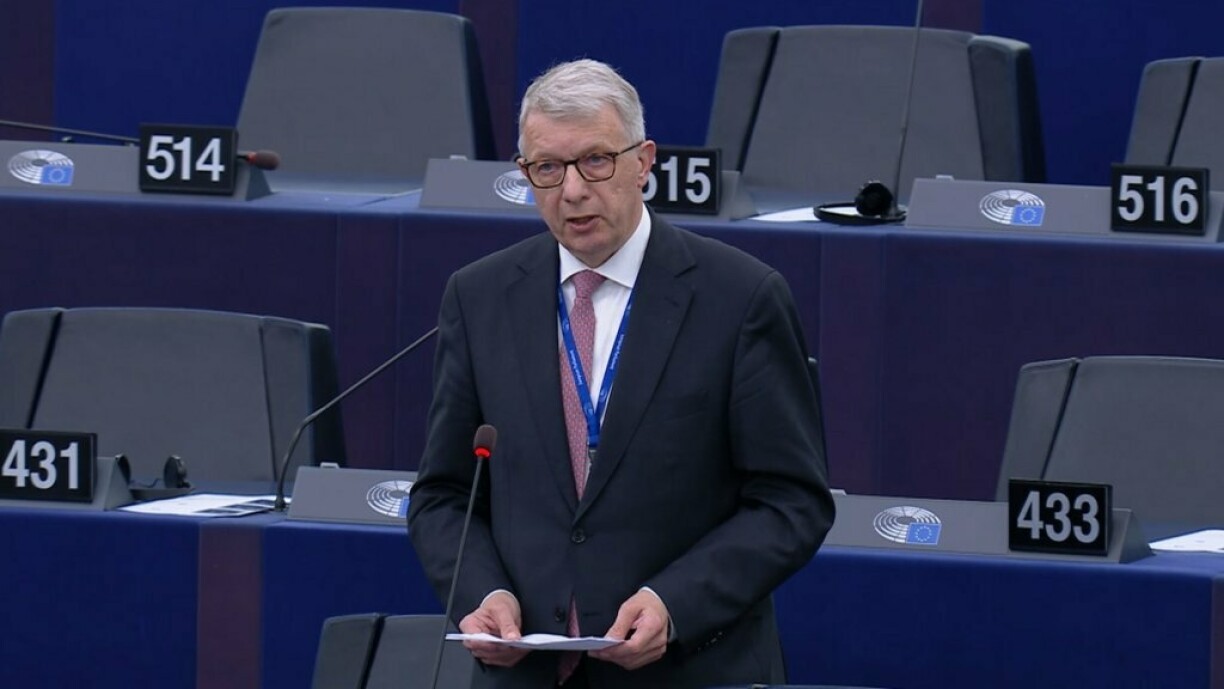
You're not wrong Fernand, you're just...
...being childish.
I know, I know, that's not how the Big Lebowski quote goes, but let us try to be civil and fair here.
When Luxembourg's newest MEP Fernand Kartheiser of the Alternative Democratic Reform Party (ADR) decided to address the EU Parliament in Luxembougish this week, he certainly managed to raise eyebrows and make for a memorable moment in the spotlight. Some have since come to his defence, some have ridiculed him, and again others have used the moment to point to the ever-diminishing role of the Luxembourgish language, not only in the Grand Duchy, but also on the European stage.
For me, the interesting part about the incident was the fact that the man was making a more than valid point, but unfortunately chose a rather childish way of making it.
Admittedly, I have so far spent little thought on the official languages of the EU Parliament, and I was likely not the only one to be somewhat surprised that a language like Maltese is recognised while Luxembourgish is not permitted on the floor.
Aside from the fact that the Grand Duchy is one of the founding members of the Union – and perhaps one of its staunchest defenders – there are several reasons why it should not be an issue to make it an official language. For one, there are 24 official languages, so the number of accepted ones exceeds that of those not included. Should not be too difficult to add one more to the roster, right?
For another, why not help lawmakers make the best out of their limited speaking times by granting them to use their native language. Yes, French and German are also official languages here in Luxembourg, but most people are well-aware that the average Luxembourger is still much more comfortable expressing themselves in Luxembourgish than in any of the other options.
Similarly, the argument that there are not enough translators is somewhat ridiculous. Take it from an active Luxembourgish translator that we would appreciate a job offer at an EU level, but that is just a side note.
All in all Kartheiser's strategy was rather unfortunate given that he could have easily turned the point into a uniting rather than dividing issue. Getting the various national parties behind the push for Luxembourgish recognition should not have been overly difficult, as it would have represented a win-win for all those involved. I do not think that any of the parties could have come up with a reasonable explanation for opposing a motion to strengthen and promote the essence of our culture.
Instead, animosity on the floor has once again hardened the fronts between the ADR and the rest of Luxembourg's political landscape. Culture Minister Eric Thill was quick to criticise Kartheiser, but upon closer look it is not even really clear what his counterargument is. Also, his plans to promote Luxembourgish are rather vague, making it unsurprising that somebody who considers the issue close to their heart would jump the gun and come up with a stunt to finally get the level of attention that they think they deserve.
But, the rules are the rules, and Vice-President Esteban González Pons was right to instruct Kartheiser to resort to one of the numerous official languages during his time on the parliamentary floor.
In short, you're not wrong Fernand, in fact it is much easier to argue for your point than it is to argue against it. When your position is as strong as this one, there is absolutely no need to make a fool out of yourself – and other Luxembourgers by proxy – when you seek to stand up for the Luxembourgish language. Just argue the point, after all, that is where you're making the most sense.





