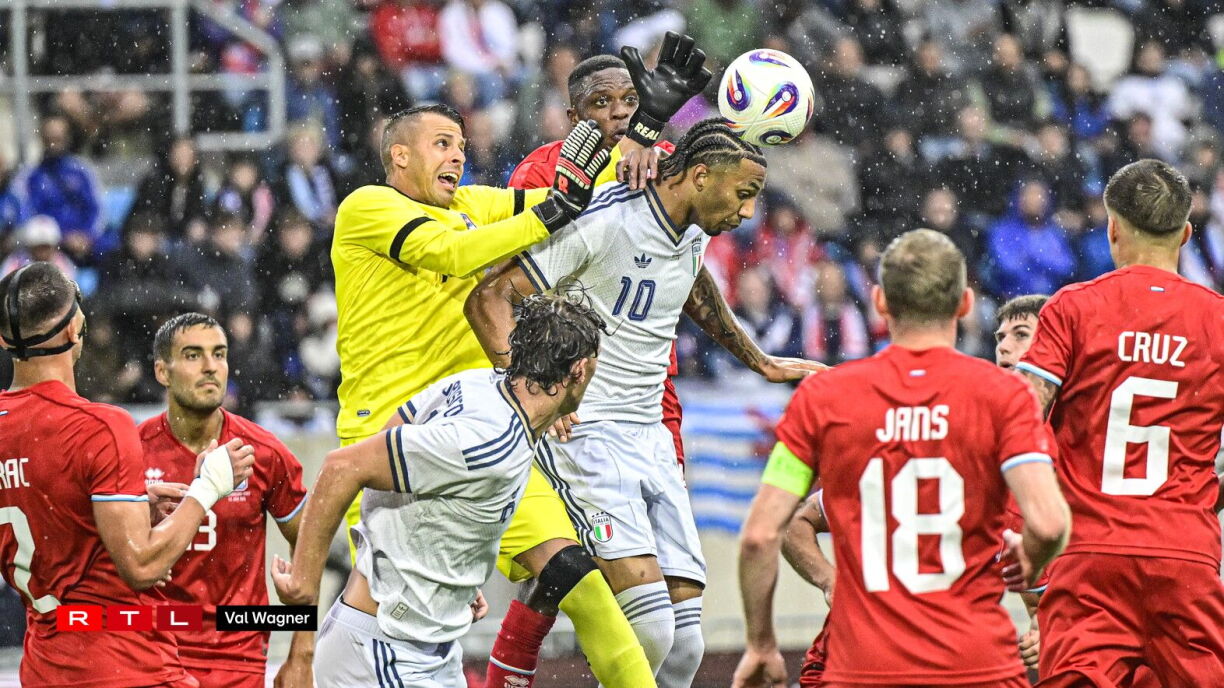
When the Luxembourgish Football Federation (FLF) announced the two end-of-season friendly opponents for the men’s national team – Italy and Albania – the prospect of the Squadra Azzurra’s presence in the Grand Duchy evoked unprecedented fanfare across the country.
Beyond the sizeable Italian diaspora in Luxembourg, and despite the fact that Italy had just missed on their third consecutive World Cup, this is still one of the most decorated teams in the continent, and supporters now had a (perhaps) one-off chance to see their heroes in the flesh.
The Italian FA’s decisions since the announcement did raise some eyebrows in Luxembourg. Appointing interim manager Silvio Baldini to oversee the friendlies was a sign of the national setup’s approach to the upcoming international break. His squad selection confirmed those fears.
In the final 26-man squad, goalkeeper Gianluigi Donnarumma was the only player above the age of 22. Most of the players were uncapped. Some played second-division football or turned out for their teams’ reserves or academy teams.
Granted, it was still a team full of professionals, and of a level that competes with Luxembourg’s elite, but the chance to see a team of world-class European Championship winners in Gasperich diminished. Italy’s next opponents, Greece, even called for a cancellation of the friendly and a refund for the fans who acquired their tickets expecting a different show altogether.
Luxembourgish fans were also quick to book all the seats for the occasion, with over 9,000 tickets being sold in a matter of hours. The game went on despite the curious make-up of the opponents’ roster.
Less than two hours later, after a lacklustre display and a narrow loss, Jeff Strasser would probably feel that he got more questions than answers from his side’s display.
Strasser’s squad announcement caused little stir in the media in May, as the only key player missing was Leandro Barreiro (who had skipped friendlies due to personal reasons before). Olivier Thill has been without a club for a while, and Gerson Rodrigues’ controversies have been well-documented over the years, and so both were expected to be left out.
The selection looked balanced overall, both across different positions and in terms of age and experience. A number of potential debutants (Helmer Tavares, Miguel Gonçalves, Leon Elshan, Hamza Kadamani, Diego Duarte, Lucas Fox, Tim Kips) were picked with an eye on the future, complemented by the most seasoned professionals in the country (like Anthony Moris, Laurent Jans or Mica Pinto).
This balance was completely shaken up by two pieces of news delivered on the eve of the game: Aiman Dardari failed to recover from his slight niggles and would have to miss the first game, while Yvandro is facing another long stint on the sidelines with a cruciate ligament tear suffered in training.
Luxembourg’s struggles in attack and their inability to break down defences through creative, combination play date back long before Strasser’s arrival last summer. Losing two of the team’s rare creative, technically gifted assets in one day was always going to be a cause for concern.
Lacking an out-and-out established centre-forward, it has often fallen upon wingers Danel Sinani or Dardari to fill in for the entire 90 minutes at times. This prevented Luxembourg from building up through the middle and deprived teammates of a valid option for hitting long balls and having a target man fight for headers and second balls, interacting with runners from midfield.
Against Italy, Strasser once again opted for something "unnatural", an option that requires impeccable tactical discipline and anticipation at all times. Wing-back Florian Bohnert was tasked with playing left-winger, attacking alongside Sinani and Vincent Thill. Behind him, Pinto would cover in defence.
Bohnert had considerable experience playing as an attacker on both wings during his years at Mainz’s academy, but has not played that role at club level for several years at Progrès Niederkorn and France’s SC Bastia. His pace and endurance make him a regular starter for the Red Lions and ensure he gets enough space on either flank, but his chance creation numbers, either through passing or dribbling, remain low.
The decision to line up with only two truly attack-minded players foreshadowed the 90 minutes that followed. While Italy enjoyed most of the possession, they failed to truly threaten Moris’ goal. The few counter-attacking opportunities presented to Luxembourg were all squandered, by a combination of hasty decision-making, erratic first touches or wayward finishes.
One thing was common in all these opportunities: they were either individual actions or the result of one long, vertical pass forward. In essence: the lack of creativity, teamwork, cohesion or attacking patterns whatsoever.
The Red Lions’ problems in front of goal started with Yvandro’s worsening injury troubles and Gerson Rodrigues’ removal from the setup. Dardari did well to cover for them at times, and young Brian Madjo seemed destined for a long international career with Luxembourg until he switched allegiances to represent England in the future.
It is now back to square one, and there still seems to be a dearth of options. After the only goal of the game – a magnificent header by rising star Pio Esposito – the hosts failed to switch up a gear and produce more in the opponents’ box. Apart from a few fleeting moments from set pieces and hopeful (but desperate) penalty calls, it was once again a frustrating night for the Luxembourg front line.
From the three natural strikers in the squad, Leon Elshan did not even make the substitutes’ bench on Wednesday, while Alessio Curci also only enjoyed a brief cameo at the end, replacing Sinani. Edvin Muratović, the most experienced and physically imposing of the three, spent the evening watching his side’s inefficiency from the front row.
Sticking to familiar faces like Pinto and Bohnert and adopting a defence-first approach against a team of Italy’s stature is not unheard of, and made sense on paper. But considering the lack of spark and flair in Luxembourg games over several months now, fielding actual forwards in the attacking positions is something to consider for Strasser’s staff as they head to Tirana.
While it’s unlikely he will be the solution to the left-wing conundrum in Albania, there was a youngster who lit up the pitch and sparked Luxembourg back to life in his short time on the pitch against Italy. Hamza Kadamani’s name is one we can expect to hear a lot in the coming years.
The Metz forward spoke of his gratitude and delight when his first senior call-up was announced last month. In a story on Instagram, the 16-year-old mentioned his rough beginnings (fleeing from the Syrian war at the age of seven and growing up abroad) that had taken him from the youth teams of Racing Luxembourg and Swift Hesperange to a professional contract with the French giants.
For Luxembourg, he has been one of the main threats at under-19 level, playing against opponents three years his senior. As the two friendly games were approaching to wrap up the 2025/26 season, the coaching staff decided to give him a taste of senior football, rewarding his rapid development across the border.
Kadamani was the youngest player on a roster filled with young talents and players seeking a debut – it would have been entirely reasonable not to count on the winger just yet. But, with Luxembourg trailing and just under half an hour to go, Strasser did the unexpected: he made Kadamani the fifth player ever to feature for the Red Lions before their 17th birthday.
He found himself in illustrious company: of his four predecessors, Gilles Bettmer went on to have a respectable career domestically, Vincent Thill is still a regular part of the setup (when fit), while Madjo and Enzo Duarte are regarded amongst the brightest gems of their age group. But then, so is Kadamani.
His introduction against Italy now seems like a masterstroke of a decision. It felt as if his presence and his profile completed a jigsaw, one of which Luxembourg were still missing numerous pieces of, but the sheer prospect of a 16-year-old delivering such ecstatic moments, such raw skill and bravery on the ball could still provide a glimpse of what was to happen once he definitively carved out a place for himself in the starting XI.
Small footballing nations often face pressure to hand youngsters their international debuts, especially if they are dual nationals who could turn their back on their old coaches and fans any day. We have seen a string of teenagers enjoy short-lived Luxembourg careers under Luc Holtz, too, before they faded back into the everyday realities of lower-league academy football or BGL Ligue struggles.
Dismissing Kadamani’s inclusion as just another one of these moves, either driven by PR, eligibility concerns or agent relations, was logical. We have seen it all before. But unlike many of those half-hearted displays from unlikely debutants in recent years, Kadamani was exceptionally lively on the ball.
Had he spent at least one half on the pitch on Wednesday, he could have had credible claims for a Man of the Match award. His attitude and determination briefly made Luxembourg supporters sit up from their seats, believing that an equaliser might just be on the cards.
Of course, Kadamani is still only 16. We have witnessed dozens of players shine in their teenage years, only for their careers to be derailed by injuries, bad decisions or myriad other factors. But as long as his current learning curve continues, Luxembourg can hope he remains fit and available for selection.
The Red Lions are taking off to Tirana, Albania for their second and last international friendly of the June window, to be played on Saturday evening. They will then return to competitive action in September, in the UEFA Nations League’s Division C. Their opponents there will be Iceland, Bulgaria and Estonia.





