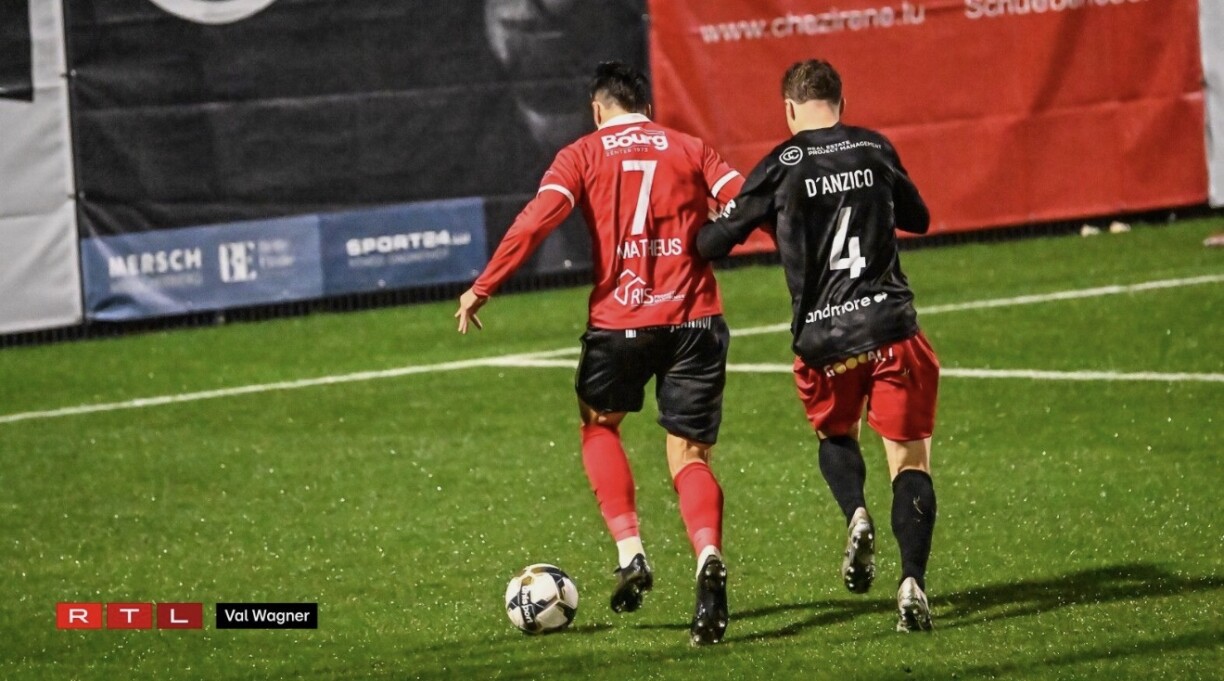
FC Differdange had been on a three-game winless streak as they travelled to UNA Strassen’s brand-new stadium to face one of the most lethal attacking forces in the league.
It has been the first time they have failed to achieve a victory for three consecutive BGL Ligue matches since September 2023. For a four-game stretch, we would have to go to May 2021, before the club’s recent glory days, which yielded four trophies in three seasons.
The weather played a more significant role than either team would have preferred. A wet, sodden pitch coupled with rain lashing down for most of the game made for a scrappy, stop-start affair. Many fans were interested in seeing the two best teams in Luxembourg battle it out on Wednesday evening, but it was a markedly different battle than expected.
Missing two key players in Juan Bedouret and Artur Abreu, manager Pedro Silva moved Leandro back into defence as expected, while he favoured Boris Mfoumou and Adham El Idrissi to dovetail behind Andreas Buch, who replaced an out-of-sorts Samir Hadji in attack.
The flow of the game reflected the high stakes and complicating factors at play, with both teams implementing a possession-based, low-risk, low-reward approach that brought few clear chances and was focused predominantly on exploiting individual errors to carve out opportunities.
UNA Strassen’s Nicolas Perez was the first to break the deadlock, after his long shot got a lucky deflection that fooled goalkeeper Felipe, and whistled into the net on the brink of half-time. The two teams went for their 15-minute breaks with a lot of room for improvement, and a need to alter their respective game plans in light of the late goal – slightly against the run of play.
But Differdange’s handle on the proceedings only weakened as Strassen were presented two tantalising opportunities in the opening ten minutes of the second half. Edis Agović squandered the first one but made up for it shortly afterwards to double his team’s lead with a brilliantly-placed effort from the left side of the box.
The champions scored a consolation goal in the closing stages and were hoping to continue their unbeaten season with a third draw in a row, but a sucker punch provided by Benjamin Romeyns stifled their ambitions. The Belgian striker was on the receiving end of Matheus’ fourth assist of the season (besides 11 goals) in 14 appearances.
By inflicting a second consecutive head-to-head defeat on defending champions Differdange, Strassen are continuing to go from strength to strength in 2025/26 after a relatively quiet start. Their new stadium and increased investment in the past three years are a testament to their long-standing ambitions of becoming Luxembourg heavyweights.
This year, with a talented but inexperienced manager in the FCD dugout and turmoil in the capital, it looks increasingly like UNA’s best bet for a first-ever league title.
After years of relative success and repeated European qualifications but ultimately no league titles, Progrès Niederkorn President Thomas Gilgemann announced widespread changes in the club’s transfer strategy and identity in the summer.
Having missed out on continental football for the first time since 2021/22, some degree of financial restructuring was necessary. However, the Wasps’ way of doing it differed from the usual cost-cutting measures and damage control interventions employed by other clubs.
When Gilgemann and Director of Football Yannick Bastos outlined the club’s policy for the upcoming years, they placed a huge focus on Niederkorn’s track record of developing youngsters and selling them on to the professional world, thanks to an eye for spotting hidden gems and a dedication to giving playing time to unproven talents.
From 2025 onwards, the board’s attention turned towards local talent. While several signings from abroad have helped Niederkorn achieve their recent successes, the new team structure was deemed to be centred around cohesion, familiarity and local youngsters. As a result of this approach, Progrès could use the funds recouped from parting with foreigners to lure some of the finest talents in the Grand Duchy.
Some headliner signings of the transformation period included Luxembourg internationals Olivier Thill and Kenan Avdusinović, or young wingers Thomas Souchard and Flavjo Hoxha. Since the start of the season, though, Thill left almost immediately for the Serbian top division. Souchard remains a work in progress with very limited time on the pitch this season. Hoxha, despite being an attacker, has one goal contribution in 480 minutes to date.
Trimming the squad and parting with key players inevitably opened up spaces in the squad that were replaced by internal hires, members of one of the country’s most successful youth setups getting their first taste of senior football. The core of the team was fleshed out with a few new such additions this summer, in all parts of the team.
Of that bunch, though, only Thomas’ son Milan Gilgemann, and electric winger Mathis Camara have received sufficient game time, while Mylan Oger was the only other youngster making an appearance as a late substitute.
Taking time to incorporate homegrown youth is an approach that makes complete sense and could pay dividends for the future. The biggest problem for now is that results have also faltered in the first half of the season.
Niederkorn’s latest loss, this time to newly-promoted Jeunesse Canach, has left them in sixth place, seven points off the top four and three points below US Mondorf in fifth. Ending the season in the same position would represent their worst league finish for the past decade.
Of the three goals in the 2-1 defeat, Progrès’ goal was the luckiest and least organised, coming after a mix-up following a corner. Canach, on the other hand, tackled an opposition defender in their own half following a coordinated high press and a well-executed link-up leading to deserved goals. Watching the game, one could have rightly felt that it could have easily been a more damaging scoreline for the Black-and-Yellows.
The homegrown project was supposed to be a springboard for everyone. It would propel the club back towards the highest tier of Luxembourgish football and simultaneously prepare the upcoming talents for the demands of senior football. In contrast, Niederkorn are looking the worst they have for a long time, and the winter transfer window can be crucial if they are to recruit some big-name domestic signings.
After one of the most eventful gameweeks in Matchday 14, teams had no time to train before gearing up for another encounter mid-week. Looking at the scores, fans were left to wonder if the workload is creeping up on some players and teams as we approach the festive season.
Only seven games were played on Wednesday (Atert Bissen beat Racing FCUL in November before postponements were announced), but two of them ended in goalless draws. Another one, between Mamer and Hostert, was decided by a penalty. Every single match saw fewer goals than Sunday’s average of 4.13.
Weather might have played a part in some places, as detailed above regarding the Differdange game. In other matches, the tactical approach of one or both teams contributed to a dull, eventless 90 minutes. Victoria Rosport’s low block and solid defensive football achieved an admirable 0-0 draw against F91 Dudelange, but might have left spectators wanting more.
Teams playing European games in the summer are often deemed to have an advantage over the rest of the league in the first games of the domestic season because of earlier physical preparation and increased sharpness going into the opener. As we near the end of the calendar year, though, we can observe the opposite: Differdange players, for example, have complained about mental and physical fatigue over the past few days (illustrated by two easily provoked suspensions last week).
This weekend will see the last set of matches in 2025, and the league does not return until 8 February 2026, giving the 16 clubs a long time to reset and prepare for the final 15 rounds of fixtures.
With the winter break looming, there are still valid concerns over the future of the country’s football. Wednesday’s matches sent alarm bells ringing: how could any of these sides cope with the demands of a European group stage, playing an average of two games a week – sometimes three? Although Differdange came close to achieving it this summer, maybe it serves them better to focus on the task at hand and aim for something more realistic than competing on multiple fronts.
UN Käerjéng continue to prove that their experienced roster and astute manager, David Vandenbroeck, have what it takes to see off direct competitors and solidify their place in the bottom half without direct relegation worries. Their latest victims were Rodange, whom they defeated 3-1 with a selection of particularly impressive goals after unluckily falling behind. Rodange have now dropped to the direct relegation spots.
Mickaël Jager continues to deliver from the spot for Mamer 32, scoring the game’s only goal from a penalty from his sixth successful attempt out of seven this year. Hostert were the dominant side throughout the game but lacked the attacking edge to clinch the three points. Mamer still remain rock bottom despite their win, but have closed the gap to the relegation play-offs to a single point – the same fate Hostert are trying to escape.
US Mondorf continue their good form and have now taken home all three points from Stade Alphonse Théis, picking apart Swift Hesper with relative ease. In a game with few clear-cut chances, the Angry Goats took the lead after a comical Geordan Dupire blunder and retained it successfully for the whole game. Hesper only managed to find the net in stoppage time, but remain stable in mid-table, still outperforming their pre-season objectives.
Union Titus Pétange are craving stability on many fronts: Ado Kojo has been the interim head coach for almost half a year, and results have declined from past seasons. They found some solace in a 0-0 draw against Jeunesse Esch on Wednesday, with a little luck and an overall satisfactory defensive display. Jeunesse have been earning plaudits for their solid performances with a radically overhauled squad and they find themselves seventh with another point.
Victoria Rosport produced some of their typical dogged low-blocked defending this season against F91 Dudelange. A solid, disciplined press and an organised structure have been the backbone of Rosport’s longest-ever stay in the BGL Ligue, and they demonstrated it to great effect to suppress a completely toothless and lost F91 side. A few counter-attacks provided a rare opportunity for Martin Forkel’s team to tip the scales in their favour, but there was no breakthrough to be had.





