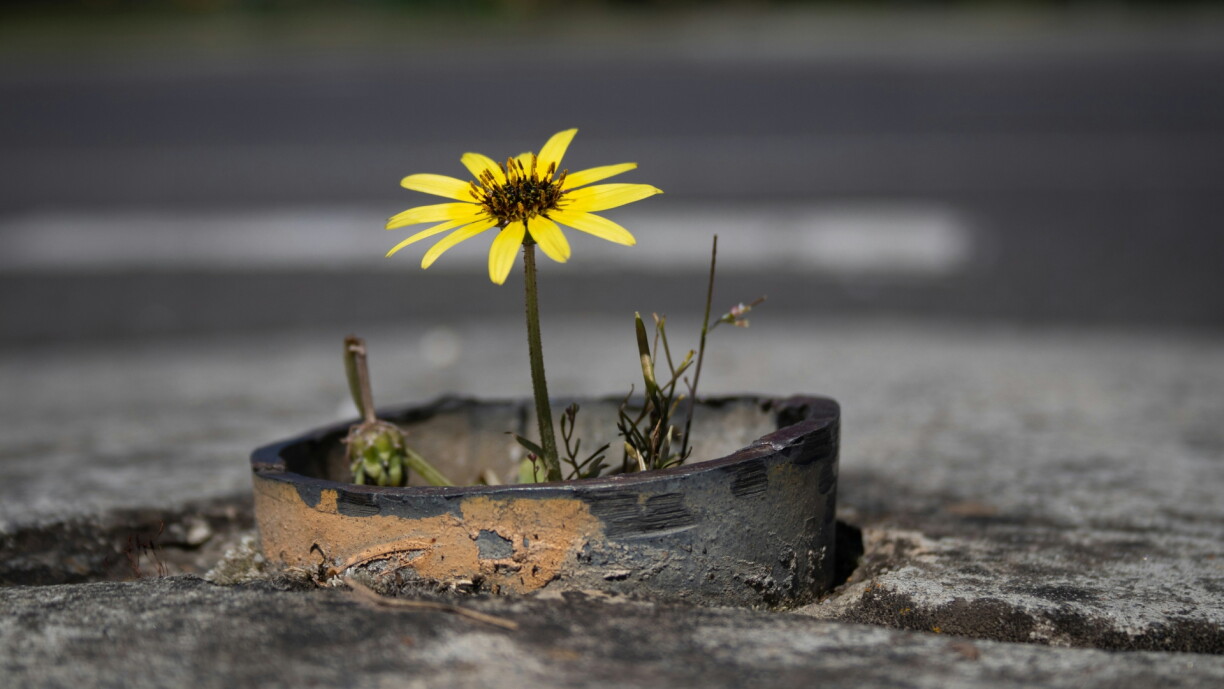
Dealing well with a stressor without suffering significant psychological harm, this phenomenon is known as “resilience”. Incidentally, the word comes from the Latin verb “resilire” and can be translated as “to bounce back or to rebound”.
Resilience does not mean always being strong or never experiencing difficult phases. Even resilient people know sadness, feeling overwhelmed, despair and frustration. What is crucial is not whether such feelings occur – that is human and unavoidable – but how we can deal with them.
Resilience is therefore not a trait that you either have or do not have. It can develop and change over the course of a lifetime. In doing so, not only do our personal resources and experiences play a part, but also the circumstances in which we live.
Fact is: most of us have already experienced one or more critical events in our lives. And yet, most of us manage to deal with it constructively, to carry on with our lives and, little by little, to find new perspectives again.
A well-known example is provided by the ‘Kauai Study’, conducted by developmental psychologist Emmy Werner. Here, nearly 700 children who had grown up on the Hawaiian island of Kauai under very difficult conditions, including poverty, broken family relationships or ill parents, were followed for a period of 40 years. The results of this study showed that around one-third of these children nevertheless developed into successful and psychologically stable adults.

Resilience cannot be considered independently of the respective life phase as the strains and challenges people face change over the course of their lives. Children and adolescents, for example, are often confronted with school or university stress, pressure to perform, conflicts with their parents or anxiety about their future. Critical life experiences such as the loss of a family member can also represent a significant burden at this stage of life. For adults, the stressors can take different forms: professional pressure, job loss, financial worries, illness, caring for family members, burnout or conflicts and separations within family life can be challenging.
These differences show that resilience should not be understood as a single ability that is applied in the same way at every stage of life. Rather it depends on the kinds of stressors people face and the individual and social resources available to them. Whereas for children and adolescents support from the family, school and social environments can play an important role, additional professional, financial and family resources may become increasingly relevant for adults. Considering the different age categories thus makes it clear that resilience must always be understood in the context of the individual's respective life situation.

Sticking with the example of the Kauai study, several ‘protective factors’ could be identified. The first factor was a positive attitude towards life and the feeling of being able to control their own lives and meet challenges. In addition, they had developed hobbies or interests, such as sport or music, which gave them affirmation and self-confidence. The third factor was that they had at least one reliable person, a so-called ‘trusted adult’ or a positive role model in their environment. Here they were given the feeling: ‘I am being listened to, and I am valuable’. Being part of a community, and having clear tasks and structure, also helped them immensely to become more resilient.
An important prerequisite is to listen to yourself and to identify what actually makes you feel good. It's about taking your own body's signals seriously and, where possible, changing things yourself. This also applies to the expectations we place on ourselves. We can adjust and change our expectations. Not everything has to be perfect, and we don't always have to achieve everything. Sometimes it's just as important to be more patient with ourselves and to show ourselves some self-compassion.
An important first step can be to accept the situation as it is: ‘I feel tired and stressed. For me, it's just a difficult time at the moment.’ Therefore, it is more about recognizing one’s own feelings and current difficulties rather than putting additional pressure on oneself. Things do not always have to be perfect, making mistakes is a normal part of life, too. Even though they can be frustrating, they also provide the opportunity to learn from and grow as a person.
The following questions can be helpful for regular self-reflection:
· What makes me feel good?
· What do I enjoy doing?
· What gives me energy?
· What helps me to recharge my batteries when I'm not feeling so well?
· Where and from whom can I ask for support?
· What is important?
· Where can I make a difference?
In essence, it is about recognizing that, despite difficult circumstances, one can still make a difference and actively shape one’s own life. This can lead to experiences that show: ‘I can make a difference and I have a certain influence on my own life’. In psychology, this is referred to as self-efficacy. Self-efficacy helps us take action in areas where we can make a difference ourselves, such as seeking help and finding meaning in our lives. Equally important is recognizing that we do not always have control over everything, and it is okay to ask for additional help and support when needed.
Even when life sometimes feels as if there is no way out, there are often still other options for dealing with a challenging situation. Sometimes, seeking an outside perspective can offer helpful support. This support can take many different forms: a chat with a good friend, an anonymous telephone helpline, a professional counselling service or therapy. There is no single form of help that suits everyone. What matters most is identifying what personally helps you during an overwhelming period and what enables you to feel more relieved and at ease again.
It is important to trust your child to be able to cope with difficult situations. If we take every difficulty away from the child or do too much for them we can unconsciously send the message: ‘You can't handle this on your own. You need me to cope with it.’
This does not mean that the child should be expected to deal with its problems alone. It's about an attitude of: ‘I trust you to be able to handle this’. The child should feel: ‘I am capable of dealing with challenges – and I know that I will get support when I need it’.
The aim of the KJT is to ensure that children and young people do not have to face their worries, fears, problems and questions alone. They can contact us anonymously and confidentially – via the phone helpline ‘Kanner-Jugendtelefon’, the parents' helpline, online help or chat counselling. The offer is not only aimed at children, young people and young adults, but also at parents, grandparents, professionals and other individuals within their environment.
Anyone who is looking for someone to talk to, has a question, or simply wants to talk about what is bothering them, is welcome at KJT. During the conversation, we work together with the person who contacts KJT to identify individual ways forward and support them in putting these into practice. In most cases, we also refer people to other appropriate institutions or support services.
Counselling is available in Luxembourgish, German, French and English. You can find our opening hours and further information at kjt.lu





