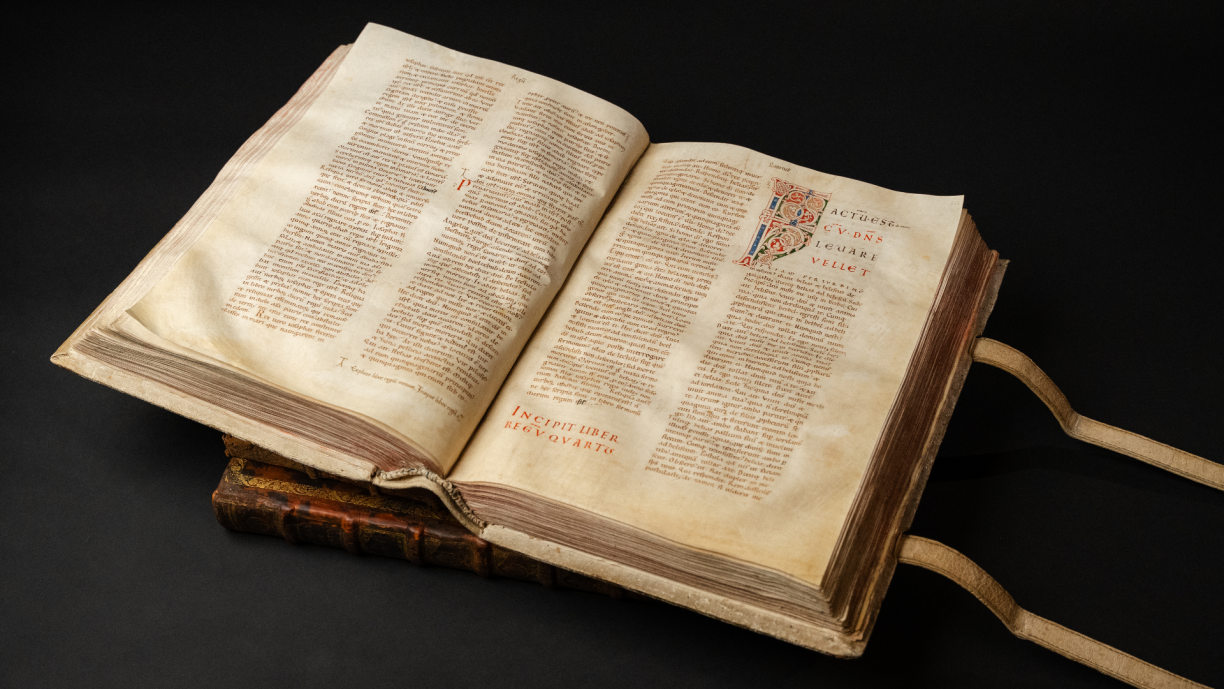
In 2024, the BnL acquired a thousand-year-old medieval manuscript, bringing a priceless treasure back to the region where it was originally created.
Written at the end of the 11th century, this manuscript is one of the last surviving examples of its kind. Not only is it exceptionally rare, but it is also in a remarkable state of preservation. It was created in close collaboration with the scriptorium of Echternach, one of the most influential intellectual and artistic centres of the early Middle Ages. At the time, Echternach was part of the archbishopric of Trier and played a central role in the creation of high-quality illuminated manuscripts. This unique document represents a high point in the scribal culture of the Echternach school, whose influence extended far beyond the cloister walls.
Weighing around 25 kilos and measuring 80 cm wide and 55 cm high when opened, this Bible is an extraordinary example of medieval craftsmanship. The production of its parchment required the hides of more than 230 cows, testifying to the enormous investment in resources and labour required to produce such a piece.
Although the core of the text was written in the 11th century, the Bible was subject to additions and revisions until the 16th century, particularly for liturgical use in the abbey of Saint-Maximin. This manuscript reflects the work of at least fifteen scribes over the course of five centuries.
The manuscript’s decorations showcase a clear visual hierarchy. The ornate initials are one of the highlights of this work. Drawn in red ink and surrounded by geometric or plant motifs, they form genuine miniature works of art. The letters are decorated with foliage and interlacing, notably the split letters, which are typical of the art of the period and echo those in the Giant Bible of Echternach, commissioned by Abbot Regimbert. The layout elements reveal a constant concern for clarity and elegance. Medieval manuscripts followed strict rules for text composition, and this Bible is no exception.
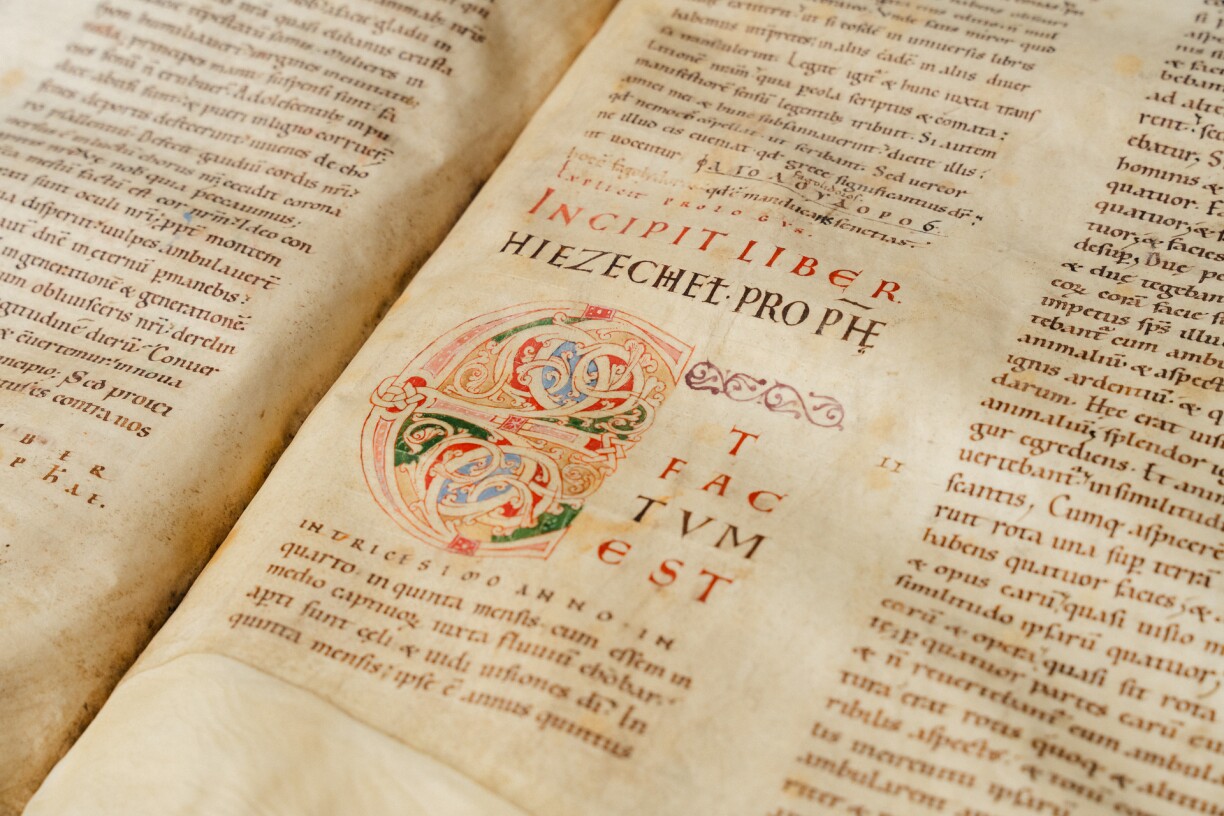
Another fascinating aspect of the decoration is the spectacular frontispiece pages. The first page (folio 1v) features a frame painted in red, blue and yellow, designed to hold the title of the book of Genesis, while the page on folio 5v displays ten bands of colour spread over two columns. This play of colours evokes the production of a generation prior to that of this Bible, hearkening back as it does to the time of the Codex aureus of Nuremberg.
The Giant Bible stands as a testament to the skill and devotion of medieval scribes and craftsmen. From the painstaking parchment production to the elegant illuminations, it captures centuries of cultural history. Its size, decoration and ongoing revisions over centuries highlight its significance as both a sacred object and a living document, cherished and used throughout its long history.
This medieval manuscript has lived through almost a thousand years of history, passing from monastic hands to the most prestigious private collections. It was first kept at the Abbey of Saint-Maximin in Trier, where it was used for five centuries as a lectionary for special occasions.
Its exceptional history was marked by several major events, notably when the abbey was suppressed in 1802, leading to the dispersal of its library. This Bible miraculously escaped the looting and destruction that decimated so many other manuscripts of the period.
In absolute terms, it is very rare for a manuscript to return to its ‘birthplace’, so to speak, almost a millennium after it was made; and it is even rarer for its history over such a long period to be retraced almost year by year. The giant Bible that the BnL was lucky enough to purchase after lengthy negotiations is an almost unique example.
In the 19th century, it entered the legendary collection of Sir Thomas Phillipps in London, one of the greatest bibliophiles of his time. Phillipps’ stencilled crest, as well as those of many other owners, can still be seen in the manuscript, testifying to its passage through numerous private collections.
In the 20th century, the Bible was consigned for sale at Sotheby’s in 1946 and was subsequently purchased by several private collectors.
In 2024, the BnL was finally able to acquire this priceless treasure after lengthy negotiations, bringing it back almost a thousand years after its creation to the region where it was originally produced.
Its acquisition by the BnL is a unique opportunity to enrich Luxembourg’s national heritage and ensure its preservation for future generations.
The National Library collects, catalogues and preserves all analogue and digital publications published in Luxembourg and any works published abroad that relate to the Grand Duchy. It is the country’s leading academic, research and cultural heritage library. To meet the requirements of its users, about three-quarters of its printed collections come from other countries and cover different fields of knowledge.
In the Manuscripts Collection, the National Library holds approximately 270 fully preserved medieval manuscripts (dating from the 7th century to 1638), over 500 partially preserved medieval manuscripts (corresponding to over 400 bibliographic entities), and about 50 medieval manuscripts that were written to accompany printed books. There are also about some 600 manuscript call numbers (including modern authors’ archives) from the second half of the 17th to the late 20th centuries.
Documents in this collection are not available for home loan. However, you can view them in our Dr Jean-Claude Loutsch Rare Books Reading Room on the 1st floor. A member of staff will guide you in the proper handling of these precious documents.
Part of the collection is referenced in a-z.lu and can be pre-ordered online or by written request.
Why do we need your help?
Every contribution, however small, will help us to preserve this document for future generations.
How can you help us?
What are the tax benefits of your donation?
By becoming a donor, you are playing a vital role in the preservation and promotion of cultural heritage, which is why the law provides for a tax deduction for your donation disbursed as a natural or legal person. More information on focuna.lu





