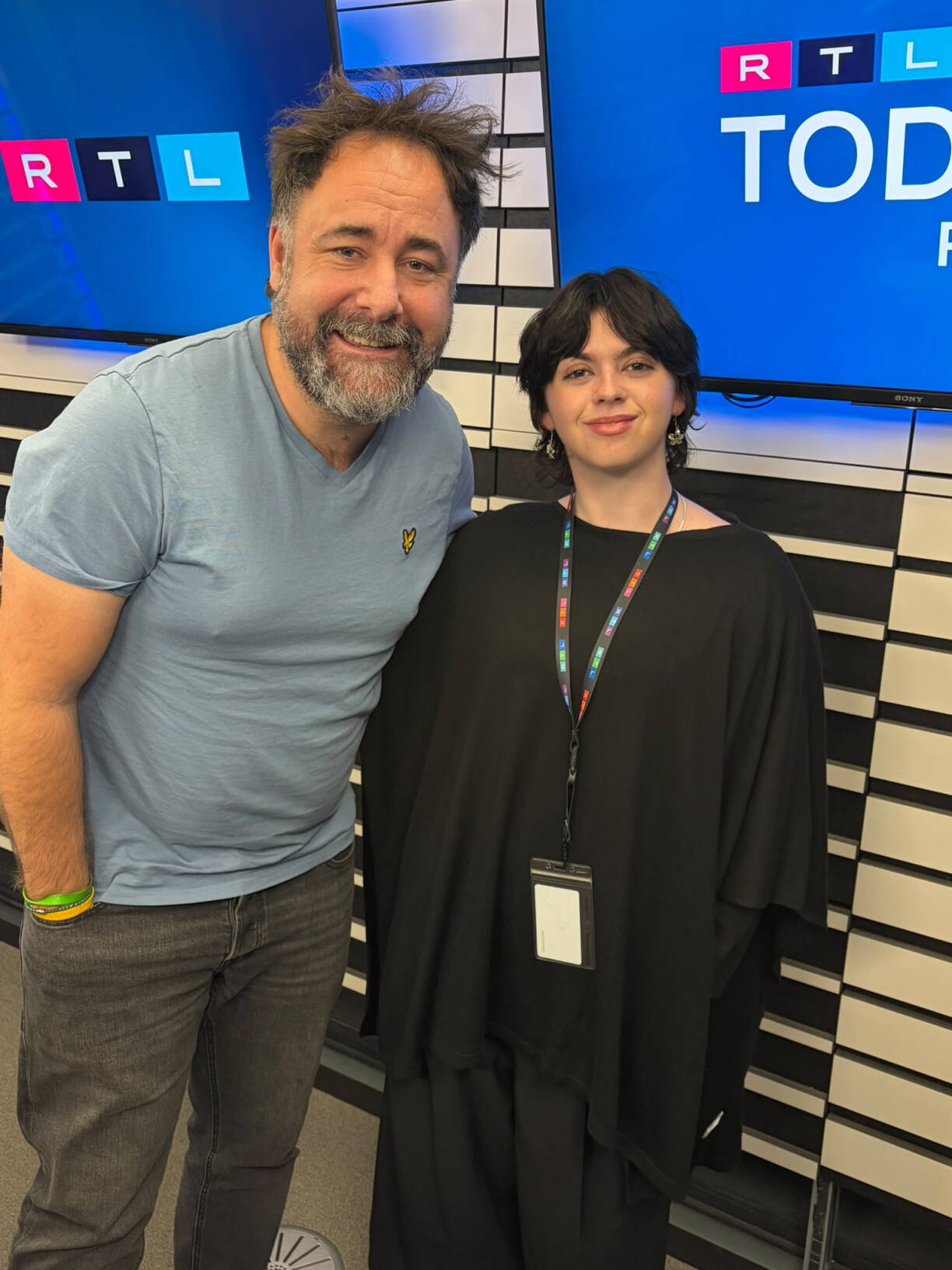
Luxembourg artist Maya Fish joins RTL Today Radio to talk about an unlikely beginning to her musical career, winning Rocklab’s Songwriting Accelerator Programme, bringing her background in contemporary dance into her music and the importance of learning to trust her own creative instincts.
Maya's route into releasing her own music began with somebody else deciding she was ready before she did. She hadn’t planned to enter Rocklab’s Songwriting Accelerator Programme at all.
In fact, Fish admits she had already convinced herself that she wasn’t sufficiently established to belong there. Her mother disagreed, and quietly submitted a voice memo of one of her songs on her behalf.
“I knew of the programme because of Viana, of Francis of Delirium, [and] Ninon,” Maya explained to Stephen Steps Lowe on RTL Today Radio. “I was like, ‘Oh, I’m not going to enter this because I’m not good enough. I’m not, like, a proper, have-a-platform musician.’ And she sent it in.”
It proved to be a fairly spectacular piece of maternal interference.
Fish was selected for the programme and suddenly found herself surrounded by an established creative team, receiving mentorship from Luxembourg musician Daniel Balthasar and working with producer Charles Stoltz, alongside support for the visual side of the project.
What followed wasn't simply the opportunity to professionally record a song. For Fish, the experience helped dismantle some of the uncertainty she'd carried about whether she could legitimately describe herself as a musician at all.
“I was a little bit like, ‘Oh God, now I have to pretend I’m a proper musician and I can do this,’” she says. “And then, you know, in the end… I guess it’s on the air, it’s on Spotify.”
Music isn't actually an entirely new world for Fish. Her principal creative background is in contemporary dance, where she has regularly worked alongside musicians, incorporated live music into choreography and explored the relationship between sound and physical movement.
Rather than leaving that identity behind as her songwriting develops, she now sees it as something that can distinguish the music she makes.
“Working as a dancer, you have a certain body musicality,” she explains. “You feel the rhythms and you feel how it affects you and how you want to move.”
That physical relationship with music has already begun influencing how Fish communicates with producers and develops songs.
When she imagines a new release, she isn't necessarily hearing only the recording; she's simultaneously considering how it moves, how it looks and how it could be choreographed.
The approach became particularly important while creating the video for “If I Fall”, where Fish was able to bring her dance experience directly into the visual identity of the song.
Working with Rari Mattei, Two Steps Twice and a wider team of dancers and creatives also brought another challenge: the familiar feeling that everybody else in the room somehow knows what they're doing more than you do.
Fish is refreshingly open about that imposter syndrome. But rather than allowing it to define the experience, the collaboration helped her realise that her background wasn't something she needed to disguise in order to become a musician.
“I think now I know my identity as a musician,” she says.

That confidence is perhaps the most important thing Fish says she has taken from the Rocklab programme.
For emerging musicians, professional recording, production and video work can represent a considerable financial barrier before an artist has even begun establishing an audience.
The programme gave Fish access to those resources without requiring her to personally fund every stage of the process.
But she believes the professional support surrounding that investment was equally valuable.
It gave her a reference point for understanding both her value as an artist and her right to make decisions about her own work — particularly important, she argues, for young artists entering an industry where the pressure to mould yourself into something more immediately marketable can be considerable.
“This is who I am,” she says of the confidence she developed through the process. “I don’t want this. This is not my sound. This is not who I am.”
For Fish, authenticity isn't simply a convenient piece of artist branding.
“Your authenticity is really important,” she says, arguing that this remains true whether somebody is creating music privately in their bedroom or performing on one of the world's biggest stages.
It's an idea that runs throughout the conversation. Fish talks about seeing extraordinary musicians online whose songs receive only a handful of likes, and the frustration of knowing that visibility and artistic value aren't remotely the same thing. The challenge is therefore not simply getting noticed, but avoiding the temptation to reshape yourself entirely in pursuit of being noticed.
There is already more music coming. Fish is working on another single (due for end October), and characteristically, the plans aren't limited to what the song will sound like. She's already imagining the accompanying dance visualiser and considering how individual sections could translate into choreography.
Singer-songwriter, dancer, actor, director, the joke during the interview is that the traditional “triple threat” description may already be inadequate. But underneath it is an artist beginning to recognise that these don't necessarily have to exist as separate careers.
For Maya Fish, they can all feed into the same thing.
And perhaps that's the real significance of what began with her mother secretly submitting a voice memo. Rocklab gave Fish access to studios, production, mentorship and a professional network, but the most important result may be considerably simpler: the confidence to stop wondering whether she belongs in music and start deciding what she wants her music to be.
“I think now I know my identity as a musician.”
Maya Fish’s “If I Fall” is out now, with the accompanying music video available on YouTube.





