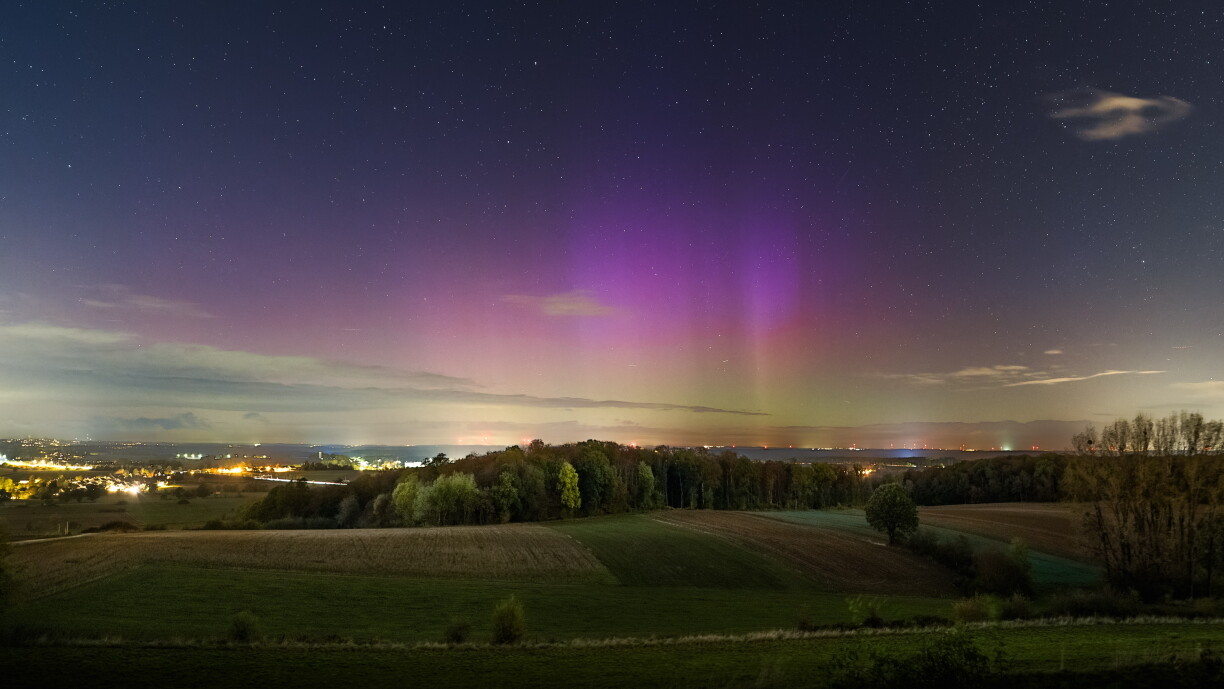
RTL asked Adnan Ceman, a meteorologist at Meteolux, what skywatchers can expect.
According to Ceman, another sighting is unlikely in the near future. Aurora forecasts can only reliably predict activity one to three days ahead, and there is currently no significant solar activity that would raise the chances of a repeat in Luxembourg.
There was some geomagnetic activity on Monday, but it mainly affected Northern Europe. In Luxembourg, the KP index, a scale used to measure geomagnetic disturbances, is too low at present. More cloud is also expected in the nights ahead, reducing the chances further.
The northern lights occur when strong solar storms send charged particles from the sun into Earth’s atmosphere. Whether the aurora can be seen as far south as Luxembourg depends largely on the KP index: the higher the value, the greater the chance of seeing it.
It may seem that the northern lights have become more frequent in recent years, but that is not necessarily the case. Periods of heightened solar activity play a part, but so do advances in smartphone cameras. Modern cameras are far more sensitive to light than the human eye, which makes it easier to capture and share images of the aurora’s distinctive colours and structures.
Ideal conditions are a clear night sky, an unobstructed view to the north and minimal light pollution. The best time is usually the darkest part of the night, especially around midnight, and a faint moon and cloudless sky help further. In the coming days, however, the forecast does not favour another display over Luxembourg.
If you took photos of the northern lights on Saturday, RTL invites you to send them to red@rtl.lu.





