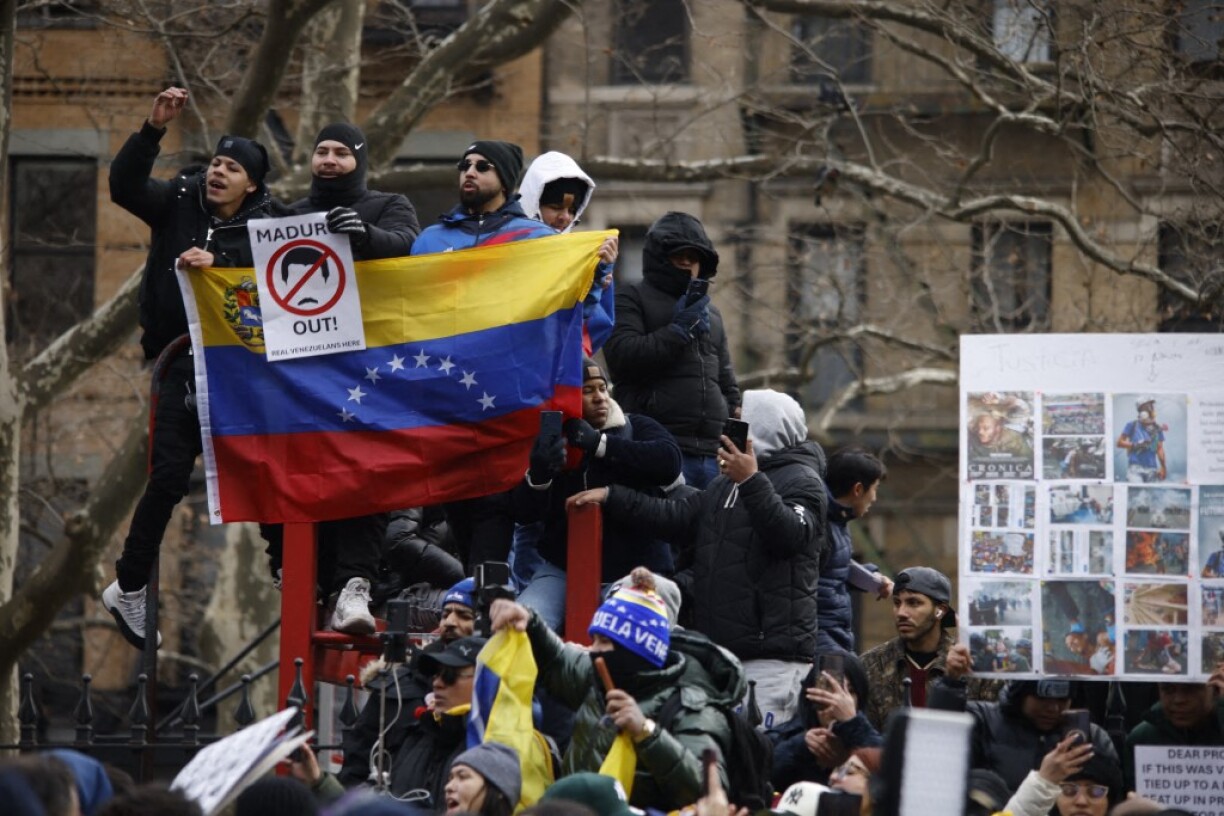
After months of escalation, last Saturday US president Donald Trump ordered a military intervention in Venezuela, which saw president Nicolas Maduro forcibly removed and brought to New York to face charges of "narco-terrorism".
Venezuelan expatriates around the world erupted in jubilation at the news, expressing joy that the head of a corrupt government that had enriched itself over decades from the state's oil reserves without caring about the well-being of its own population was no longer in power. But in addition to the hope for a better future, many Venezuelans abroad also feel uncertain about what will happen to their country. Two Venezuelans in Luxembourg discussed the prospects with RTL this week.
Names have been changed to guarantee anonymity.
Juan moved to Luxembourg in 2015, after a friend helped him to organise a work contract so he could enter the country legally. He cites the economic instability in his home country as the primary reason behind his departure. After a dramatic drop in oil prices in 2014, the Venezuelan economy virtually collapsed due to its dependence on the national petrol industry and oil exports. Since then, many people in the country struggle to afford basic goods such as food or toilet paper.
Fabian, who wished for RTL to only use his first name, said his decision to emigrate was also driven by the continual decline of the country's economy. He initially earned a good wage at home whilst working as a salesman in the construction industry, but as the economy deteriorated, he was forced to change sectors. His work in journalism and eco-tourism enabled him to earn a living, but he ultimately decided to leave after it became apparent that Venezuelan universities faced bankruptcy, risking a lack of education for his children.
Fabian learned of the US intervention on social media, reacting above all with surprise. Juan, however, was concerned. He was born in Caracas and felt uncomfortable with the footage of his home city being bombed. The initial images of the military operation left him in a state of shock and unable to sleep. Above all, he was concerned for his family remaining in Venezuela. After some time, he was able to establish contact with them and confirm no relatives had been injured.
The presence of his relatives in Venezuela is behind Juan's desire for anonymity. Any critical statements made against the Venezuelan government could put his relatives at risk of arrest or physical injury. He pointed out that the Maduro regime installed checkpoints following the 2024 elections in order to monitor the public's phones, specifically in case they posted negative comments online regarding the president or the government.
Within the context of Maduro's repressive regime, RTL asked if Fabian and Juan viewed the US intervention as an act of liberation, or whether it could be the start of further escalation. The US carried out the operation without a UN mandate, thus damaging the sovereignty of another country.
Fabien said it was too early to predict the long-term consequences of the intervention at this stage. Many Venezuelans hoped that Edmundo Gonzáles, who was estimated to have won the July 2024 elections, would take over as president amid Maduro's arrest. But Trump's statements that the US would retain control over the country until further notice have caused confusion and uncertainty. Much is still unclear about this transition period, but the fact that individuals from the Maduro regime will remain part of the transition administration could lead one to think the US intervention was based on economical motives, while nothing much will change for the political reality of Venezuela residents.
Juan added that no one could predict how things would unfold following the US intervention. The current regime in Venezuela is a "monster with many heads", and while one of these heads is gone following Maduro's arrest, the power structures remain in place. In terms of sovereignty, Juan said a country's sovereignty should benefit its people, rather than shielding dictators and tyrants. For 27 years, Venezuelans have suffered under a corrupt government, without benefiting from its oil exports. Ideally, Juan would have preferred a democratic change in government. But the fact that Maduro remained in power in spite of the 2024 election results showed this was not a realistic option. An illegitimate and dictatorial regime such as Maduro's could not hide behind the concept of national sovereignty.
The question that ultimately arises now is whether a political new beginning without violence is possible after the end of Maduro's rule. Fabian said it was what everyone is hoping for, but it is difficult to predict how situations can develop. Simply put, he said people cannot benefit from violence as it hinders economic growth. However, individuals could benefit from violent developments. So it was a case of waiting to see what the future brings.
Juan said the US intervention has changed a lot. He believes the corrupt elites would find it harder to get rich at the expense of the public if the country is under foreign surveillance. Although he said the Trump administration had elements of corruption, he could not imagine that the situation would be worse for Venezuelans than before. In a country where the official minimum wage is roughly 43 cents a month, it could hardly get any worse.





