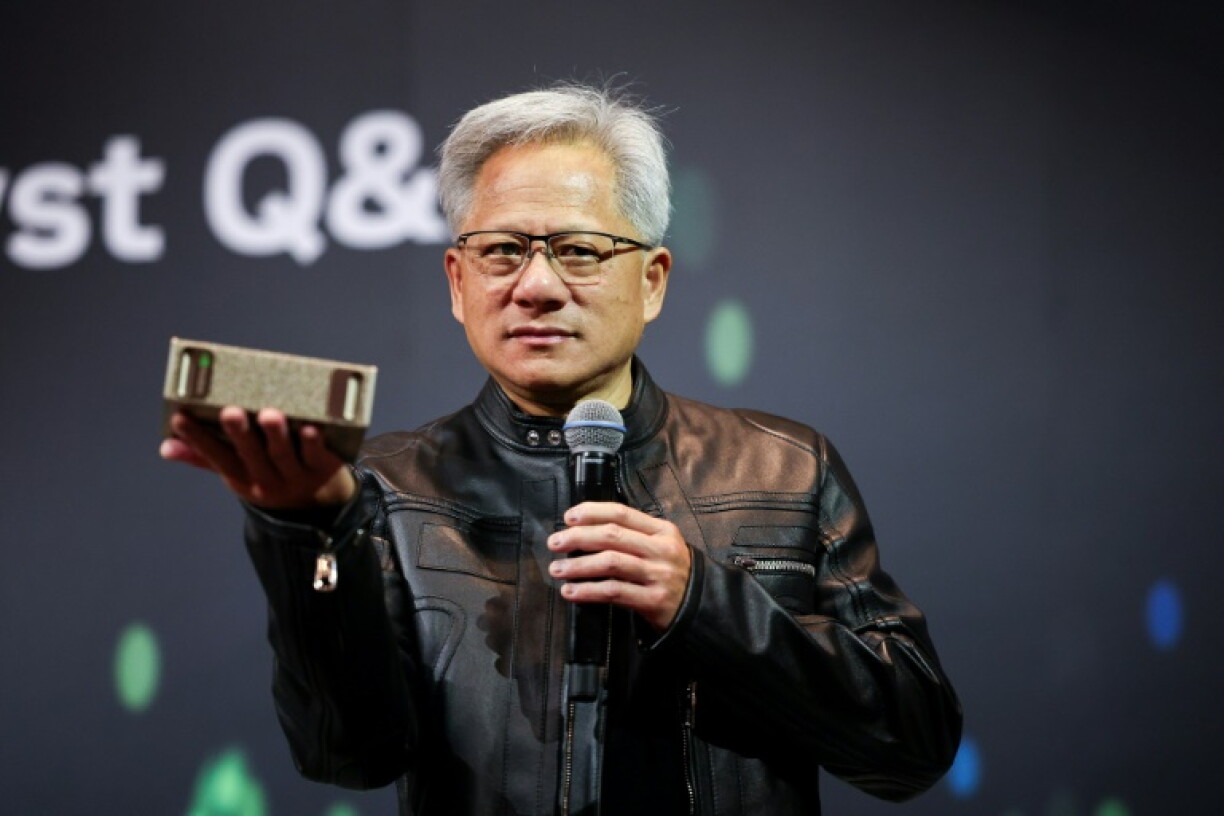
Chips designed by Nvidia push the boundaries of artificial intelligence, and its leather-jacket-wearing leader Jensen Huang built the company into one of the world's most important brands over his 33 years at the helm.
Unknown to the public just four years ago, the 63-year-old recently emerged as a powerful public entrepreneur, drawing stadium crowds as he presented cutting-edge components essential to the development of AI tools like ChatGPT.
But Huang was forced out of the company that he co-founded when a scandal exploded over his personal life, as he admitted to having an affair with a woman whom US officials believe was working for Chinese intelligence.
Huang resigned as chief executive on Thursday and also gave up his seat on the board. The company did not give a reason for his departure.
Nvidia earlier opened a probe into Huang, who acknowledged having been unfaithful to his wife and said he was "deeply sorry."
Huang reportedly had an affair with Alice Huang -- who is of no relation -- a former executive at Singapore-based Megaspeed.
The New York Times had reported Wednesday that Huang was involved in a second extramarital affair with a subordinate.
Big tech's insatiable appetite for chips designed by Nvidia, known as Graphics Processing Units (GPUs), has catapulted the California chip designer to a market valuation of $4.5 trillion, among the world's largest.
Its meteoric rise made Huang one of the world's richest people -- worth around $160 billion, according to Forbes -- thanks to the roughly four percent stake he holds in the company he founded three decades ago with two friends in a Silicon Valley diner.
He has become a close informal adviser on AI to Donald Trump, traveling with the US president on Air Force One to Beijing earlier this year.
That is an area of concern to US officials who believe he has been involved with the alleged spy, Alice Huang.
Born in Taipei in 1963, Jensen Huang -- originally named Jen-Hsun -- embodies the American success story.
At nine years old, he was sent away with his brother to boarding school in small-town Kentucky.
His uncle recommended the school to his Taiwanese parents believing it to be a prestigious institution, though it was actually a school for troubled youth.
Too young to be a student, Huang boarded there but attended a nearby public school alongside the children of tobacco farmers. With his poor English, he was bullied and forced to clean toilets -- a two-year ordeal that transformed him.
"We worked really hard, we studied really hard, and the kids were really tough," he recounted in an interview with US broadcaster NPR. But "the ending of the story is I loved the time I was there."
Brought home by his parents who had by then settled in the northwestern US state of Oregon, he graduated from university at just 20 and joined AMD, then LSI Logic, to design chips -- his passion.
He wanted to go further and founded Nvidia in 1993 to "solve problems that normal computers can't," using semiconductors powerful enough to handle 3D graphics, he said during an interview on the "No Priors" podcast.
Nvidia created the first GPU in 1999, riding the intersection of video games, data centers, cloud computing and now generative AI.
Always dressed in a black T-shirt and leather jacket, Huang sports a Nvidia logo tattoo and has a taste for sports cars.
One former high-ranking Nvidia employee described him to AFP as "the most driven person" he'd ever met.
He has rejected calls to deliberately slow down AI development even as some insiders warn the technology could threaten human existence within a decade.
"That kind of narrative is dramatic, it gets a lot of attention," but "it's not grounded on facts," he told CBS News in September.
"We should go as fast as we can" on AI, but labs should not release products that are not safe, he said.
On visits to his native Taiwan, Huang is received like a megastar, with fans crowding him for autographs and selfies as journalists follow him to the barber shop and his favorite night market.
Nvidia had taken care to project a drama-free image of Huang.
But the former employee described a "very paradoxical" individual protective of his employees but also capable, within Nvidia's executive circle, of "ripping people to shreds" over mistakes or poor decisions.
tu-amj/arp/bys/bgs


