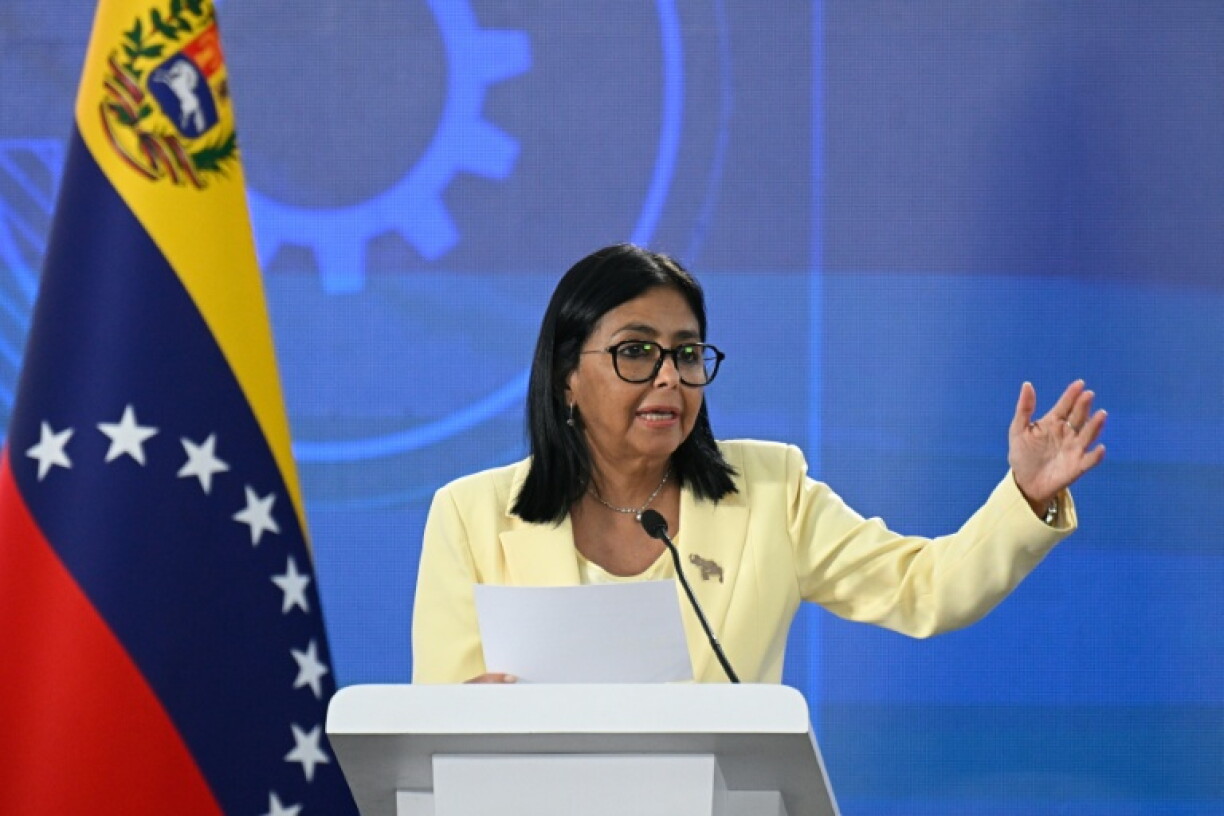
Venezuela's interim president Delcy Rodriguez and her team are at the UN climate talks with an unusual agenda: drumming up oil investment and defending the use of fossil fuels.
Addressing the COP31 summit in Turkey on Thursday, Rodriguez insisted on her country's "sovereign right" to develop its oil industry.
"We believe there is no inevitable contradiction between energy development and environmental protection, because a just transition does not shut down economies -- it transforms them," said Rodriguez, whose country is home to the world's biggest proven oil reserves.
She and her delegation at the talks, which includes Venezuelan oil minister Paula Henao, have put that stance into action with a series of meetings seeking investment in the country's badly underfunded crude industry.
On Wednesday, Rodriguez held a bilateral meeting with Brazil's President Luiz Inacio Lula da Silva, during which the pair talked about increasing Brazilian investment in Venezuela's oil sector.
On Thursday, Henao met with Turkish Energy Minister Alparslan Bayraktar, whose country is keen to develop oil and gas projects overseas.
"We comprehensively discussed potential joint projects in the hydrocarbons sector, particularly oil and natural gas," Bayraktar said on X.
Rodriguez, who became interim leader in January, after US troops captured Venezuelan president Nicolas Maduro in a dramatic raid, is looking to breathe new life into her crisis-racked country's languishing oil sector.
The industry has suffered from decades of underinvestment and sanctions, and its export revenues are now under American oversight -- including a deal for US access to more than 65 billion barrels of oil, about 20 percent of Venezuela's proven reserves.
But Rodriguez's oil push is at odds with the key climate conference goal of weaning the world off fossil fuels.
Brazil, which hosted last year's talks, is pushing for every country to draw up a road map for transitioning away from fossil fuels.
However, in a delicate balancing act, veteran leftist Lula continues to champion oil exploration, a key sector for Brazil.
Lula, whose country is Latin America's top crude producer, argues oil revenues can help fund the clean-energy transition.
Brazilian Environment Minister Joao Paulo Capobianco addressed the controversy that stance has caused when asked about Lula's meeting with Rodriguez.
"We don't believe there's any contradiction, because Brazil is pursuing an accelerated energy transition agenda, it's the country that invests the most in biofuels," he told a press conference.
But he added that oil "is still a strategic resource from an international point of view".
Venezuela's lingering focus on oil -- out of sync with the prevailing rhetoric at the conference on curbing planet-warming fossil fuels -- is a product of the country's crude "dependency" going back decades, said former Colombian environment minister Irene Velez Torres.
As for Brazil, "yes, there are contradictions" on fossil fuels, though that is common among oil- and gas-producing nations, she told AFP.
"These contradictions are permanent fixtures of our national agendas, of the political tensions that have to be navigated," said Velez, who co-organised the First International Conference on Transitioning Away from Fossil Fuels in Colombia in April, bringing together nearly 60 countries.
Such contradictions have become a "habit" in climate negotiations, said Ariel Slipak, research coordinator at the Argentina-based Environment and Natural Resources Foundation (FARN), criticising planet-saving plans that get announced to great fanfare but "never get implemented".
avl/jhb/phz


