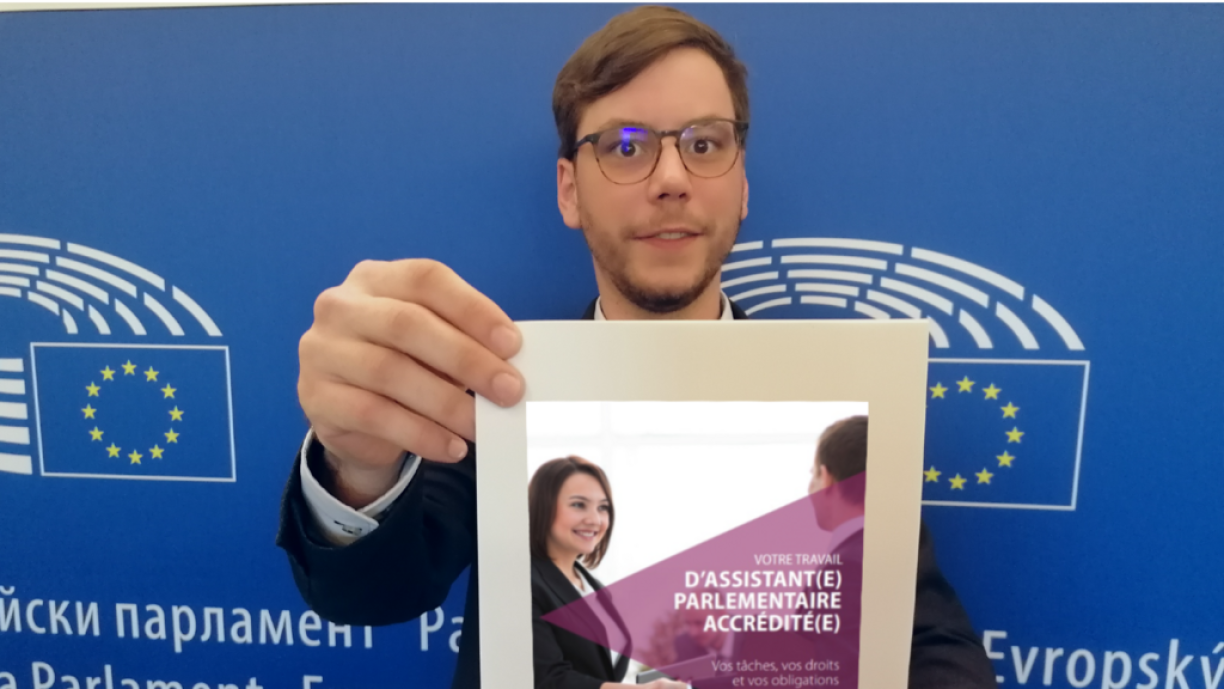
Every morning, Hoffmann cycles through the streets of Brussels to the European Parliament. In his early thirties and a political science graduate from the Université Libre de Bruxelles, he says he was shocked – like many of his colleagues – by the extent of the fraudulent scheme allegedly orchestrated by the then-National Front from as early as the 2000s. He regrets that the scandal risks undermining the public's trust in the work that most assistants carry out diligently and honestly.
He commented further that it is often the actions of a few dishonest individuals that unfairly tarnish the integrity of those who are committed to doing their jobs properly.
MEP Charles Goerens of Renew Europe group and member of the Democratic Party (DP) of Luxembourg, whose experience in the European Parliament dates back to 1982, also expressed his disbelief that the fraudulent system could have persisted for so many years. He argued, however, that the fact it was eventually uncovered demonstrates that oversight mechanisms do work, with no one being above the law.
According to a French court ruling delivered on 31 March, the National Rally (formerly National Front) misused public funds allocated for hiring parliamentary assistants, fraudulently diverting over €4 million between 2004 and 2016. Party leader Marine Le Pen was sentenced to five years of immediate ineligibility for public office, along with a four-year prison sentence – two of which are to be served with electronic monitoring.
Altogether, 23 individuals and the party itself were convicted. Among those sentenced were Yann Le Pen, Marine Le Pen's sister, who was officially employed as an assistant to MEP Bruno Gollnisch while actually organising major party events, and Thierry Légier, the personal bodyguard of Jean-Marie Le Pen. Légier's role reportedly required constant availability and was incompatible with the responsibilities of a parliamentary assistant.
Despite these findings, some in France have portrayed the ruling – particularly the political ban against Marine Le Pen – as a politically motivated verdict. Goerens, for his part, stated that while he accepts the court's decision, the case underscores that decisions made in the European Parliament can have far-reaching consequences at both the European and national levels.
Hoffmann, meanwhile, took the opportunity to highlight what the role of a genuine assistant entails, which in his case includes daily morning consultations with Goerens. Hoffmann further explained that parliamentary assistants must live within 40 kilometres of their place of work – in his case, Brussels, though Strasbourg and Luxembourg are also permitted.
Each MEP receives roughly €30,000 per month from the Parliament to hire assistants – usually three to four per office. While the MEP decides how to distribute the allowance, assistants are paid directly by the European Parliament.
Hoffmann's responsibilities are wide-ranging, particularly given that Goerens also holds the role of Vice-Chair of the Committee on Constitutional Affairs. Along with his colleagues, Hoffmann supports the legislative process, conducts research for proposed amendments, manages communications and press relations, and handles various administrative duties.
These are tangible, day-to-day tasks – nothing like the fictitious roles revealed in the National Rally case, where some assistants were either paid without working or were occupied with party-related activities unrelated to the European Parliament.
Nevertheless, the legal saga is not over. Marine Le Pen and 12 other individuals have filed an appeal, with a new trial expected in the first half of 2026. Moreover, further allegations are surfacing.
According to French investigative outlet Mediapart, Andréa Kotarac, spokesperson for the National Rally, held dual roles – working for the party and serving as an assistant to an MEP – without obtaining the necessary authorisation from the European Parliament. This reportedly occurred between November 2021 and December 2022.
Looking ahead, Hoffmann says the damage done to the institution's image is regrettable, not only for the European Parliament, but also for assistants like himself. He worries that the public now views them all with suspicion.
Still, he remains confident in the integrity of his peers, estimating that 99% of those working in Parliament are honest and committed to their roles.





