The organisers of the protest communicated on Saturday evening that the expected crowd of 150 people had been exceeded by 200 demonstrators. Members of the Horesca sector thus walked from Place Guillaume II to the Chamber of Deputies, demanding that both restaurants and bars are allowed to open their businesses once more.
The administration recently decided to prolong the current measures and restrictions until 21 February in an attempt to limit the spread of new coronavirus variants. The Horesca sector laments this decision and emphasises that the government support is not coming in fast enough. Businesses want to reopen, even if they still have to apply additional safety measures.
Last year, 127 businesses in the sector had to shut down forever. Although 44 fewer than in 2019, the fear of bankruptcies persists. Businesses therefore demand that they be given a clearer perspective on how to move forward. Especially smaller bars and restaurants are nearing their financial limits.
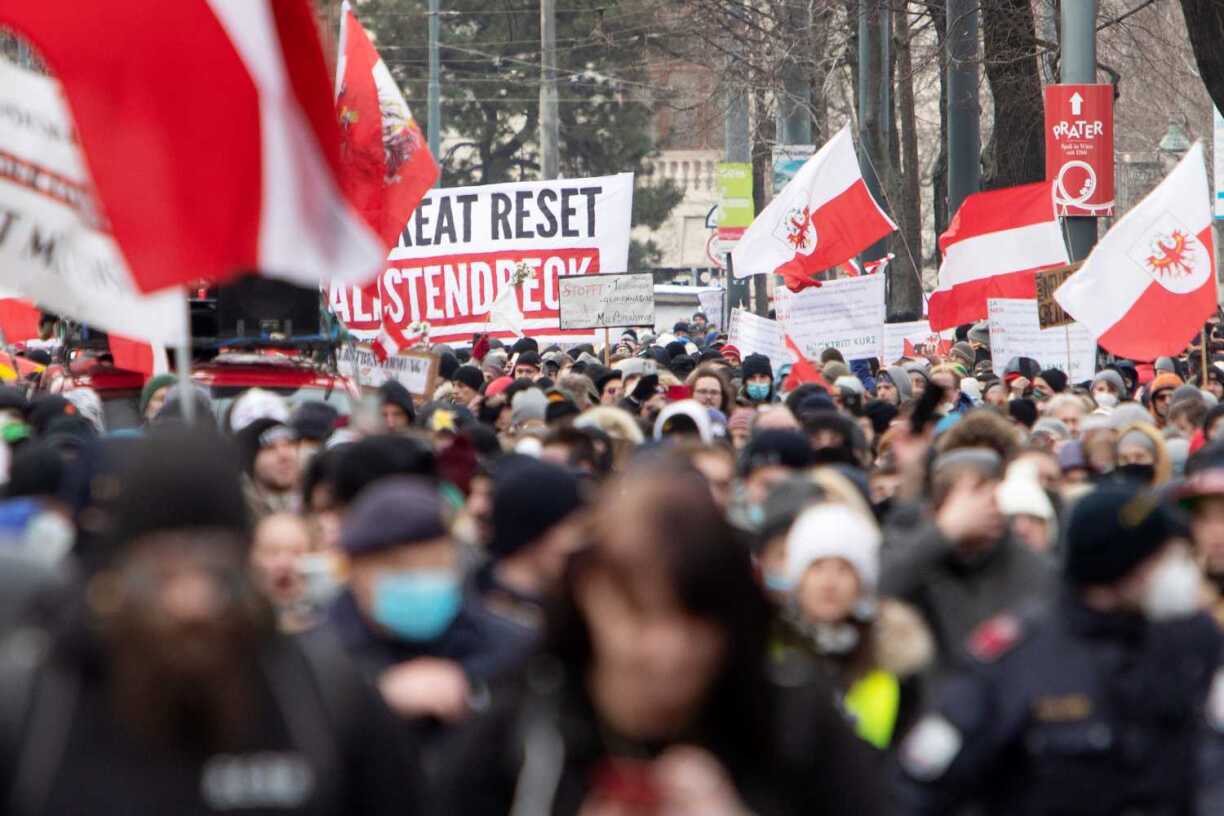
Around 5,000 people defied a ban to march Sunday in Vienna in protest against a curfew and lockdown aimed at curbing the spread of Covid-19.
The march was organised by the far-right FPOe party, and many participants ignored government regulations on mask wearing and the respect for minimum distances from each other. Neo-nazi militants and thugs were reportedly among the crowd, which refused to disband and blocked traffic as it began to march towards the national parliament. Police then intervened and detained some protestors.
It was the first time that the FPOe, and member Herbert Kickl who is a former interior minister, officially called for a protest against the third Austrian lockdown. "We are seeing unprecedented censure," Kickl told media Saturday, before the party put in a second request for a rally permit which was also refused.
The reason for the refusal was given as a risk of increased transmission rates of new variants, and a "lack of contact traceability" among those who were to take part in the march.
Austrian schools, sports clubs, hotels, restaurants, cultural venues and many stores have been shut to stem the spread of Covid-19, but the country's iconic ski resorts have been allowed to remain open.
Police in the Belgian capital said Sunday they have detained scores of people in a bid to prevent two banned demonstrations against measures to curb the spread of the coronavirus.
"We are above 200 arrested at the moment," mainly around the rail stations in Brussels, a police spokesman said around midday. Police evacuated one square in front of the main railway station, where some of the protesters were football supporters from Belgian clubs.
Dozens of people, responding to calls on social media for protests against measures to check the coronavirus, also began gathering at the Atomium, a landmark building in Brussels. "We remind you that there is no authorisation to come and demonstrate this Sunday," the Brussels police said in a Tweet.
"Those people who still intend to demonstrate in Brussels today will be approached, dissuaded from staying and if necessary" detained, it said.
It later tweeted a gallery of items that officers had found on people, including knives, catapults and mouth guards.
Tens of thousands of protesters turned out in dozens of French cities Saturday against a security bill they say will restrict the filming and publicising of images of police brutality, but also to protest the restrictions imposed against the coronavirus.
Those joining the demonstrations included activists from the "yellow vests" movement that gripped France for more than a year before the pandemic restricted large-scale protests.
Others were there to stand up for the cultural sector, hit hard by the restrictions imposed to curb the spread of the coronavirus.
Also among the protesters were young people calling for the right to hold rave parties such as the one in Brittany that attracted 2,400 at the start of the year.
According to interior ministry figures, 32,077 people turned out to protest across France, significantly down on the 133,000 they said attended the largest protest against the measures, back in November -- although organisers put the true turnout then at more than half a million people.
Organisers put the fall in numbers down to the coronavirus restrictions, poor weather and the fact that this was just the latest in a long series of such protests.
At around 5 pm, an hour before the start of the overnight 6-6 curfew now in place as a measure against the coronavirus, clashes broke out between a group of around 50 youths and police.
After being pelted with projectiles, the police used water cannon to clear the square. The Paris prosecutors office said 26 people had been detained.
Hundreds turned out for similar rallies in other cities.
Polish police said they raided discos in the cities of Wroclaw and Rybnik that had opened in breach of coronavirus restrictions on Saturday, using stun grenades and tear gas to clear the dance floor.
Almost 150 officers were deployed at the Face 2 Face club in Rybnik, local police said in a statement on Sunday.
Two officers were injured, while police arrested three men and checked the ID papers of 213 others.
Similar operations requiring less force were held in the southwestern city of Wroclaw, police said.
As is the case elsewhere, restrictions on dance and sports clubs, hotels, restaurants and ski areas have run into opposition in Poland, and some venues have decided to open despite the risk of heavy fines.
Restaurant workers took to the streets in Budapest on Sunday, where at least 100 restaurants planned to re-open despite threats of heavy fines.
"We have had enough of the mass destruction of businesses," the organisers of the rally said on Facebook.
Although protesters wore masks but defied rules of banned public gatherings, police checked documents.
Around 30 peeple were arrested in the Dutch capital when around 600 flouted social distancing rules and ignored a ban on public gatherings. However, none of the events taking place were anywhere near the riots of last week.





