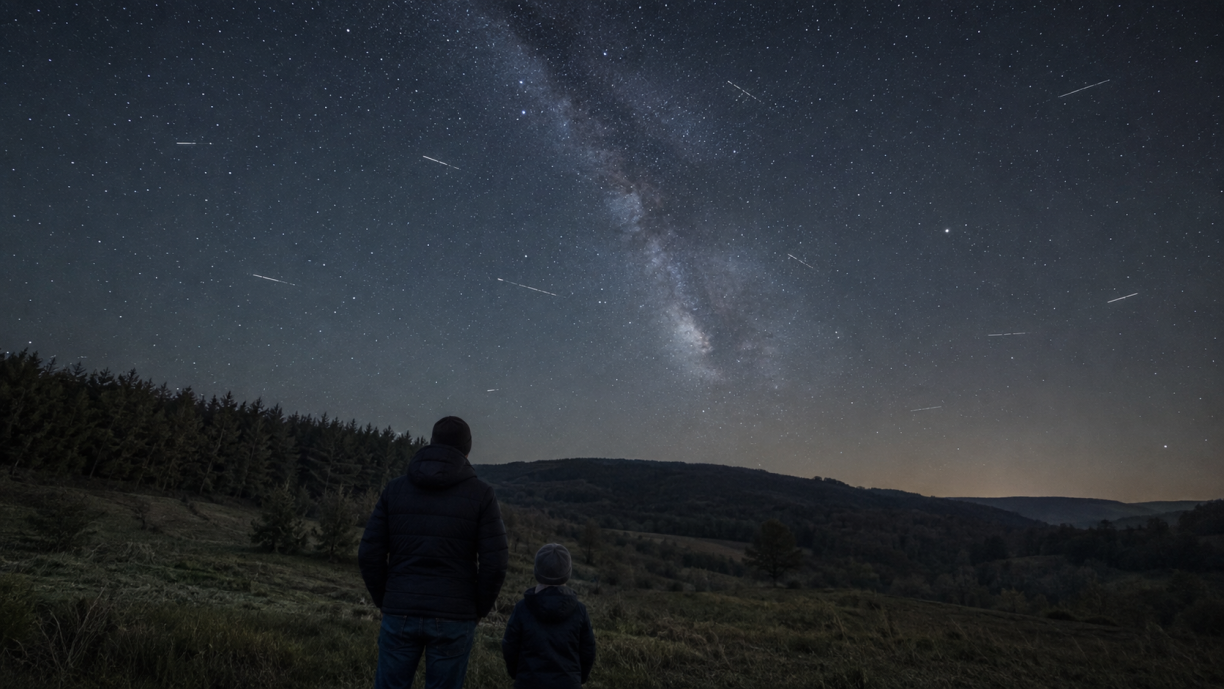
On a clear evening in the Oesling, far from Luxembourg’s brightest urban areas, look up for only a few minutes and you are likely to notice several points of light moving steadily among the stars. They are the visible signs of a transformation taking place far above us.
Each moving point seems harmless, even interesting, but taken together they reveal how quickly the natural character of the night sky is being eroded, and how different the sky inherited by our children could become.
Satellites support modern civilisation through communication, navigation, weather monitoring and forecasting, among many other services. The problem is not their existence, but their cumulative number and brightness: satellites in low Earth orbit can remain illuminated by the Sun after darkness falls, reflecting some of that light towards the ground.
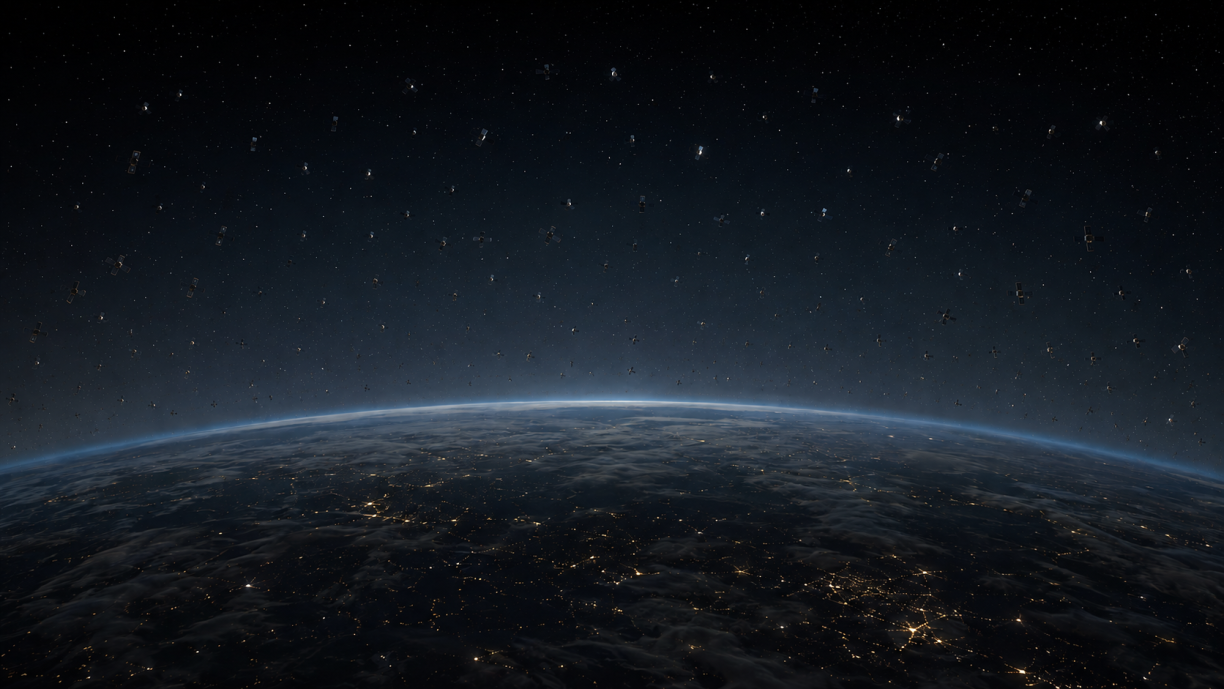
When SpaceX launched its first large batch of Starlink satellites in 2019, around 2,000 active satellites orbited Earth. The growth has been extraordinary: the European Space Agency’s latest figures, updated on 31 July 2026, place the functioning population at approximately 16,000, largely because of the rapid expansion of telecommunications constellations. The figure rises to nearly 19,000 when inactive satellites left in orbit are included. When satellites, rocket stages, fragments and other debris are counted, more than 46,000 artificial objects in orbit are now regularly tracked.
With current proposals exceeding 1.7 million satellites, a new European Southern Observatory (ESO) study warns that their combined light could brighten the night sky itself, creating a new form of global light pollution.
This does not mean that all 1.7 million have been authorised or will all be launched. SpaceX alone has applied to operate up to one million orbital data-centre satellites, while E-Space’s Cinnamon constellation and two large Chinese proposals would add hundreds of thousands more.
What would happen if satellite expansion continued without effective limits, and how many objects could the night sky accommodate before the damage became unacceptable?
The greatest threat to natural darkness may come from the satellites' combined light. Faint satellites add a diffuse glow, while brighter ones scatter light through the atmosphere. As the sky brightens, faint stars and the Milky Way become harder to see.
The ESO study therefore proposes keeping satellites fainter than visual magnitude 7 and limiting the total population to around 100,000. The astronomical magnitude scale runs backwards, so magnitude 7 is fainter than magnitude 6 and normally beyond naked-eye visibility.
The simulations suggest that a population of approximately 60,000 satellites would have a negligible effect on overall sky brightness if everyone were fainter than visual magnitude 7. At that brightness, individual satellites should remain just beyond naked-eye visibility under an excellent dark sky.
This raises a fundamental question: who has the right to change the night sky?
The sky belongs to no single country, company or individual. It has always been a shared human inheritance, visible across borders and passed from one generation to the next. Yet decisions capable of altering the sky for the entire planet are still largely made through national licensing procedures, even though their consequences cross every border.
This leads to an uncomfortable question: why should a billionaire or private company, acting through a single national regulator, be able to change something shared by everyone, primarily in pursuit of commercial profit, while the people who share that sky have no equal or direct voice in the process?
No company owns the stars, yet a company’s satellites can determine what we see between them. While many of the commercial benefits may be private or limited to paying customers, the loss of an undisturbed night sky is imposed on everyone. A decision with global and long-lasting consequences deserves global scrutiny, transparent limits and genuine public participation.
This is not an argument against satellite technology. It is an argument for scale, regulation and responsibility. Useful services do not remove the need to consider cumulative environmental and cultural costs. Low Earth orbit is a shared environment, and so is the sky seen from beneath it.
The next time you stand under the stars in the Oesling, take a few minutes to count the artificial points moving overhead. What you see is still only a small part of today’s orbital population, but it offers a glimpse of the decision now facing us.
Future generations could see satellites as occasional travellers among the stars, or the stars as a background between satellites.
Active satellites in orbit: approximately 16,000
Active and inactive satellites still in space: approximately 18,840
Regularly tracked artificial objects: approximately 46,230
Proposed new constellations: more than 1.7 million additional satellites
Main effects: diffuse orbital glow, atmospherically scattered light and reduced contrast between the stars and the sky
Suggested ceiling: around 100,000 satellites, all fainter than magnitude 7





