Scientists are still debating when they formed, how they have changed and whether their bright appearance has been misleading us.
Seeing Saturn through a telescope for the first time is an overwhelming experience, one that can turn a casual observer into an avid stargazer forever. Even when you know exactly what to expect, that view can leave you speechless.
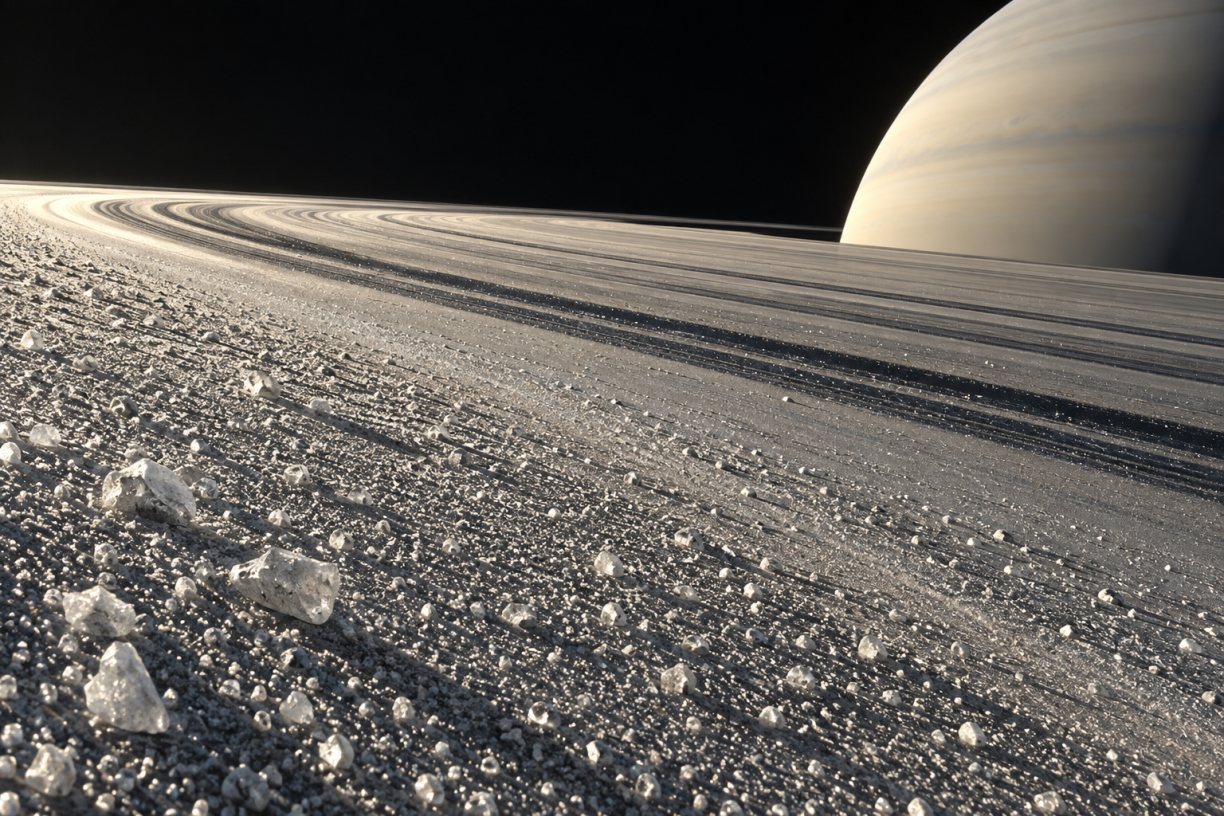
Through a telescope, Saturn’s rings can appear compact and continuous, but this solidity is an illusion created by the vast distance separating us: much like a beach that looks uniform until viewed closely enough to reveal individual grains of sand. In reality, the ring system consists of countless distinct particles composed primarily of water ice, each pursuing its own independent orbit around the planet.
A sufficiently powerful telescope also reveals that these icy particles gather into distinct regions, divided by dark gaps, the most famous being the Cassini Division, which separates the B and A rings. While the gap looks like empty space through a telescope, it is actually filled with its own fine structures and ring material.
At closer range, NASA’s Cassini spacecraft uncovered even finer structures within this system. Small moons orbiting Saturn disturb nearby particles, generating waves and intricate features throughout the rings, while other moons actively supply or strip away material. It remains a complex, continually evolving system whose exact origins continue to defy simple explanation.
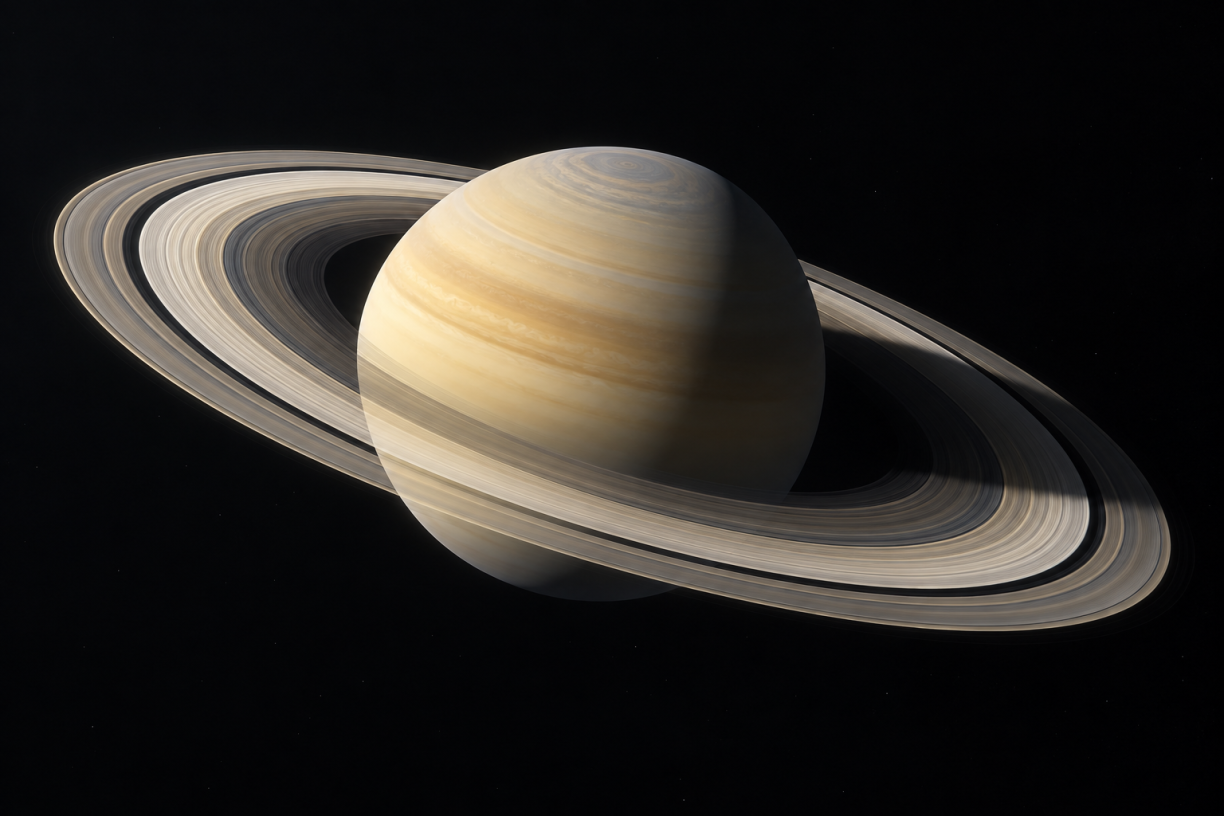
While Saturn formed roughly 4.5 billion years ago in the early Solar System, analyses of Cassini’s data suggest that its main rings may be surprisingly young. A key 2023 analysis estimated their age at just 100 to 400 million years, which would make them a recent addition on a cosmic scale.
To determine this timeline, astronomers measured dust contamination: space particles continually bombard the rings, gradually darkening their brilliant water ice. By calculating the current ratio of dust to ice against the incoming dust rate, researchers can estimate how long the system has been exposed to interplanetary debris.
Under that study’s assumptions, the rings appeared too clean to have spent billions of years gathering material from their surroundings.
However, this conclusion hinges on how faithfully the rings retain incoming material. Recent modelling suggests that impacts can vaporise a portion of the dust, allowing some of it to escape into space rather than accumulate within the ice. If the ring system retains less contamination than previously assumed, it could be considerably older than its bright appearance suggests, leaving its true age a matter of ongoing scientific debate.
Even the origin of the rings remains uncertain. One leading possibility is that the main rings are the remnant material of moons destroyed during a violent episode in Saturn’s history.
Simulations published in 2023 demonstrated how high-energy collisions between ancient icy moons could scatter debris into the regions the main rings occupy today. In these models, the outer icy layers of the colliding moons were stripped away and dispersed differently from their dense rocky cores, providing a compelling explanation for why the ring system is composed almost entirely of water ice.
While these simulations offer promising ways to unify the observational evidence, no single model has yet definitively settled the question of their origin.
The rings’ future is equally unclear: material continually cascades towards Saturn through several mechanisms, including a phenomenon scientists call "ring rain", in which gravity and magnetic fields pull icy particles down into the planet's atmosphere.
High-profile estimates suggest the ring system could vanish within a few hundred million years, but these projections hinge on whether present-day loss rates remain constant over cosmic time. Ultimately, measurements made over a limited period cannot definitively predict the behaviour of an entire planetary system over millions of years.
For anyone peering at Saturn this October, these open questions only add to the fascination of the ringed planet. Its rings may hold the debris of shattered moons, a far older record of gradual evolution, or a complex dynamic that scientists have yet to fully untangle.
While Saturn's silhouette in a telescope eyepiece is instantly recognisable, the history of its rings remains one of the Solar System’s most captivating unfinished stories.





