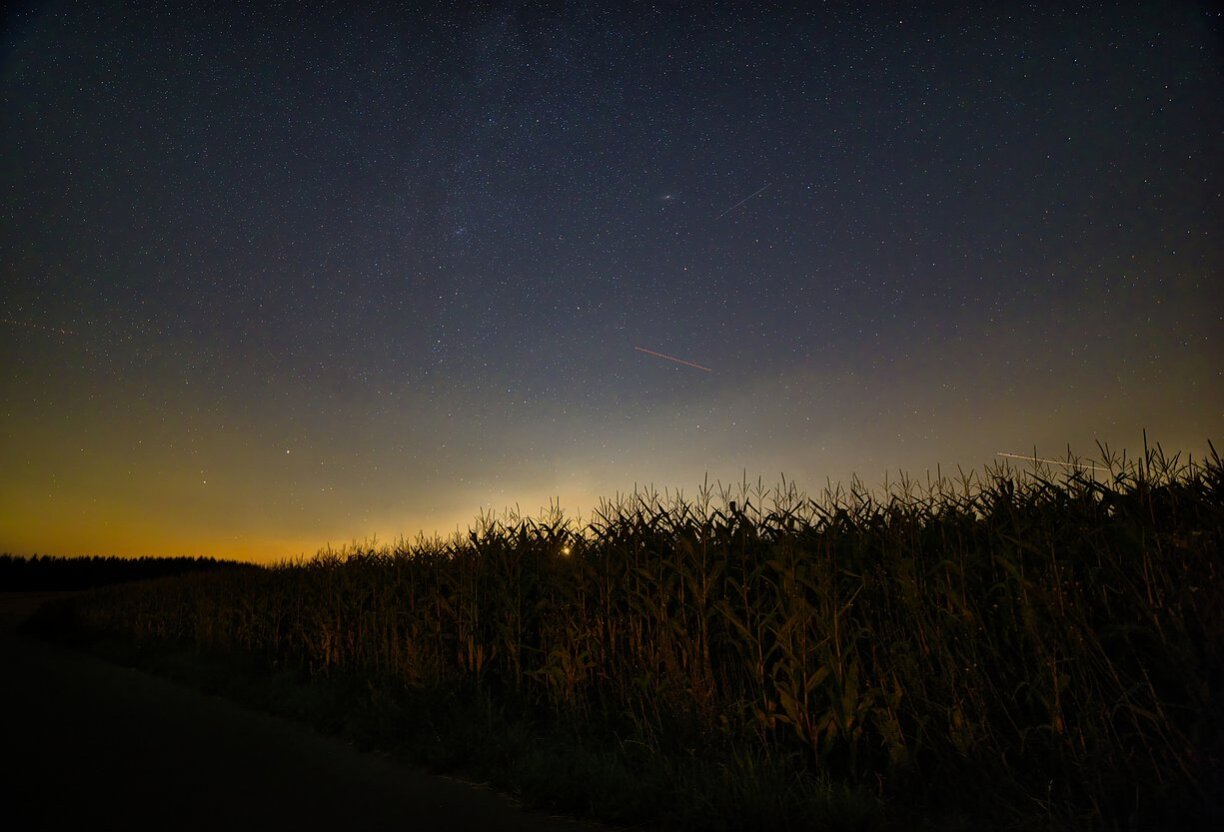
Every November, Earth crosses the trail of dust left behind by Comet Tempel–Tuttle, an icy body just a few kilometres wide. This small comet, which circles the Sun once every 33 years, leaves behind a tail of tiny fragments of rock and ice. When Earth passes through this stream, those particles enter our atmosphere at incredible speed, at more than 250,000 kilometres an hour, heating the air around them and glowing briefly as meteors.
Most of the particles burn up completely between 80km and 100km above the ground, leaving only a faint trail of glowing air. The brightest Leonids sometimes create delicate, twisting streaks that linger for a few seconds before fading into the darkness.
Meteoroid – A small piece of rock or metal travelling through space, usually debris from comets or asteroids.
Meteor – The streak of light produced when a meteoroid enters Earth's atmosphere and burns up.
Meteorite – The rare fragment that survives the fiery passage and lands on the ground.
Most Leonid meteoroids are no bigger than a grain of sand. They never reach the surface, but their brief glow can outshine the brightest stars.
These modest grains of dust have a remarkable story – and at times, they've turned the night sky into a spectacle unlike any other. While most years bring a gentle drizzle of 10 to 20 meteors an hour, there have been rare occasions when the sky seemed to rain stars.
The most famous occurred in 1833, when observers across North America reported thousands of meteors every minute, a storm so intense that people feared the end of the world.
It was that extraordinary night that turned public fascination into scientific study: astronomers realised for the first time that meteor showers were recurring, predictable events tied to comets.
Other storms followed in 1866, 1966, and 1999, each one tied to Earth passing through especially dense trails of debris.
In 2025, the Leonids will peak on the night of 17–18 November. The Moon will not be visible, creating with its absence the ideal conditions for meteor watching. The best time to observe is from midnight until dawn, when the constellation Leo rises high in the east and the radiant climbs well above the horizon.
Under good conditions, observers might see 15 to 20 meteors per hour, with the occasional bright fireball. The Leonids are among the fastest meteors of all, and they often leave fine, bluish trails that briefly persist after the meteor itself has vanished.
Meteor watching requires no telescope or binoculars, only patience and a cloudless sky. Choose a location away from artificial lights, give your eyes at least 20 minutes to adapt to the dark, and simply look up. The meteors can appear anywhere in the sky, not just near Leo, so a wide view is best.
Luxembourg offers several good dark-sky spots: the Parc naturel de l'Our in the north, the Haute-Sûre region near the lake, and the ridgelines around Kautenbach or Wiltz all provide open horizons and minimal light pollution. Even from suburban areas, the brightest Leonids can still be seen.
While November nights might already be too cold to lie on the ground, a reclining chair is definitely the best option to enjoy the show. Remember to dress in warm layers and bring a hot drink. The secret to seeing more meteors is simply to stay outside longer. After half an hour, the shower's rhythm becomes apparent, with long pauses followed by bursts of activity.
Meteor showers like the Leonids reveal how comets shape the architecture of the Solar System. As comets shed material over successive orbits, their dust trails spread and evolve under the influence of solar radiation and planetary gravity.
By tracking meteor showers from year to year, astronomers can model those changes and even predict when Earth might encounter denser filaments.
Studying meteoroids that survive entry also helps scientists understand the composition of the early Solar System. These tiny travellers preserve unaltered material from the time of planet formation, offering clues to the chemistry that preceded life itself.
While you wait for meteors, take in the broader view. Orion is climbing higher in the southeast, its Belt stars pointing down toward Sirius, the brightest star in the sky. High overhead, the Pleiades sparkle in Taurus, and further north, Cassiopeia's “W” marks the path of the Milky Way fading into the autumn haze.
On clear, moonless nights, the Andromeda Galaxy is still visible to the naked eye.
For photographers, wide-angle shots capturing both the stars and landscape work best. All you need is a tripod, long exposures of 15–30 seconds, and a remote shutter. Even if you don't catch a meteor, you'll bring home the stillness and depth of a November night.
This year the conditions for the Leonids are nearly ideal. With the Moon out of the way and long nights ahead, it's a perfect opportunity to reconnect with the night sky. Find a dark field, face east, and the meteors will come, quick, silent, and ancient, as they have for thousands of years.
Peak: Night of 17–18 November 2025
Parent body: Comet 55P/Tempel–Tuttle
Expected rate: 15–20 meteors per hour (under dark skies)
Meteor speed: 71 km/s, among the fastest known
Radiant: Constellation Leo, rising after midnight
Best time to watch: After midnight until dawn
Visibility: Best from rural areas; bright meteors visible even from towns
Tip: Dress warmly, find an open horizon, and allow eyes min. 20 minutes to adjust





