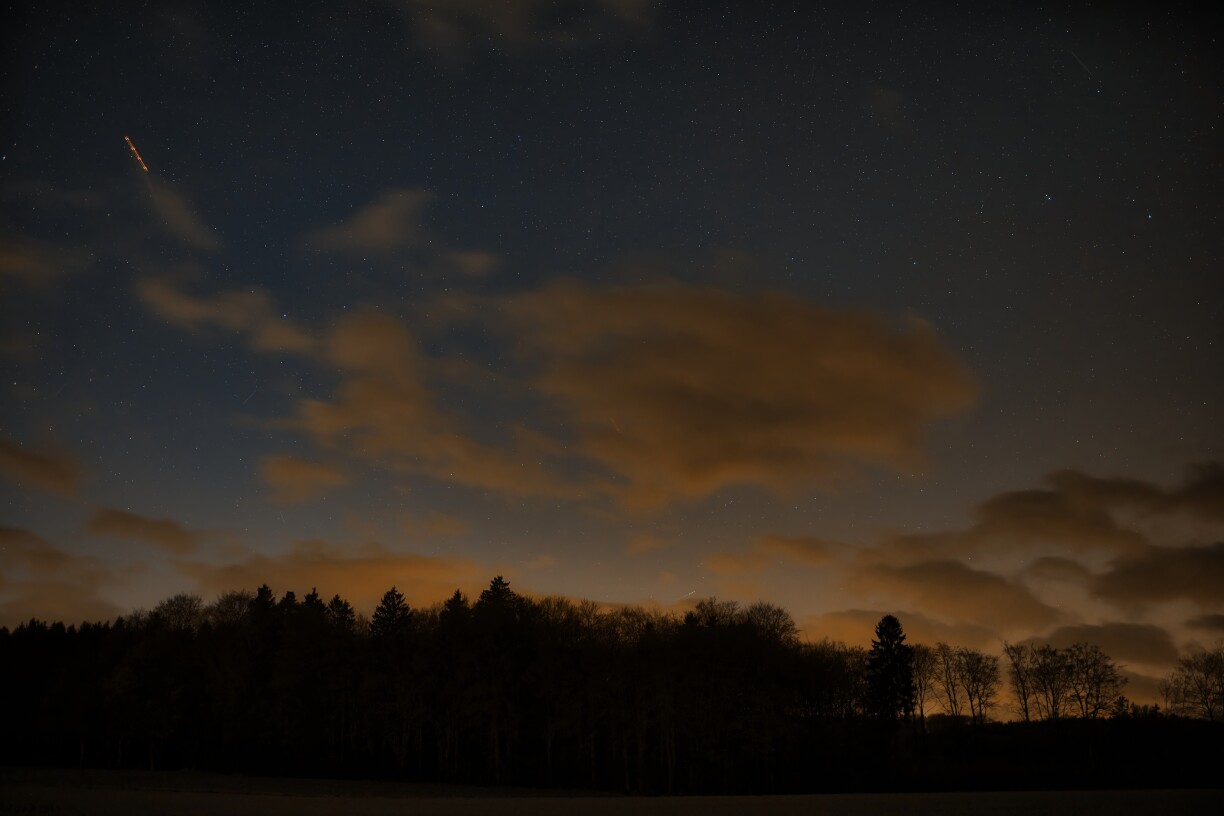
March is a month defined by transition. Winter slowly begins to loosen its grip as spring approaches, hopefully rewarding observers in Luxembourg with clearer skies and milder nights. The shift is subtle but unmistakable: familiar patterns such as Orion drift toward the western horizon, while Leo and Ursa Major rise steadily in the east.
Winter constellations still dominate the early evenings, but their presence shortens with each passing week, gradually giving way to the stars of spring. Several bright planets remain visible throughout the month, offering another opportunity to witness the sky in motion as one season quietly gives way to the next.
The month begins at full throttle as the Full Moon, traditionally known as the Worm Moon, brightens our skies on 3 March. The name comes from Native American seasonal naming traditions and refers to the thawing of the soil in early spring, when earthworms begin to reappear.
Grab your binoculars or camera and head outside: no matter where you are, the Grand Duchy looks stunning under the glow of our natural satellite. While you're out, look high in the south after sunset to spot Jupiter among the stars of Gemini – it appears as a brilliant, steady point of light dominating the evening sky, unmistakable even from brightly lit areas. With binoculars, its four largest moons become visible as tiny points of light aligned beside the planet.
Lower in the western sky, another show unfolds. Venus shines intensely in the fading twilight, impossible to miss. During the first week of March, Saturn lies nearby, although much fainter and closer to the horizon.
On 7–8 March, the two planets appear very close together, forming a striking but subtle pairing. The pair is visible roughly 30 to 45 minutes after sunset, low above the western horizon. Binoculars will easily reveal Venus and may also allow Saturn to emerge from the twilight glow.
These are among the last opportunities to observe Saturn in the evening sky before it disappears into the Sun's glare later in the month.
The central part of the month is characterised by darker skies, as the Moon wanes and rises later each night, leaving the evening hours free from its glow. By mid-evening, new constellations begin to draw attention in the east.
Leo, the Lion, becomes increasingly prominent, its distinctive sickle-shaped pattern marking the head of the celestial animal. Above and around it, the familiar stars of Gemini remain visible, bridging the gap between the winter and spring skies.
As the night deepens, the great Spring Triangle, formed by the bright stars Arcturus, Spica, and Regulus, climbs steadily higher. This large pattern dominates the eastern and southern sky in the coming months and is one of the clearest indicators that a new observing season has begun.
Unlike winter, which is dominated by bright nearby stars, spring is known for its abundance of galaxies. These distant star systems lie far beyond our own Milky Way, and although most require a telescope to be seen clearly, they represent some of the most distant objects accessible to amateur observers.
Observers in darker areas of Luxembourg may also be treated to the zodiacal light. Head north toward the Oesling region or east toward Mullerthal for a chance to spot a faint, triangular glow rising from the western horizon after sunset. This subtle phenomenon is caused by sunlight reflecting off interplanetary dust within the inner Solar System and is best seen under clear, dark conditions.
The New Moon on 19 March brings the darkest skies of the month and offers an excellent observing opportunity. Just one day later, on 20 March, the vernal equinox marks the official beginning of astronomical spring.
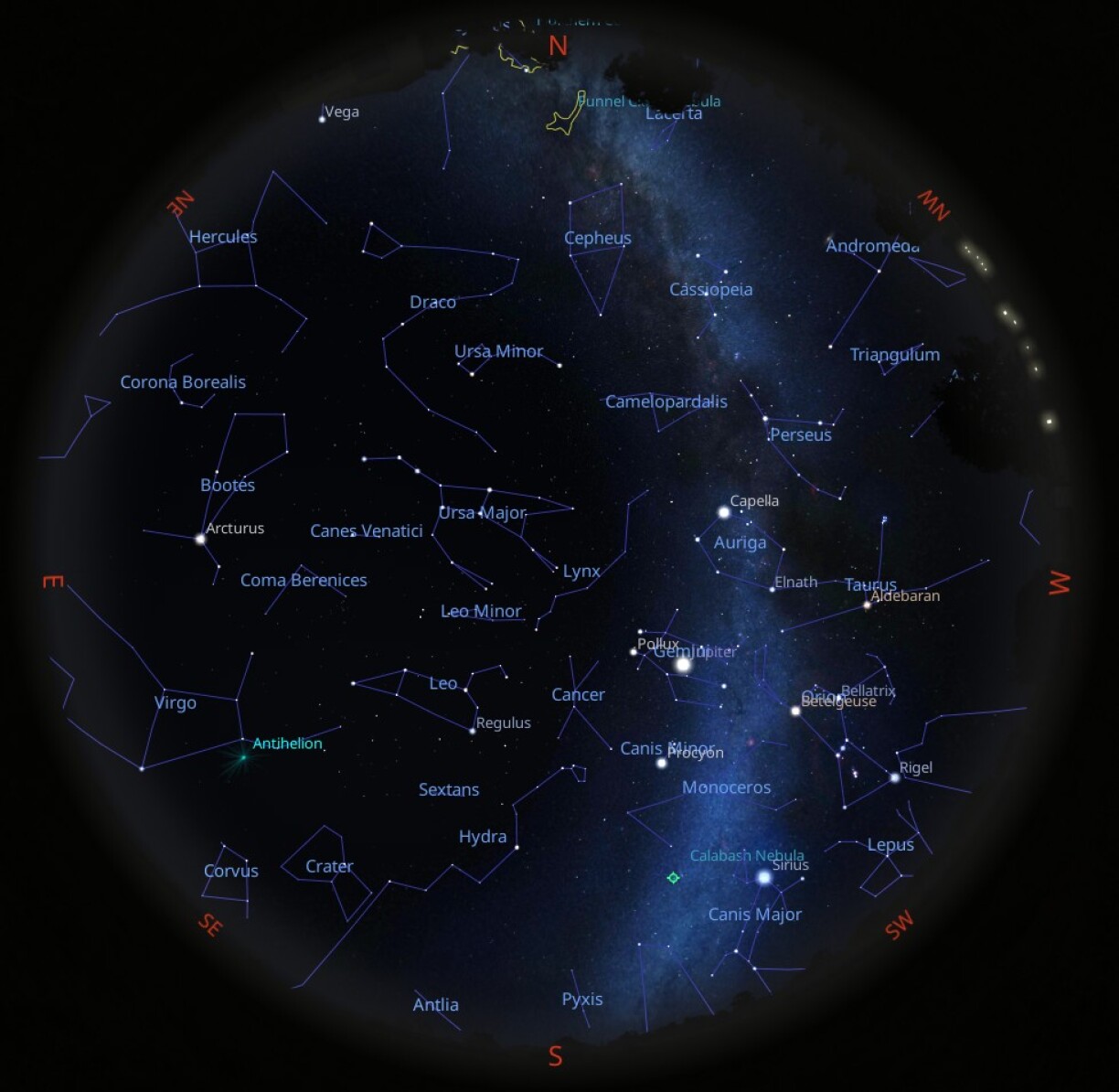
From this moment on, the Sun sets later each evening and the night sky gradually shifts toward its spring configuration. Leo now stands high in the south as darkness falls, becoming the central constellation of the season. Its bright star Regulus marks the heart of the celestial Lion, while fainter stars outline its body stretching eastward.
Above it, Ursa Major dominates the sky. Its most recognisable feature, the Big Dipper, is now perfectly positioned high overhead during the evening, making this one of the best times of year to observe it.
Between Leo and Gemini lies the constellation Cancer, home to the Praesepe, or Beehive Cluster. This rich open cluster is easily visible with binoculars, appearing as a delicate concentration of stars suspended in the darkness.
Jupiter remains a constant presence, shining brightly throughout the evening and serving as an excellent reference point for observers. Its steady light distinguishes it clearly from the surrounding stars.
The Moon also returns to the evening sky, appearing first as a thin crescent after the New Moon and gradually growing brighter each night. It reaches first quarter phase on 25 March, forming a striking pairing with Jupiter high in the sky: a beautiful and easily visible alignment.
Later in the night, new constellations rise in the east, preparing to dominate the coming months – the sky's transformation is now well underway. Winter's familiar patterns have mostly faded, replaced by a new landscape rich with distant galaxies and star clusters.
Spring has arrived, not suddenly, but gradually, written in the movement of stars above us.





