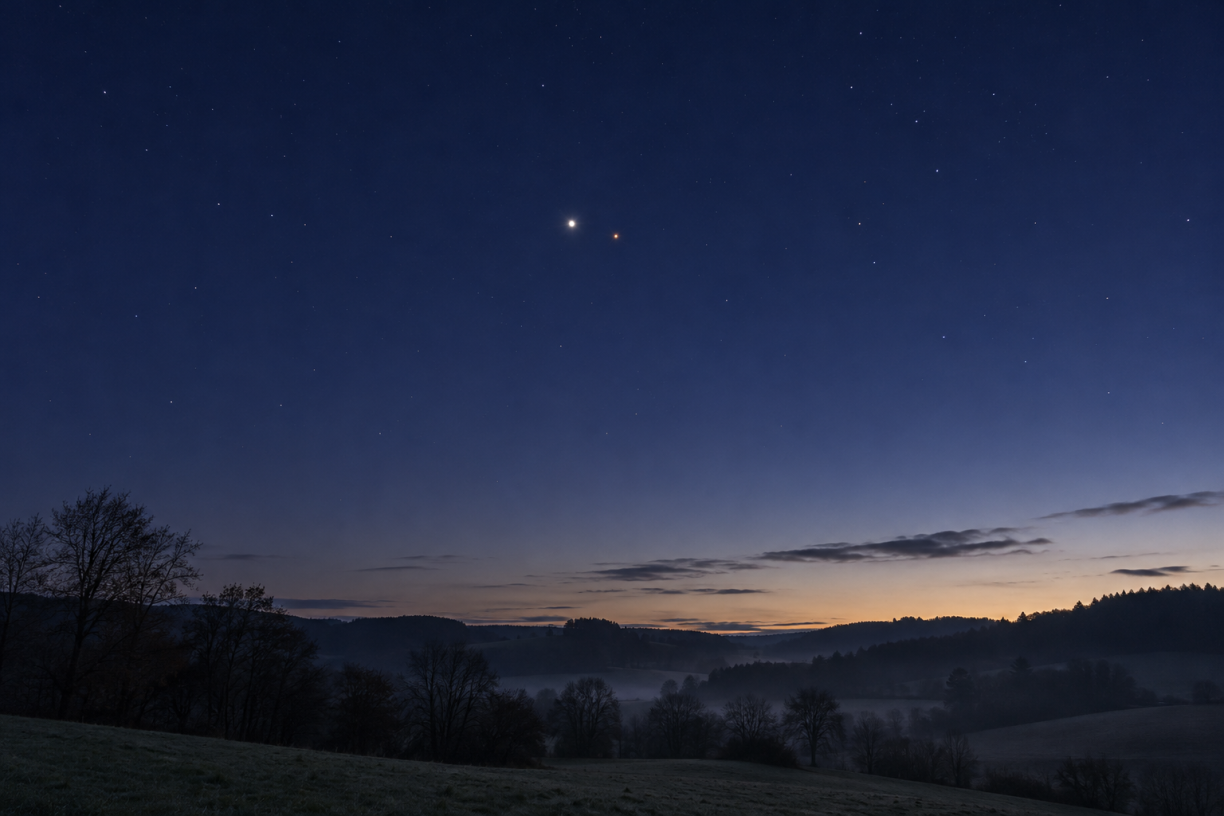
Saturn remains an inviting target after dark, while the morning sky hosts a succession of encounters between the Moon, distant planets and bright stars.
Here is what to look for in the November night sky.
Before dawn on 2 and 3 November, the waning Moon passes through the region occupied by Mars, Jupiter and Regulus, Leo’s brightest star. Look towards the south-east around 6am and compare the view on consecutive mornings: the Moon’s movement around Earth noticeably changes the arrangement.
Jupiter is the brightest point in this group, while Mars has a warmer, orange tint. No telescope is needed: these encounters are an opportunity to learn your way around the sky using the Moon as a signpost.
On 7 November, a much thinner crescent appears near brilliant Venus before sunrise, with the star Spica nearby. Choose somewhere with an unobstructed east-south-eastern horizon and try looking around 6.30am, as dawn begins to brighten the sky.
The New Moon on 9 November creates ideal dark skies for spotting faint objects, like the Andromeda galaxy, which appears high near Cassiopeia and the Great Square of Pegasus in the evening sky. From a dark location, it may appear to the naked eye as a faint, misty patch, while binoculars make its brighter centre and surrounding elongated glow easier to recognise.
The Northern Taurids reach their maximum around 12 November, following the Southern Taurids around 5 November. Both showers produce relatively slow meteors and occasional bright fireballs, but sightings are sparse. Treat them as a possible bonus during a longer observation session rather than expecting a continuous display.
The month’s most striking planetary encounter happens on the mornings of 15 and 16 November, when Mars and Jupiter appear just over one degree apart, a little more than twice the apparent width of the Full Moon.
Look towards Leo between about 5 and 6.30am, when both planets have climbed well above the horizon. Jupiter shines much more brightly than its neighbour, making the pair easy to identify. Binoculars show them together in the same field of view but in reality Mars and Jupiter remain far apart in space: their pairing is just a matter of perspective from Earth.
Keep that early alarm set for the Leonid meteor shower, which reaches its main peak on the night of 17–18 November as Earth passes through debris left behind by Comet Tempel–Tuttle. No meteor storm is expected this year so there will likely be quiet stretches between shooting stars.
With the Moon setting shortly after midnight on 18 November, a prime viewing window opens up between 2am and 5.45am as Leo climbs higher in the sky. Although the meteors seem to radiate from this constellation, taking in a wide view of the sky rather than focusing on a single point gives you the best chance of seeing them streak overhead.
Mercury reaches its greatest western elongation around 20–21 November, placing it at its widest angular separation from the Sun during this morning appearance. Look low towards the south-east around 7am, choosing somewhere with an unobstructed horizon. If using binoculars or a telescope, finish observing before sunrise and never point them towards the Sun.
The Full Moon rises around 4pm on 24 November, shortly before sunset, offering an attractive opportunity for landscape photography. Often called the Beaver Moon, it is also popularly described as a supermoon because it occurs near the Moon’s closest approach to Earth although its apparent size is only modestly larger than that of an average Full Moon.
Over the nights of 23 and 24 November, you can also track the Moon as it glides past the Pleiades star cluster, though binoculars will be helpful to bring out stars that might otherwise be lost in the bright lunar glare.
For observers with optical equipment, Uranus reaches opposition during the night of 25–26 November. This distant planet is in Taurus and remains above the horizon through the night. A detailed finder chart and binoculars can help locate it while a telescope reveals its tiny disc.
Towards the end of the month, Mars offers one final naked-eye highlight on 25 November as it draws close to Regulus, the heart of the constellation Leo. The encounter provides a striking visual contrast between the rusty, warm hues of Mars and the cooler, blue-white light of Regulus, a celestial pairing best appreciated through binoculars or under a clear pre-dawn sky.
November stargazing takes patience with the clouds, but a clear spell can reveal anything from a passing meteor to the faint glow of another galaxy. Wrap up warmly and give your eyes time to adjust: this month, even a short session can be extremely rewarding.
7 November: Thin crescent Moon near Venus
9 November: New Moon
15–16 November: Mars and Jupiter close together
18 November: Leonid meteor shower
20–21 November: Mercury at greatest western elongation
24 November: Full Moon


